
BuddhistCatholicContemplativeEvangelicalGeneral ChristianHinduJewishLatter-day SaintMuslimNew VisionsProgressive Christian
Beliefs
- Buddhist
- Catholic
- Contemplative
- Evangelical
- General Christian
- Hindu
- Jewish
- Latter-day Saint
- More Voices
- Muslim
- New Visions
- Pagan
- Progressive Christian
Topics
- Religion News
- Food and Religion
- Sports and Religion
- Religious Art
- Religious Music and Entertainment
- Religious Events
- History and Religion
- Style and Religion
- Politics and Religion
- Women in Religion
- Recreation Outdoors and Religion
- Business Finance and Religion
- Careers Workplace and Religion
- Education and Religion
- Family Parenting and Religion
- Health Fitness and Religion
- Home and Religion
- Relationships and Religion
- Technology and Religion
- Travel and Religion
Columnists
- Buddhist Columnists
- Business Finance and Religion Columnists
- Careers Workplace and Religion Columnists
- Catholic Columnists
- Contemplative Columnists
- Education and Religion Columnists
- Evangelists Columnists
- Family Parenting and Religion Columnists
- General Christian Columnists
- Health Fitness and Religion Columnists
- Hindu Columnists
- History and Religion Columnists
- Home and Religion Columnists
- Jewish Columnists
- More Voices Columnists
- Latter Day Columnists
- Muslim Columnists
- New Visions Columnists
- Nonreligious Columnists
- Pagan Columnists
- Politics and Religion Columnists
- Progressive Columnists
- Recreation Outdoors and Religion Columnists
- Relationships and Religion Columnists
- Religion News Columnists
- Religious Art Columnists
- Religious Events Columnists
- Religious Music and Entertainment Columnists
- Sports and Religion Columnists
- Style and Religion Columnists
- Technology and Religion Columnists
- Travel and Religion Columnists
- Women in Religion Columnists
Resource Library
- 2026 Calendar
- Library of World Religions
- The 100 Most Holy Places on Earth
- Patheos Answers
- Podcasts
- Videos
- Faith Leaders Database
- Anglican Episcopalian
- Bahai
- Baptist
- Buddhism
- Christianity
- Confucianism
- Eastern Orthodoxy
- Hinduism
- Holiness and Pentecostal
- ISKCON
- Islam
- Judaism
- Lutheran
- Methodist
- The Church of Jesus Christ of Latter-day Saints
- New Age
- Paganism
- Presbytarian and Reformed
- Protestantism
- Religion Behind the Scenes
- Roman Catholic
- Scientology
- Shia Islam
- Sikhism
- Sufism
- Sunni Islam
- Taoism
- Zen
- See all religions
Research Tools
 Ad-Free & Subscriber Log-In Subscription Support
Ad-Free & Subscriber Log-In Subscription Support
Follow Patheos 

- Trending:
- Forgiveness
- |
- Marriage
- |
- Consciousness
- |
- Death Penalty
- |
- Election
- |
- Halloween
 Unfundamentalist Christians
- Home
- Progressive Christian
- Faith is the task of a lifetime
Faith is the task of a lifetime
Last updated on: March 15, 2016 at 8:43 am by Dan Wilkinson
Faith is the task of a lifetime 2016-03-15T08:43:38-06:00 Dan Wilkinson
Patheos Explore the world's faith through different perspectives on religion and spirituality! Patheos has the views of the prevalent religions and spiritualities of the world.
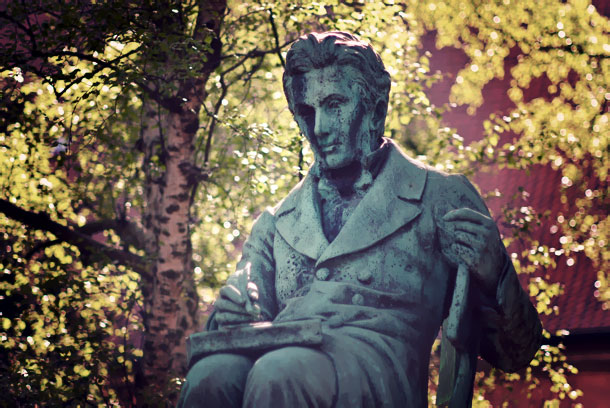
Louis Hasselriis, Søren Kierkegaard, 1918, bronze. Royal Library Garden, Copenhagen.
I’m a Christian because of Søren Kierkegaard. The 19th-century Danish philosopher didn’t introduce me to Christianity, but he did, at a pivotal time in my life, provide the crucial encouragement that sustained my faith.
During high school I began questioning virtually every aspect of Christianity. To my youthfully inquisitive mind, so much of religious belief seemed to rest on such shaky foundations and so much of what I had been taught about Christianity seemed fraught with irreconcilable difficulties.
In my search for answers I read widely in theology, philosophy and history. But more often than not, the sources that were supposed to provide answers and reassurances only led to more frustration. Works of Christian apologetics proved to be particularly disappointing: they had an answer for everything, but their “answers” usually seemed to be little more than elaborate exercises in obfuscation and self-assurance.
It was in the writings of Kierkegaard that I eventually found a way to move past trite answers and beyond paralyzing doubt. Kierkegaard’s ruminations on truth, faith and reason still resonate me with today:
Without risk, no faith. Faith is the contradiction between the infinite passion of inwardness and the objective uncertainty. If I am able to apprehend God objectively, I do not have faith; but because I cannot do this, I must have faith. If I want to keep myself in faith, I must continually see to it that I hold fast the objective uncertainty, see to it that in the objective uncertainty I am “out on 70,000 fathoms of water” and still have faith.
from Concluding Unscientific Postscript, p204.
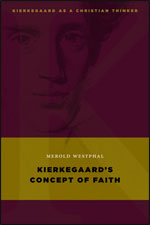 Given the crucial role that Kierkegaard played in my religious development, my interest was piqued by Merold Westphal’s recent book on the subject of Kierkegaard and faith, appropriately, if unimaginatively, titled Kierkegaard’s Concept of Faith, (Eerdmans, $35).
Westphal offers a comprehensive overview of faith across the corpus of Kierkegaard’s work, thoughtfully presenting the nuances and challenges of the various perspectives on faith that Kierkegaard gives us. Westphal explains the diversity of these understandings:
I have presented a dozen accounts of faith. If I call them definitions it is not because I think any one of them – or all of them taken together, for that matter — gives the definition of faith. I think of them as aspects or facets, each of which provides us with a distinctive perspective on the nature of faith, sometimes generically religious, sometimes generically biblical, often specifically Christian.
Instead of trying to review the entirety of Westphal’s book — suffice it to say that it’s an engaging and challenging exposition of this aspect of Kierkegaard’s thought — I’m going to focus on a single crucial facet of faith that can be gleaned from Kierkegaard: faith is the task of a lifetime.
Discussing the Preface and Epilogue of Kierkegaard’s Fear and Trembling, Westphal draws attention to the idea that faith is not merely an end to achieve, but is a process, an undertaking that is never complete.
Drawing upon the work of Gilbert Ryle, Westphal identifies a distinction between task words and achievement words:
Task words signify an activity that is still ongoing, while achievement words signify activities that have been brought to successful completion. Thus in the pairs of hunting-finding, treating-healing, traveling-arriving, and running-winning, the former terms are task words, while the latter are achievement words.
Westphal then summarizes Kierkegaard’s understanding of faith as a task:
It is clear that … [for Kierkegaard] ‘faith’ is a task word. … [F]aith is not just a task but, like doubt and love, properly understood, the task of a lifetime. It is never fully mastered; there is always more to learn. It is never fully perfected; there is always the challenge to become more faithful.
Westphal goes on to explore many other facets of faith in Kierkegaard’s work, but this point — that faith is the task of a lifetime — stands as the foundation for all the other understandings. When we view faith as a task to be undertaken (not an achievement to be reached), when we engage with our faith as something that must be nurtured and developed (as we should with other virtues such as love and charity), only then have we begun to truly grasp what it means to have faith. Or, more rightly, what it means to do faith.
When I first encountered Kierkegaard’s thoughts on Christianity some twenty years ago, they didn’t provide straightforward answers or definitive conclusions. Kierkegaard certainly didn’t solve my crisis of faith. But his work did open doors that have allowed me to progress on my journey. Kierkegaard encouraged me to retain my Christian faith not despite my doubts and uncertainties, but along with them. I continue to struggle with faith, but thanks to Kierkegaard — and his expositors such as Westphal — I know that this struggle isn’t something to be feared and hidden, but is something to be embraced and lived: the task of a lifetime.
Faith does not result from straightforward scholarly deliberation, nor does it come directly; on the contrary, in this objectivity one loses that infinite, personal, impassioned interestedness, which is the condition of faith, the ubique et nusquam [everywhere and nowhere] in which faith can come into existence.
from Concluding Unscientific Postscript, p29
 Dan Wilkinson
Dan is the Executive Editor of the Unfundamentalist Christians blog. He is a writer, graphic designer and IT specialist. He lives in Montana, is married and has two cats
Previous Post

December 8, 2014
The Misuse of Scripture (Southern Baptists seem to lead the way)
Next Post
December 12, 2014 Back to the '90s: My Hometown (Again) Spurns the LGBT Community
Browse Our Archives
Select a Category Book Reviews Christian History Christian Issues Christian Spirituality Current Events Fundamentalism Islam John Shore LGBT Movie Reviews Poetry Uncategorized
Select a Month October 2017 September 2017 August 2017 July 2017 June 2017 May 2017 April 2017 March 2017 February 2017 January 2017 December 2016 November 2016 October 2016 September 2016 August 2016 July 2016 June 2016 May 2016 April 2016 March 2016 February 2016 January 2016 December 2015 November 2015 October 2015 September 2015 August 2015 July 2015 June 2015 May 2015 April 2015 March 2015 February 2015 January 2015 December 2014 November 2014 October 2014 September 2014 August 2014 July 2014 June 2014 May 2014 April 2014 March 2014 February 2014 January 2014 December 2013 November 2013 October 2013 September 2013 August 2013 July 2013 June 2013
Follow Us!
TAKE THE
Religious Wisdom Quiz
True or False: Paul taught the Galatians that circumcision is necessary for salvation.
Select your answer to see how you score.
TRUE FALSE
Related posts from Unfundamentalist Christians


Bible Nation: The United States of Hobby Lobby

Faith in the Fog: On Losing Beliefs and...

What's So Confusing About Grace?
TRENDING AT PATHEOS Progressive Christian

Why Christians Have a Sacred Duty to Vote:...
The Bible offers strong support for the sacred duty to vote. Here...

What Being a Modern-Day Apostle Means to Me
In my last column, I discussed the ins and outs of modern-day...

Did Ancient China Once Worship the God of...
Across human history, a common thread weaves through the origins of the...

Love Your Neighbor – Including Earth-Kin: Lev. 19,...
God’s command to love your neighbor means acting in an ethical and...

Lead a Church Study of “Jesus and Lao...
Guest writer Jack Thomas (The Irreverent Reverend) reflects on leading his church...

Principles for Understanding the Apostolic Ministry Today
Whenever people discover that my formal ministry title is "apostle," as in...
view all Progressive Christian blogs
Ad-Free & Subscriber Log-In Subscription Support
- About Us
- 2026 Calendar
- Videos
- Podcasts
- Library of World Religions
- Faith In Media Tracker
- Advertise With Us
- Write for Us
- Privacy Policy
- Terms of Service
- Do Not Sell My Data
- Contact Us
- Radiant Digital
- Manage Newsletter Subscriptions
- Unsubscribe From Notifications
- Sitemap
Copyright 2008-2026, Patheos. All rights reserved.
Subscription Support Ad-Free & Subscriber Log-In
Follow Patheos