
BuddhistCatholicContemplativeEvangelicalGeneral ChristianHinduJewishLatter-day SaintMuslimNew VisionsProgressive Christian
Beliefs
- Buddhist
- Catholic
- Contemplative
- Evangelical
- General Christian
- Hindu
- Jewish
- Latter-day Saint
- More Voices
- Muslim
- New Visions
- Pagan
- Progressive Christian
Topics
- Religion News
- Food and Religion
- Sports and Religion
- Religious Art
- Religious Music and Entertainment
- Religious Events
- History and Religion
- Style and Religion
- Politics and Religion
- Women in Religion
- Recreation Outdoors and Religion
- Business Finance and Religion
- Careers Workplace and Religion
- Education and Religion
- Family Parenting and Religion
- Health Fitness and Religion
- Home and Religion
- Relationships and Religion
- Technology and Religion
- Travel and Religion
Columnists
- Buddhist Columnists
- Business Finance and Religion Columnists
- Careers Workplace and Religion Columnists
- Catholic Columnists
- Contemplative Columnists
- Education and Religion Columnists
- Evangelists Columnists
- Family Parenting and Religion Columnists
- General Christian Columnists
- Health Fitness and Religion Columnists
- Hindu Columnists
- History and Religion Columnists
- Home and Religion Columnists
- Jewish Columnists
- More Voices Columnists
- Latter Day Columnists
- Muslim Columnists
- New Visions Columnists
- Nonreligious Columnists
- Pagan Columnists
- Politics and Religion Columnists
- Progressive Columnists
- Recreation Outdoors and Religion Columnists
- Relationships and Religion Columnists
- Religion News Columnists
- Religious Art Columnists
- Religious Events Columnists
- Religious Music and Entertainment Columnists
- Sports and Religion Columnists
- Style and Religion Columnists
- Technology and Religion Columnists
- Travel and Religion Columnists
- Women in Religion Columnists
Resource Library
- 2026 Calendar
- Library of World Religions
- The 100 Most Holy Places on Earth
- Patheos Answers
- Podcasts
- Videos
- Faith Leaders Database
- Anglican Episcopalian
- Bahai
- Baptist
- Buddhism
- Christianity
- Confucianism
- Eastern Orthodoxy
- Hinduism
- Holiness and Pentecostal
- ISKCON
- Islam
- Judaism
- Lutheran
- Methodist
- The Church of Jesus Christ of Latter-day Saints
- New Age
- Paganism
- Presbytarian and Reformed
- Protestantism
- Religion Behind the Scenes
- Roman Catholic
- Scientology
- Shia Islam
- Sikhism
- Sufism
- Sunni Islam
- Taoism
- Zen
- See all religions
Research Tools
 Ad-Free & Subscriber Log-In Subscription Support
Ad-Free & Subscriber Log-In Subscription Support
Follow Patheos 

- Trending:
- Forgiveness
- |
- Marriage
- |
- Consciousness
- |
- Death Penalty
- |
- Election
- |
- Halloween
 Unfundamentalist Christians
- Home
- Progressive Christian
- Is “Biblical Truth” all that matters?
Is “Biblical Truth” all that matters?
Last updated on: June 25, 2016 at 10:03 pm by Dan Wilkinson
Is “Biblical Truth” all that matters? 2016-06-25T22:03:35-06:00 Dan Wilkinson
Patheos Explore the world's faith through different perspectives on religion and spirituality! Patheos has the views of the prevalent religions and spiritualities of the world.
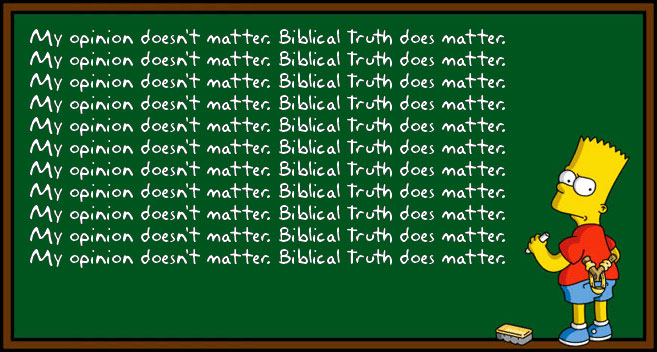
One of the hallmarks of American Evangelicalism is its dogmatic biblicism. This understanding of the Bible goes far beyond mere love and respect for Scripture, instead functioning as a distorted trinity composed of God, Jesus, and the Bible, with the Bible acting as virtually the only means through which we can properly come to God.
It is the Bible that is at the center of Fundamentalist and Evangelical faith, and it is the absolute, inerrant, and infallible authority of the Bible that many Christians cling to as the essential doctrine of Christianity. The Holy Spirit is relegated to an afterthought. Logic and reason are of questionable value. Experience and emotion are sure to mislead. Tradition and church teaching have their place, but only insofar as they support Scripture.
This biblicism was succinctly expressed in a commentary by conservative pastor Jim Garlow entitled “The Source of Wisdom.” Dr. Garlow said:
There is truth that goes beyond us. It predates us. It will outlive us. It’s called ‘Biblical Truth.’ … What’s your source of wisdom? Ultimately my opinion matters little. And sorry to say, neither does yours. But there’s a truth that does matter. It’s called ‘Biblical Truth.’ Some will say, ‘Well, according to who’s interpretation? The answer: according to the collective minds of authentic followers of God for the last two thousand years. Others will argue, ‘well it’s his interpretation against yours, right?’ No, the Bible was written plainly. Tearing up a baby in the womb is anti-biblical. Redefining marriage is anti-biblical. Depriving people of expressing true creativity through excessive governmental control denies the integrity of the human spirit–it’s anti-biblical. The Bible can spare us a lot of pain–personally and nationally–if we’ll read it and follow it.
It’s precisely this sort of unnuanced understanding of the Bible’s appropriate role in the life of a Christian that has led to so much discord within the church. It’s this sort of tortured logic that drives non-Christians up the wall. And it’s the advancement of the Bible as a panacea for life’s problems–and its inevitable failure to live up to that expectation–that leads so many Christians to walk away from their faith.
There is no “biblical truth,” there is simply truth. Whether truth comes from the pages of your ESV Study Bible or your favorite atheist blog, it’s just as true. Christians who only seek answers within the pages of a written text are ignoring the vast and bountiful resources that God has made available to us. And claiming that the Bible functions as the very foundation of truth–the “source of wisdom”–is nothing less than bibliolatry. The Bible itself teaches, and Christians down through the ages have always held, that God is the source of truth and wisdom.
Garlow is right to raise questions about biblical interpretation, but fails to address them in any meaningful way. He defers to tradition and a “plain” reading of the text as a sufficient counter to any hermeneutical conundrums. But there is no way we can accurately poll the “collective minds” of the last two thousand years, and when we do know the theological opinions of ages past, they often disagree with one another. We should take tradition seriously, but we should never blindly defer to a supposed traditional interpretation of Scripture when given good reason to do otherwise.
Contrary to Dr. Garlow’s opinion (which, in his own words, “matters little”), the Bible wasn’t “written plainly.” Reading translations of ancient texts from vastly different cultures is rarely a matter of straightforward understanding, and even the writers of those texts often eschewed plain meaning. The Bible is full of metaphor and nuance, subtlety and simile, poetry and allegory. Jesus’ own words regularly confuse and confound his disciples–he seemed to delight in not speaking “plainly.”
Holding to such a flat view of Scripture allows one to easily impose personal opinions and positions upon the text. Labeling certain positions on controversial issues as “biblical” or “anti-biblical” when, in reality, the Bible doesn’t directly address our modern situation in relation to any of those issues is not only dishonest, it’s a blatant abuse of the Scripture that Evangelicals claim to respect. Deferring to the “biblical” answer to these issues is nothing more than theological doublespeak, a not-so-subtle way of saying “God’s on my side in this argument.”
Reading and understanding the Bible is as much art as it is science. In light of that fact, I offer up as far more useful and relevant than Garlow’s precepts of tradition and perspicuity, the Nine Theses put forth by The Scripture Project of the Center of Theological Inquiry as presented in the book The Art of Reading Scripture:
- Scripture truthfully tells the story of God’s action of creating, judging, and saving the world.
- Scripture is rightly understood in light of the church’s rule of faith as a coherent dramatic narrative.
- Faithful interpretation of Scripture requires an engagement with the entire narrative: the New Testament cannot be rightly understood apart from the Old, nor can the Old be rightly understood apart from the New.
- Texts of Scripture do not have a single meaning limited to the intent of the original author. In accord with Jewish and Christian traditions, we affirm that Scripture has multiple complex senses given by God, the author of the whole drama.
- The four canonical Gospels narrate the truth about Jesus.
- Faithful interpretation of Scripture invites and presupposes participation in the community brought into being by God’s redemptive action–the church.
- The saints of the church provide guidance in how to interpret and perform Scripture.
- Christians need to read the Bible in dialogue with diverse others outside the church.
- We live in the tension between the “already” and the “not yet” of the kingdom of God; consequently Scripture calls the church to ongoing discernment, to continually fresh rereadings of the text in light of the Holy Spirit’s ongoing work in the world.
These principles, while definitely not the final word on Biblical interpretation, nevertheless offer a robust starting point for better understanding how Christians might relate to the Bible. The Bible isn’t a rule book; it’s not a guide for political action, and trying to follow it–whatever that may mean for an individual or a nation–certainly won’t “spare us a lot of pain.”
But if we as Christians take our faith seriously, and therefore take the Bible seriously, it’s incumbent upon us to wrestle with the meaning of our text. We must never settle for pithy commentary or the snap-judgements of supposed “biblical truth.” Instead we must embrace tension and ambiguity, learning from the journey of interpretation, and remaining ever open to new and diverse understandings of the Bible.
 Dan Wilkinson
Dan is the Executive Editor of the Unfundamentalist Christians blog. He is a writer, graphic designer and IT specialist. He lives in Montana, is married and has at least two cats.
Previous Post

January 17, 2014
To oppose a negative is a positive
Next Post

January 23, 2014 You know how sometimes
Browse Our Archives
Select a Category Book Reviews Christian History Christian Issues Christian Spirituality Current Events Fundamentalism Islam John Shore LGBT Movie Reviews Poetry Uncategorized
Select a Month October 2017 September 2017 August 2017 July 2017 June 2017 May 2017 April 2017 March 2017 February 2017 January 2017 December 2016 November 2016 October 2016 September 2016 August 2016 July 2016 June 2016 May 2016 April 2016 March 2016 February 2016 January 2016 December 2015 November 2015 October 2015 September 2015 August 2015 July 2015 June 2015 May 2015 April 2015 March 2015 February 2015 January 2015 December 2014 November 2014 October 2014 September 2014 August 2014 July 2014 June 2014 May 2014 April 2014 March 2014 February 2014 January 2014 December 2013 November 2013 October 2013 September 2013 August 2013 July 2013 June 2013
Follow Us!
TAKE THE
Religious Wisdom Quiz
According to 1 Peter, believers are a chosen people, a royal priesthood, and what else?
Select your answer to see how you score.
A holy nation, God's special possession A light to the world Ambassadors for Christ Salt of the earth
Related posts from Unfundamentalist Christians


Bible Nation: The United States of Hobby Lobby

Faith in the Fog: On Losing Beliefs and...

My Cancer Didn't Happen for a Reason
TRENDING AT PATHEOS Progressive Christian

Why Christians Have a Sacred Duty to Vote:...
The Bible offers strong support for the sacred duty to vote. Here...

What Being a Modern-Day Apostle Means to Me
In my last column, I discussed the ins and outs of modern-day...

Did Ancient China Once Worship the God of...
Across human history, a common thread weaves through the origins of the...

Love Your Neighbor – Including Earth-Kin: Lev. 19,...
God’s command to love your neighbor means acting in an ethical and...

Lead a Church Study of “Jesus and Lao...
Guest writer Jack Thomas (The Irreverent Reverend) reflects on leading his church...

Principles for Understanding the Apostolic Ministry Today
Whenever people discover that my formal ministry title is "apostle," as in...
view all Progressive Christian blogs
Ad-Free & Subscriber Log-In Subscription Support
- About Us
- 2026 Calendar
- Videos
- Podcasts
- Library of World Religions
- Faith In Media Tracker
- Advertise With Us
- Write for Us
- Privacy Policy
- Terms of Service
- Do Not Sell My Data
- Contact Us
- Radiant Digital
- Manage Newsletter Subscriptions
- Unsubscribe From Notifications
- Sitemap
Copyright 2008-2026, Patheos. All rights reserved.
Subscription Support Ad-Free & Subscriber Log-In
Follow Patheos