
BuddhistCatholicContemplativeEvangelicalGeneral ChristianHinduJewishLatter-day SaintMuslimNew VisionsProgressive Christian
Beliefs
- Buddhist
- Catholic
- Contemplative
- Evangelical
- General Christian
- Hindu
- Jewish
- Latter-day Saint
- More Voices
- Muslim
- New Visions
- Pagan
- Progressive Christian
Topics
- Religion News
- Food and Religion
- Sports and Religion
- Religious Art
- Religious Music and Entertainment
- Religious Events
- History and Religion
- Style and Religion
- Politics and Religion
- Women in Religion
- Recreation Outdoors and Religion
- Business Finance and Religion
- Careers Workplace and Religion
- Education and Religion
- Family Parenting and Religion
- Health Fitness and Religion
- Home and Religion
- Relationships and Religion
- Technology and Religion
- Travel and Religion
Columnists
- Buddhist Columnists
- Business Finance and Religion Columnists
- Careers Workplace and Religion Columnists
- Catholic Columnists
- Contemplative Columnists
- Education and Religion Columnists
- Evangelists Columnists
- Family Parenting and Religion Columnists
- General Christian Columnists
- Health Fitness and Religion Columnists
- Hindu Columnists
- History and Religion Columnists
- Home and Religion Columnists
- Jewish Columnists
- More Voices Columnists
- Latter Day Columnists
- Muslim Columnists
- New Visions Columnists
- Nonreligious Columnists
- Pagan Columnists
- Politics and Religion Columnists
- Progressive Columnists
- Recreation Outdoors and Religion Columnists
- Relationships and Religion Columnists
- Religion News Columnists
- Religious Art Columnists
- Religious Events Columnists
- Religious Music and Entertainment Columnists
- Sports and Religion Columnists
- Style and Religion Columnists
- Technology and Religion Columnists
- Travel and Religion Columnists
- Women in Religion Columnists
Resource Library
- 2026 Calendar
- Library of World Religions
- The 100 Most Holy Places on Earth
- Patheos Answers
- Podcasts
- Videos
- Faith Leaders Database
- Anglican Episcopalian
- Bahai
- Baptist
- Buddhism
- Christianity
- Confucianism
- Eastern Orthodoxy
- Hinduism
- Holiness and Pentecostal
- ISKCON
- Islam
- Judaism
- Lutheran
- Methodist
- The Church of Jesus Christ of Latter-day Saints
- New Age
- Paganism
- Presbytarian and Reformed
- Protestantism
- Religion Behind the Scenes
- Roman Catholic
- Scientology
- Shia Islam
- Sikhism
- Sufism
- Sunni Islam
- Taoism
- Zen
- See all religions
Research Tools
 Ad-Free & Subscriber Log-In Subscription Support
Ad-Free & Subscriber Log-In Subscription Support
Follow Patheos 

- Trending:
- Forgiveness
- |
- Marriage
- |
- Consciousness
- |
- Death Penalty
- |
- Election
- |
- Halloween
 Unequally Yoked
- Home
- Catholic
- 7QT: Time-travel, Esperanto, Dinosaurs, and Other Oddly Expressed Dreams
7QT: Time-travel, Esperanto, Dinosaurs, and Other Oddly Expressed Dreams
Last updated on: July 17, 2015 at 9:53 am by Leah Libresco
7QT: Time-travel, Esperanto, Dinosaurs, and Other Oddly Expressed Dreams 2015-07-17T09:53:49-04:00 Leah Libresco
Patheos Explore the world's faith through different perspectives on religion and spirituality! Patheos has the views of the prevalent religions and spiritualities of the world.

— 1 —
First things first: the song of the week
— 2 —
Elsewhere in science news, I really enjoyed this article about lizards who find their way home by a still unknown mechanism (especially all the weird ways scientists have tried to rule out various answers)
Then the researchers created caps with pieces of Ping-Pong ball, and attached them with surgical glue and cork as a cushion, to the heads of the anoles to interfere with polarized light that might reach an organ in the brain called the parietal eye. Some research has shown that lizards can detect polarized light with that organ, not with their regular eyes.
The team didn’t just block all light to the parietal eye, because it controls the daily rhythms of the lizard. Block it completely, Dr. Leal said, and “after a day they just stop moving.” They are normally quiet at night. If it is always night for them, they stay quiet.
And how did the lizards do with the Ping-Pong ball hats?
They came back. Same percentage. Same time period.
— 3 —
One of my friends spotted a great critique of a flaw in the way dinosaur bones have historically been extrapolated to dinosaur flesh:
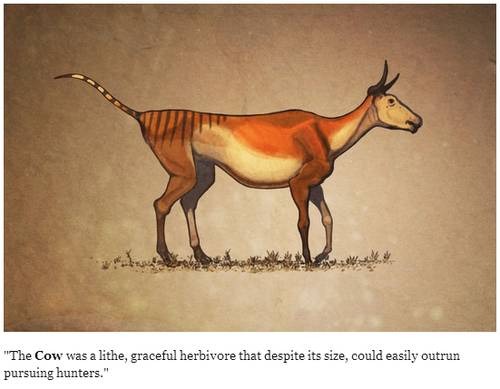
At the end of All Yesterdays (the extremely good book about imagining and illustrating dinosaurs in complex speculative ways i was talking about yesterday) there’s a section where they prove the point about the fact that we need to be more open to imagining skin coverings and fat/cartilage deposits by illustrating modern-day animals as if a nonhuman paleontologist from millions of years in the future reconstructed them using the just-skin-stretched-over-the-skeleton-and-muscles method that unimaginative paleoartists use with dinosaurs
Here’s one of the pictures (and there are more at the link). Behold, the majestic, svelte cow!
— 4 —
Speaking of reenvisionings, Noah Millman has a fascinating review of a Taming of the Shrew that played the conflict between Kate and Petruchio so straight that Millman felt sick. He wound up writing a meditation on what it takes for Shrew not to be brutal.
But that play, to my mind, is itself more complex than it appears on the surface, a genuine and touching love story that Shakespeare deftly hides inside, and uses to explode, a genre – the “shrew play” – about a husband with a hectoring wife. I say explode because Kate is as atypical a shrew as Hamlet is a avatar of revenge. Just as Hamlet, far from cleverly plotting his vengeance (as in the original source material), instead comments obsessively on his inability to take it, Kate, far from hectoring, haranguing and trying to control her husband, is enraged by other men’s efforts to control her, and bitter about her inability to attract anything resembling affection from anyone in her life. This is not the story of a man getting out from under the thumb of a domineering woman, and turning the tables on her, but of a man choosing a difficult woman whom nobody else sees the virtue of.
And then, yes, schooling her in how to live with him. There is no way around the profound power differential implied by that schooling, and I can fully understand why that stings for many women, notwithstanding that Shakespeare also wrote plays (e.g., As You Like It, The Winter’s Tale) where a woman puts a man through schooling necessary for him to be a fit companion. My experience of most good productions of Shrew, though, is akin to my experience of “The Philadelphia Story” – that is to say, I’m aware of the power differential between the female lead and her male “tutor,” and aware that her schooling is painful, even cruel, and that all of this is problematic. But I’m also aware of a real, mutual love, and a sense that his love is for this woman, at her best and most authentic; that the story isn’t about breaking her spirit but freeing it from its self-imposed bonds; and that the point isn’t that she should become meek and subservient but – well, yar.
— 5 —
This article on Esperanto came very close to getting me to sign up to study it on Duolingo.
Like its vastly more successful digital cousins — C++, HTML, Python — Esperanto is an artificial language, designed to have perfectly regular grammar, with none of the messy exceptions of natural tongues. Out loud, all that regularity creates strange cadences, like someone speaking Italian slowly while chewing gum. William Auld, the Modernist Scottish poet who wrote his greatest work in Esperanto, was nominated for the Nobel Prize multiple times, but never won. But it is supremely easy to learn, like a puzzle piece formed to fit into the human brain.
— 6 —
Americans do wind up having a much easier time with Esperanto than with Arabic names. Ivan Plis wrote a post “Nobody in the News Knows How Arabic Names Work” that delivers on its promise.
The mix-up over Saad bin Laden wasn’t the only recent failure to provide a basic understanding of Arabic. After special forces killed an Islamic State operative last weekend named “Abu Sayyaf,” outlets including CNN, The New York Times and the Washington Post all misrepresented the jihadi’s nickname.
“Abu Sayyaf” is a single name, called a kunya in Arabic. “Abu” here means “father of,” and Sayyaf is a male name that means “swordsman.” Arabic speakers use kunyas as a respectful name referring to one’s children: Palestinian leader Mahmoud Abbas is sometimes called Abu Mazen, for example, after his firstborn son, Mazen.
Some terrorists also use kunyas as symbolic nicknames to raised their credibility as warriors. The female equivalent is “Umm,” meaning “mother of.”
Individually, “Abu” and “Sayyaf” are not names that make sense. But The New York Times’ original article on the raid called the terrorist “Mr. Sayyaf,” as though Sayyaf were his last name. The Times issued a correction after TheDCNF pointed out the error.
— 7 —
In “One Minute Time Machine,” the protagonist has a solution to all forms of embarrassment and missteps (which might be a comfort to the people corrected by Ivan above. This short was a delight (and not just for the reasons you think) and I’ve been making all my friends watch it.
https://www.youtube.com/watch?v=vBkBS4O3yvY
For more Quick Takes, visit Conversion Diary!
Previous Post

July 16, 2015
Sophisters, Economists, and Calculators Succeed on the Last ITT Question
Next Post

July 18, 2015 If You Like A Queer Calling, You May Want to Help Out the Authors
Browse Our Archives
Select a Category 7 Quick Takes Apologetics Atheism Book Conversion Debate Tactics Debates Epistemology/Philosophy Housekeeping Ideological Turing Test Marriage Morality in Practice Parsing Catholicism Possibly Heretical Radio Reviews/Recommendations Sequence Index Spiritual Practice Uncategorized
Select a Month April 2017 March 2017 January 2017 December 2016 September 2016 August 2016 July 2016 June 2016 May 2016 April 2016 March 2016 February 2016 January 2016 December 2015 November 2015 October 2015 September 2015 August 2015 July 2015 June 2015 May 2015 April 2015 March 2015 February 2015 January 2015 December 2014 November 2014 October 2014 September 2014 August 2014 July 2014 June 2014 May 2014 April 2014 March 2014 February 2014 January 2014 December 2013 November 2013 October 2013 September 2013 August 2013 July 2013 June 2013 May 2013 April 2013 March 2013 February 2013 January 2013 December 2012 November 2012 October 2012 September 2012 August 2012 July 2012 June 2012 May 2012 April 2012 March 2012 February 2012 January 2012 December 2011 November 2011 October 2011 September 2011 August 2011 July 2011 June 2011 May 2011 April 2011 March 2011 February 2011 January 2011 December 2010 November 2010 October 2010 September 2010 August 2010 July 2010 June 2010
Follow Us!
TAKE THE
Religious Wisdom Quiz
Who was the strongest man mentioned in the Bible?
Select your answer to see how you score.
David Goliath Samson Saul
Related posts from Unequally Yoked

7QT: Fake Bears, Faker Weapons, and Austen

7QT: Moms, Pacifist Pilots, and other superheroes

7QT: Remixes, Underwear, & Fake Fingers

7QT: The Peculiar Virtues of Daredevil, Pool Table...
TRENDING AT PATHEOS Catholic

Rejecting Doom: Christian Hope And Human Action
Christianity is a religion of hope. We are to have hope and...

It’s What Comes From Within Which Matters
One of the most difficult things for us to understand is why...

Why I Choose the Eucharist Over the Sermon
Choose the Eucharist, Not the Sermon What are we supposed to get...

5 Design Elements Found in Spiritually Rooted Homes
Putting Spirituality Into Home Decor Our homes are more than our living...

Credo: A Story of God Told with the...
About 10 years ago, I began to imagine a personal "Credo" that...

The Anatomy of Divine Revelation in Catholic Thought
The claim that God has made Himself known to human beings is...
view all Catholic blogs
Ad-Free & Subscriber Log-In Subscription Support
- About Us
- 2026 Calendar
- Videos
- Podcasts
- Library of World Religions
- Faith In Media Tracker
- Advertise With Us
- Write for Us
- Privacy Policy
- Terms of Service
- Do Not Sell My Data
- Contact Us
- Radiant Digital
- Manage Newsletter Subscriptions
- Unsubscribe From Notifications
- Sitemap
Copyright 2008-2026, Patheos. All rights reserved.
Subscription Support Ad-Free & Subscriber Log-In
Follow Patheos