
BuddhistCatholicContemplativeEvangelicalGeneral ChristianHinduJewishLatter-day SaintMuslimNew VisionsProgressive Christian
Beliefs
- Buddhist
- Catholic
- Contemplative
- Evangelical
- General Christian
- Hindu
- Jewish
- Latter-day Saint
- More Voices
- Muslim
- New Visions
- Pagan
- Progressive Christian
Topics
- Religion News
- Food and Religion
- Sports and Religion
- Religious Art
- Religious Music and Entertainment
- Religious Events
- History and Religion
- Style and Religion
- Politics and Religion
- Women in Religion
- Recreation Outdoors and Religion
- Business Finance and Religion
- Careers Workplace and Religion
- Education and Religion
- Family Parenting and Religion
- Health Fitness and Religion
- Home and Religion
- Relationships and Religion
- Technology and Religion
- Travel and Religion
Columnists
- Buddhist Columnists
- Business Finance and Religion Columnists
- Careers Workplace and Religion Columnists
- Catholic Columnists
- Contemplative Columnists
- Education and Religion Columnists
- Evangelists Columnists
- Family Parenting and Religion Columnists
- General Christian Columnists
- Health Fitness and Religion Columnists
- Hindu Columnists
- History and Religion Columnists
- Home and Religion Columnists
- Jewish Columnists
- More Voices Columnists
- Latter Day Columnists
- Muslim Columnists
- New Visions Columnists
- Nonreligious Columnists
- Pagan Columnists
- Politics and Religion Columnists
- Progressive Columnists
- Recreation Outdoors and Religion Columnists
- Relationships and Religion Columnists
- Religion News Columnists
- Religious Art Columnists
- Religious Events Columnists
- Religious Music and Entertainment Columnists
- Sports and Religion Columnists
- Style and Religion Columnists
- Technology and Religion Columnists
- Travel and Religion Columnists
- Women in Religion Columnists
Resource Library
- 2026 Calendar
- Library of World Religions
- The 100 Most Holy Places on Earth
- Patheos Answers
- Podcasts
- Videos
- Faith Leaders Database
- Anglican Episcopalian
- Bahai
- Baptist
- Buddhism
- Christianity
- Confucianism
- Eastern Orthodoxy
- Hinduism
- Holiness and Pentecostal
- ISKCON
- Islam
- Judaism
- Lutheran
- Methodist
- The Church of Jesus Christ of Latter-day Saints
- New Age
- Paganism
- Presbytarian and Reformed
- Protestantism
- Religion Behind the Scenes
- Roman Catholic
- Scientology
- Shia Islam
- Sikhism
- Sufism
- Sunni Islam
- Taoism
- Zen
- See all religions
Research Tools
 Ad-Free & Subscriber Log-In Subscription Support
Ad-Free & Subscriber Log-In Subscription Support
Follow Patheos 

- Trending:
- Forgiveness
- |
- Marriage
- |
- Consciousness
- |
- Death Penalty
- |
- Election
- |
- Halloween
 Unequally Yoked
- Home
- Catholic
- 7QT: Avengers, Revengers, and Re-stagers
7QT: Avengers, Revengers, and Re-stagers
Last updated on: May 1, 2015 at 10:55 am by Leah Libresco
7QT: Avengers, Revengers, and Re-stagers 2015-05-01T10:55:23-04:00 Leah Libresco
Patheos Explore the world's faith through different perspectives on religion and spirituality! Patheos has the views of the prevalent religions and spiritualities of the world.
— 1 —
Guess where I was last night?
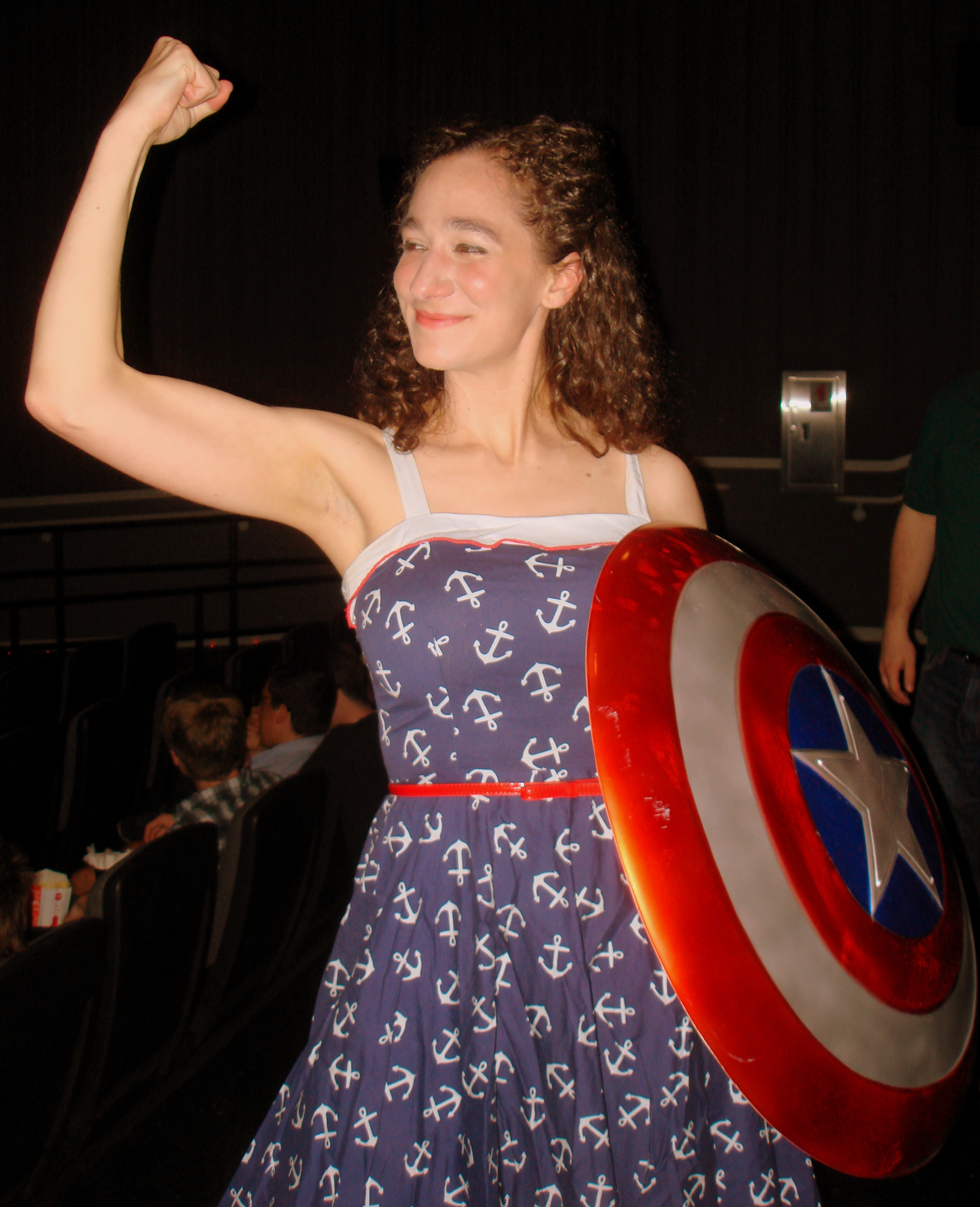
After the movie, a couple girls asked to take a picture with me and then said, “Are you a student at Georgetown, too?”
“Nope!” I said, “I’m an adult!”
And this is what adults do:
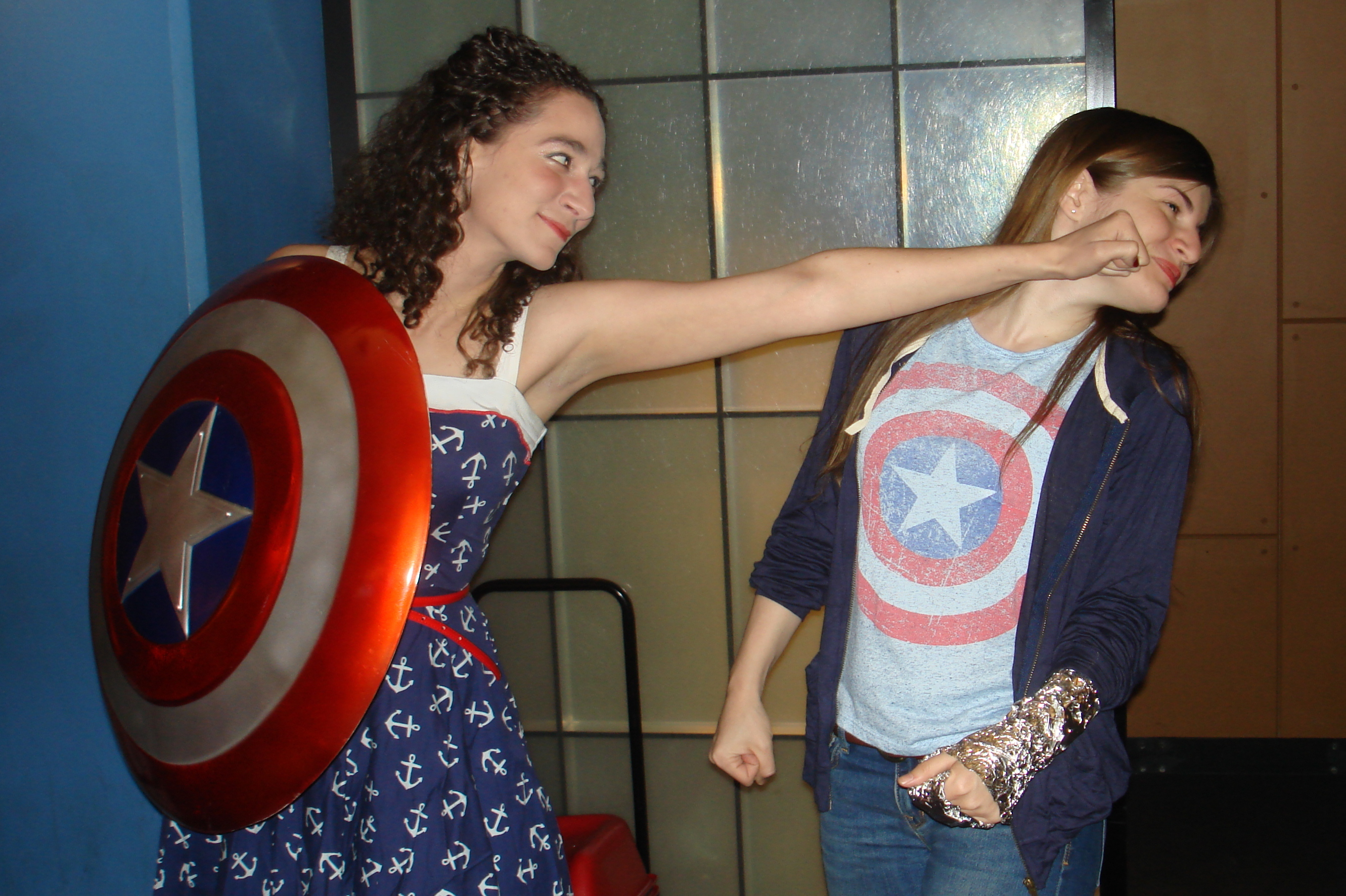
(my friend is Bucky Barnes)
— 2 —
In other fictional universe news, I tend to recommend Diane Duane’s Young Wizard series fairly often on this blog (well, at least books 1-6 in the series), so I thought I should tip you all off that Duane is doing a special, half-price sale of the ebook versions of her series.
— 3 —
In other book recommendation news, Rosamund Hodge’s Crimson Bound comes out next week (I discussed it a couple weeks ago on my radio show). In the run-up, she’s been doing some great blog posts. Her sister (at DarwinCatholic) has a roundup + a giveaway. Here’s an excerpt from one I particularly liked, on the significance of the elaborate court makeup the main character sometimes wears:
I found that I felt better when I wore makeup. Not just prettier, but like I was more in control of my life. Like I mattered.
I’d always thought of makeup as being something you did because you wanted to look pretty. And I really, really wanted to be pretty, so I really wanted to wear makeup. But what I learned in Oxford is that makeup can also be a way of saying that you matter. It can be a way of saying: I deserve to look pretty. I deserve to be taken care of. I am precious and my body is precious and I deserve to spend time perfecting my mascara technique.
Crimson Bound is a novel that deals a lot with self-hatred. The heroine, Rachelle, killed somebody to save her own life and has never been able to forgive herself for it–because that killing also gave her supernatural badass powers, so she’s still benefitting from it. She feels completely unworthy of being alive, let alone loved or happy or pretty. Her only lifeline is her friendship with Amélie, a girl who dreams of being a makeup artist and likes to practice on her. And it’s through Amélie’s cosmetics that Rachelle is first able to imagine what it might feel like to be worth loving again.
— 4 —
While we’re discussing new takes on old stories, Noah Millman of AmCon, has a really interesting review of a Hamlet that cut the ghost from the play:
Now, given that the entire play revolves around Hamlet’s response to the ghost’s information and the ghost’s command, this would seem to be a pretty risky choice. But the more I thought about it, the more I saw the promise in it, as a way of simplifying and psychologizing a play that can wander off into the philosophical and theological weeds. Not that those weeds aren’t really interesting – they most certainly are – but I find them more interesting to study than they are practical to explore on stage.
If we never see or hear the ghost, and neither do the other characters, then we don’t know whether it is even real, or a figment of Hamlet’s imagination – or even Hamlet’s excuse for his increasingly wild behavior, a part of his “antic disposition” act (if it is an act). From being a meditation on the inability to act, the play would become a story about the kinds of stories we have to tell ourselves in order to overcome our scruples about revenge. Indeed, Claudius, in such a reading of the play, might not be guilty at all – at least not of murder – and Hamlet’s wildness may in fact make a mortal enemy of a man who was entirely sincere in wanting to be a surrogate father. The result might be less Shakespearean – but it might be more, well, Scandinavian.
— 5 —
Meanwhile, in Afghanistan, a group of activists is forcing others to see a ghost. They restaged the murder of a woman accused of burning a Quran in the streets where she was killed:
They killed Farkhunda again, but this time there were tears in the crowd rather than cheers.
Men pummeled her with rocks and paving stones, knocked her down, kicked her, ripped her head scarf off, all the while shouting religious slogans and denouncing her as a blasphemer. Blood tangled her hair and made a red mask of her bruised face.
Since it was a re-enactment of the real crime, the mob of men outside a mosque in central Kabul on Monday skipped some of the specifics — the parts where the actual attackers had dragged Farkhunda behind a car, or tossed her off a bridge, among other acts. But they did douse the actress Leena Alam, who was playing Farkhunda, in a liquid meant to symbolize gasoline, and buried her in a pile of ashes.
There were even real policemen present, doing what their colleagues had done on March 19 in the same place: standing aside. Some of them, however, were seen to be teary-eyed this time.
— 6 —
Pedro Paulo Oliveira Jr. (a name you may recognize from the comments here!) has an essay at Ethika Politika on what exactly we mean by “neighbor” in “love thy neighbor” and how that word has different inflections in other languages:
A cornerstone of Christian doctrine is the commandment to love one another. The parable of the Good Samaritan and the mandatum novum do vobis summarize the nature of caritas. Jesus begins the Good Samaritan’s parable answering a question: Et quis est meus proximus?, translated in the USCCB version as: “And who is my neighbor?”
Neighbor is used as a translation of the Latin word proximus, which isprójimo in Spanish and próximo in Portuguese. In all romance languages there is another word for neighbor (Spanish: vecino, Portuguese: vizinho, French: voisin) used only to describe the person who lives close to us.
Thus proximus is a word employed to describe not only physical but rather spiritual neighborhood. I’m neither the vizinho of the reader nor his friend, as we don’t have a close relationship, but I could say that the bond created by reading this article makes me his proximus, at least more proximus than someone who’s never heard about me. This is not to say that the use of “neighbor” as a translation for proximus is a naïve choice; it’s just that by collapsing the spiritual neighborhood with the physical one the language loses punch.
— 7 —
Finally, remember how you’re supposed to put on your own air mask before helping your neighbor? io9 has an explainer of where the oxygen in your masks comes from (I falsely believed it was in big gas canisters somewhere!)
The safety demonstration at the beginning of each flight has taught you that you have to tug on your mask to start oxygen flowing. Are you aware that, once the oxygen is flowing, nothing is going to stop it? You’re not all hooked to some communal scuba tank with a valve that can be turned on and off. When you tug on the mask, you “pull the pin” on a chemical process, and quite a violent one. Airplanes use oxygen generators, otherwise known as “oxygen candles.” These are chemicals that, when burned, release oxygen as a gas. Any extra chemicals get filtered out when the oxygen goes through to your mask, and the entire thing keeps going until it burns down.
For more Quick Takes, visit Conversion Diary!

Next Post

May 3, 2015 HIV Successes and Space Launch Failures
Browse Our Archives
Select a Category 7 Quick Takes Apologetics Atheism Book Conversion Debate Tactics Debates Epistemology/Philosophy Housekeeping Ideological Turing Test Marriage Morality in Practice Parsing Catholicism Possibly Heretical Radio Reviews/Recommendations Sequence Index Spiritual Practice Uncategorized
Select a Month April 2017 March 2017 January 2017 December 2016 September 2016 August 2016 July 2016 June 2016 May 2016 April 2016 March 2016 February 2016 January 2016 December 2015 November 2015 October 2015 September 2015 August 2015 July 2015 June 2015 May 2015 April 2015 March 2015 February 2015 January 2015 December 2014 November 2014 October 2014 September 2014 August 2014 July 2014 June 2014 May 2014 April 2014 March 2014 February 2014 January 2014 December 2013 November 2013 October 2013 September 2013 August 2013 July 2013 June 2013 May 2013 April 2013 March 2013 February 2013 January 2013 December 2012 November 2012 October 2012 September 2012 August 2012 July 2012 June 2012 May 2012 April 2012 March 2012 February 2012 January 2012 December 2011 November 2011 October 2011 September 2011 August 2011 July 2011 June 2011 May 2011 April 2011 March 2011 February 2011 January 2011 December 2010 November 2010 October 2010 September 2010 August 2010 July 2010 June 2010
Follow Us!
TAKE THE
Religious Wisdom Quiz
Who prophesied the fall of Babylon?
Select your answer to see how you score.
Ezekiel Isaiah Jeremiah Daniel
Related posts from Unequally Yoked

7QT: Fake Bears, Faker Weapons, and Austen

7QT: Moms, Pacifist Pilots, and other superheroes

7QT: Remixes, Underwear, & Fake Fingers

7QT: The Peculiar Virtues of Daredevil, Pool Table...
TRENDING AT PATHEOS Catholic

Rejecting Doom: Christian Hope And Human Action
Christianity is a religion of hope. We are to have hope and...

It’s What Comes From Within Which Matters
One of the most difficult things for us to understand is why...

Why I Choose the Eucharist Over the Sermon
Choose the Eucharist, Not the Sermon What are we supposed to get...

5 Design Elements Found in Spiritually Rooted Homes
Putting Spirituality Into Home Decor Our homes are more than our living...

Credo: A Story of God Told with the...
About 10 years ago, I began to imagine a personal "Credo" that...

The Anatomy of Divine Revelation in Catholic Thought
The claim that God has made Himself known to human beings is...
view all Catholic blogs
Ad-Free & Subscriber Log-In Subscription Support
- About Us
- 2026 Calendar
- Videos
- Podcasts
- Library of World Religions
- Faith In Media Tracker
- Advertise With Us
- Write for Us
- Privacy Policy
- Terms of Service
- Do Not Sell My Data
- Contact Us
- Radiant Digital
- Manage Newsletter Subscriptions
- Unsubscribe From Notifications
- Sitemap
Copyright 2008-2026, Patheos. All rights reserved.
Subscription Support Ad-Free & Subscriber Log-In
Follow Patheos