
BuddhistCatholicContemplativeEvangelicalGeneral ChristianHinduJewishLatter-day SaintMuslimNew VisionsProgressive Christian
Beliefs
- Buddhist
- Catholic
- Contemplative
- Evangelical
- General Christian
- Hindu
- Jewish
- Latter-day Saint
- More Voices
- Muslim
- New Visions
- Pagan
- Progressive Christian
Topics
- Religion News
- Food and Religion
- Sports and Religion
- Religious Art
- Religious Music and Entertainment
- Religious Events
- History and Religion
- Style and Religion
- Politics and Religion
- Women in Religion
- Recreation Outdoors and Religion
- Business Finance and Religion
- Careers Workplace and Religion
- Education and Religion
- Family Parenting and Religion
- Health Fitness and Religion
- Home and Religion
- Relationships and Religion
- Technology and Religion
- Travel and Religion
Columnists
- Buddhist Columnists
- Business Finance and Religion Columnists
- Careers Workplace and Religion Columnists
- Catholic Columnists
- Contemplative Columnists
- Education and Religion Columnists
- Evangelists Columnists
- Family Parenting and Religion Columnists
- General Christian Columnists
- Health Fitness and Religion Columnists
- Hindu Columnists
- History and Religion Columnists
- Home and Religion Columnists
- Jewish Columnists
- More Voices Columnists
- Latter Day Columnists
- Muslim Columnists
- New Visions Columnists
- Nonreligious Columnists
- Pagan Columnists
- Politics and Religion Columnists
- Progressive Columnists
- Recreation Outdoors and Religion Columnists
- Relationships and Religion Columnists
- Religion News Columnists
- Religious Art Columnists
- Religious Events Columnists
- Religious Music and Entertainment Columnists
- Sports and Religion Columnists
- Style and Religion Columnists
- Technology and Religion Columnists
- Travel and Religion Columnists
- Women in Religion Columnists
Resource Library
- 2026 Calendar
- Library of World Religions
- The 100 Most Holy Places on Earth
- Patheos Answers
- Podcasts
- Videos
- Faith Leaders Database
- Anglican Episcopalian
- Bahai
- Baptist
- Buddhism
- Christianity
- Confucianism
- Eastern Orthodoxy
- Hinduism
- Holiness and Pentecostal
- ISKCON
- Islam
- Judaism
- Lutheran
- Methodist
- The Church of Jesus Christ of Latter-day Saints
- New Age
- Paganism
- Presbytarian and Reformed
- Protestantism
- Religion Behind the Scenes
- Roman Catholic
- Scientology
- Shia Islam
- Sikhism
- Sufism
- Sunni Islam
- Taoism
- Zen
- See all religions
Research Tools
 Ad-Free & Subscriber Log-In Subscription Support
Ad-Free & Subscriber Log-In Subscription Support
Follow Patheos 

- Trending:
- Forgiveness
- |
- Marriage
- |
- Consciousness
- |
- Death Penalty
- |
- Election
- |
- Halloween
 Unequally Yoked
- Home
- Catholic
- 7QT: Math Puns, Set Tricks, and Artificial Worlds
7QT: Math Puns, Set Tricks, and Artificial Worlds
Last updated on: January 16, 2015 at 12:03 am by Leah Libresco
7QT: Math Puns, Set Tricks, and Artificial Worlds 2015-01-16T00:03:08-05:00 Leah Libresco
Patheos Explore the world's faith through different perspectives on religion and spirituality! Patheos has the views of the prevalent religions and spiritualities of the world.
Just a reminder, my new radio show (“Fights in Good Faith”) began last week (and the first episode is now up for streaming). Tune in live this week at 5p Saturday or 1p on Sunday. I’ll be talking about my visit to the National Civil Rights Museum in Memphis.
— 1 —
It’s hard to get more Leah-baity than a competition for math puns, so that link naturally gets first billing this week. Here’s my favorite:
Heard this joke about the Banach-Tarski paradox. I was beside myself! (@icecolbeveridge)
But the winner is probably a little more accessible:
My improper fractions helpline is now open 24/7. (@debecca)
There are a bunch more to delight you at the link.
— 2 —
In the slightly more useful realm of math links, the Nice Neighbors game is a crowdsourced proof. You play a webgame (about rearranging nodes and edges) and wind up helping expand our understanding of topology (by brute force) in the process:
The results in the paper (in particular Lemma 2.9) show that determining reducibility of a given digital image is equivalent to winning the game on this page.
Each “experimental level” in the game with at least 8 points represents a specific digital image whose reducibility is not known. If you can win on these levels, you are assisting in the effort to classify digital images by their reducibility. Thanks! Your solution will be saved and used in future research projects.
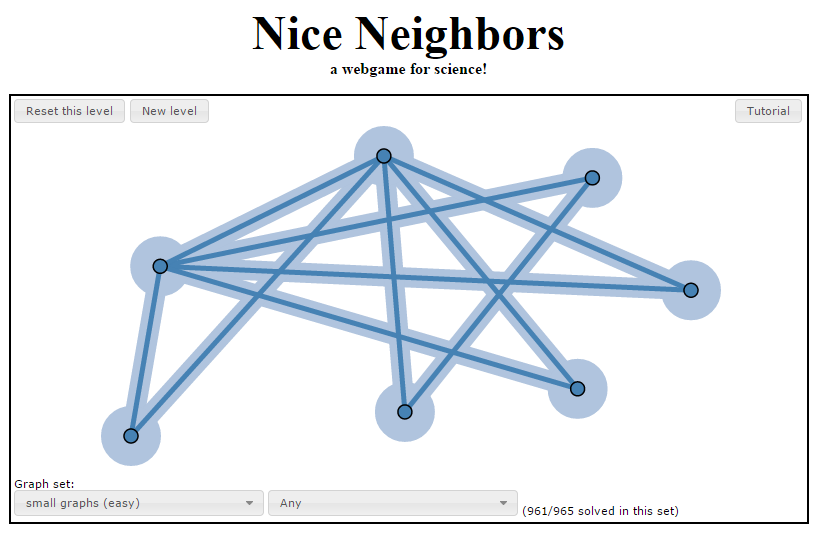
There’s a playable tutorial at the link, if you want to give it a try.
— 3 —
Also in the realm of applied math, and still involving crowds, seismologists are using their instruments to keep track of the ruckus raised by headbrick spectators. Here’s the best part:
But on Saturday, at least, football will be the focus, with a kind of technological race as well, since feedback from the stadium monitors — running about two or three seconds off real time — will be faster than the televised game, which will be broadcast with roughly a 10-second delay.
What that means is that seismically inclined fans who have QuickShake and the game on at the same time could get a kind of early warning of their own: the squiggle lines visible on the website will be tracking events in the stadium that have, in TV time anyway, yet to be shown.
— 4 —
And in one more link of scientists taking an interesting approach to group dynamics and actions, the NYT has an interesting obit this week for David H. Marlowe, who worked as an anthropologist for the army.
One of his early studies, of Army deserters in the 1950s, found that those who go AWOL are neither criminals nor cowards but mostly young people who cannot adapt to rigid military life. The poorest among them, he said, often have the hardest time adjusting, because of the social disorganization of their families and neighborhoods.
Dr. Marlowe argued that by pulling back on disciplinary actions — for minor offenses like uniform violations — the Army could retain more people and improve morale. Over time, the service has done just that, steeply reducing the number of its disciplinary barracks.
In another research project, investigating drug use among soldiers in the 1970s, Dr. Marlowe found that a crucial factor was group cohesion — measured by how well individuals formed bonds with the other members of their unit and how well their leaders knew them personally. In units where turnover was high and soldiers were virtual strangers, the use of heroin and other drugs tended to be heavy; in those where troops had some shared history, drug use was much less likely to be a problem.
After those studies, and based on his recommendation, the Army leadership made administrative changes to keep soldiers together longer, having them train together and move as units, according to Dr. Harry Holloway, a professor of neuroscience at the Uniformed Services University of the Health Sciences in Bethesda, Md., who was, for many years, Dr. Marlowe’s boss at the Walter Reed research institute.
This reminds me of some of observations that Jonathan Shay made in Achilles in Vietnam about the disorienting effect of staggered deployment rotations, which broke up unit cohesion, and the absence of long, united boat rides back to America (as opposed to flights) which troops used to transition out of the battlefield together in WWII.
— 5 —
Achilles in Vietnam turned out to be a really good book that I delayed reading for a while because the title seemed so enamored with itself. If you’ve been in danger of missing good books due to title choice or cover design (I didn’t read A Wrinkle in Time for a while since I was so scared of the Man with the Red Eyes on the cover. So scared that I hid the book behind the bookshelf), then perhaps you’ll enjoy this post from The Millions contrasting American and British cover design for some recent bestsellers.


This was the one where I thought it looked most like completely different genres of books.
— 6 —
Sticking on the theme of design choices, particularly ones that invite you to enter a new world, Two Strip Technicolor has a beautiful roundup of old-school special effects techniques. I remember reading about a couple of these in Muse Magazine (strongly recommended if you have kids in the 10+ range), but there are a bunch I’d never seen before, all illustrated so you can see how they work.
— 7 —
Finally, looking forward to the future of created environments, scifi author Charles Stross has a fascinating writeup of his trip to Tropical Islands, Germany — a massive, manufactured environment built inside a former aircraft hangar. He thinks it offers a preview of what our orbital environments would look like:
If someone goes nuts and tries to blow a hole in the wall of the fourth largest building in the world, well, there are evacuation routes into the car park. The failure modes for space colonies are much deadlier, so the panopticon paradise with tracking devices and cameras everywhere seems to be pretty much an inevitable corollary of such an environment. So, too, are climate control and the curation of space. The Aerium is cunningly filled with distractions and diversions, until the 5km rainforest walk seems unexceptional, even though it’s folded into a space less than 300 metres long: it’s as twisted and knotty as your intestines. Long-duration orbital colonists will need a sense of space: many of the same techniques—lots of interrupted sight lines, branching routes and creative environmental features—will almost inevitably be deployed. Everyone’s going to be under surveillance the whole time, behaviour monitored for signs of stress. Any children are going to be shepherded, lovingly but firmly, away from harmful things like airlock doors and plumbing, protected by doors that refuse to open for the unauthorized and robots that offer alternative, more attractive diversions for the fractious and bored or merely curious.
For more Quick Takes, visit Conversion Diary!
Previous Post

January 15, 2015
What it Means for me to be a *Catholic* Writer
Next Post

January 17, 2015 MLK and Making Invisible Violence Visible [Radio Readings]
Browse Our Archives
Select a Category 7 Quick Takes Apologetics Atheism Book Conversion Debate Tactics Debates Epistemology/Philosophy Housekeeping Ideological Turing Test Marriage Morality in Practice Parsing Catholicism Possibly Heretical Radio Reviews/Recommendations Sequence Index Spiritual Practice Uncategorized
Select a Month April 2017 March 2017 January 2017 December 2016 September 2016 August 2016 July 2016 June 2016 May 2016 April 2016 March 2016 February 2016 January 2016 December 2015 November 2015 October 2015 September 2015 August 2015 July 2015 June 2015 May 2015 April 2015 March 2015 February 2015 January 2015 December 2014 November 2014 October 2014 September 2014 August 2014 July 2014 June 2014 May 2014 April 2014 March 2014 February 2014 January 2014 December 2013 November 2013 October 2013 September 2013 August 2013 July 2013 June 2013 May 2013 April 2013 March 2013 February 2013 January 2013 December 2012 November 2012 October 2012 September 2012 August 2012 July 2012 June 2012 May 2012 April 2012 March 2012 February 2012 January 2012 December 2011 November 2011 October 2011 September 2011 August 2011 July 2011 June 2011 May 2011 April 2011 March 2011 February 2011 January 2011 December 2010 November 2010 October 2010 September 2010 August 2010 July 2010 June 2010
Follow Us!
TAKE THE
Religious Wisdom Quiz
What was the name of the field bought with Judas' betrayal money?
Select your answer to see how you score.
Aceldama Potter's Field Golgotha Field of Blood
Related posts from Unequally Yoked

7QT: Fake Bears, Faker Weapons, and Austen

7QT: Moms, Pacifist Pilots, and other superheroes

7QT: Remixes, Underwear, & Fake Fingers

7QT: The Peculiar Virtues of Daredevil, Pool Table...
TRENDING AT PATHEOS Catholic

The Parable Of The Sower And The Word...
One of Christ’s most famous parables is that of the sower who...

Rejecting Doom: Christian Hope And Human Action
Christianity is a religion of hope. We are to have hope and...

Why I Choose the Eucharist Over the Sermon
Choose the Eucharist, Not the Sermon What are we supposed to get...

5 Design Elements Found in Spiritually Rooted Homes
Putting Spirituality Into Home Decor Our homes are more than our living...

Credo: A Story of God Told with the...
About 10 years ago, I began to imagine a personal "Credo" that...

The Anatomy of Divine Revelation in Catholic Thought
The claim that God has made Himself known to human beings is...
view all Catholic blogs
Ad-Free & Subscriber Log-In Subscription Support
- About Us
- 2026 Calendar
- Videos
- Podcasts
- Library of World Religions
- Faith In Media Tracker
- Advertise With Us
- Write for Us
- Privacy Policy
- Terms of Service
- Do Not Sell My Data
- Contact Us
- Radiant Digital
- Manage Newsletter Subscriptions
- Unsubscribe From Notifications
- Sitemap
Copyright 2008-2026, Patheos. All rights reserved.
Subscription Support Ad-Free & Subscriber Log-In
Follow Patheos