
BuddhistCatholicContemplativeEvangelicalGeneral ChristianHinduJewishLatter-day SaintMuslimNew VisionsProgressive Christian
Beliefs
- Buddhist
- Catholic
- Contemplative
- Evangelical
- General Christian
- Hindu
- Jewish
- Latter-day Saint
- More Voices
- Muslim
- New Visions
- Pagan
- Progressive Christian
Topics
- Religion News
- Food and Religion
- Sports and Religion
- Religious Art
- Religious Music and Entertainment
- Religious Events
- History and Religion
- Style and Religion
- Politics and Religion
- Women in Religion
- Recreation Outdoors and Religion
- Business Finance and Religion
- Careers Workplace and Religion
- Education and Religion
- Family Parenting and Religion
- Health Fitness and Religion
- Home and Religion
- Relationships and Religion
- Technology and Religion
- Travel and Religion
Columnists
- Buddhist Columnists
- Business Finance and Religion Columnists
- Careers Workplace and Religion Columnists
- Catholic Columnists
- Contemplative Columnists
- Education and Religion Columnists
- Evangelists Columnists
- Family Parenting and Religion Columnists
- General Christian Columnists
- Health Fitness and Religion Columnists
- Hindu Columnists
- History and Religion Columnists
- Home and Religion Columnists
- Jewish Columnists
- More Voices Columnists
- Latter Day Columnists
- Muslim Columnists
- New Visions Columnists
- Nonreligious Columnists
- Pagan Columnists
- Politics and Religion Columnists
- Progressive Columnists
- Recreation Outdoors and Religion Columnists
- Relationships and Religion Columnists
- Religion News Columnists
- Religious Art Columnists
- Religious Events Columnists
- Religious Music and Entertainment Columnists
- Sports and Religion Columnists
- Style and Religion Columnists
- Technology and Religion Columnists
- Travel and Religion Columnists
- Women in Religion Columnists
Resource Library
- 2026 Calendar
- Library of World Religions
- The 100 Most Holy Places on Earth
- Patheos Answers
- Podcasts
- Videos
- Faith Leaders Database
- Anglican Episcopalian
- Bahai
- Baptist
- Buddhism
- Christianity
- Confucianism
- Eastern Orthodoxy
- Hinduism
- Holiness and Pentecostal
- ISKCON
- Islam
- Judaism
- Lutheran
- Methodist
- The Church of Jesus Christ of Latter-day Saints
- New Age
- Paganism
- Presbytarian and Reformed
- Protestantism
- Religion Behind the Scenes
- Roman Catholic
- Scientology
- Shia Islam
- Sikhism
- Sufism
- Sunni Islam
- Taoism
- Zen
- See all religions
Research Tools
 Ad-Free & Subscriber Log-In Subscription Support
Ad-Free & Subscriber Log-In Subscription Support
Follow Patheos 

- Trending:
- Forgiveness
- |
- Marriage
- |
- Consciousness
- |
- Death Penalty
- |
- Election
- |
- Halloween
 Unequally Yoked
- Home
- Catholic
- Celebrate the New Year by reading Black Lamb, Grey Falcon!
Celebrate the New Year by reading Black Lamb, Grey Falcon!
Last updated on: December 31, 2014 at 9:53 am by Leah Libresco
Celebrate the New Year by reading Black Lamb, Grey Falcon! 2014-12-31T09:53:55-05:00 Leah Libresco
Patheos Explore the world's faith through different perspectives on religion and spirituality! Patheos has the views of the prevalent religions and spiritualities of the world.
My family often celebrates New Year’s Eve by watching a very long movie (i.e. Gandhi) on New Year’s Eve, when we’re committed to staying up to finish it.
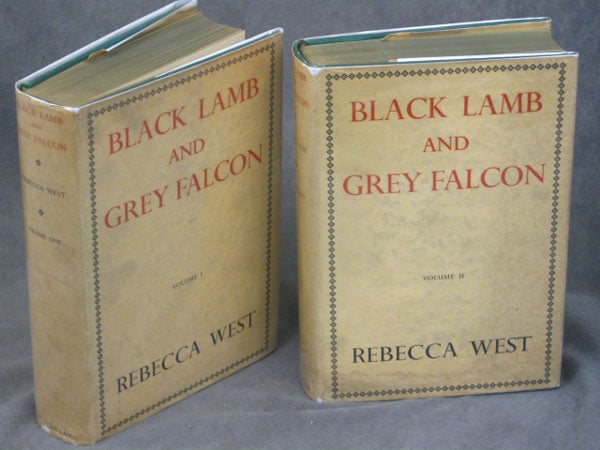
If you’d like to pick up that tradition but in a literary vein, why not welcome in the new year while reading Rebecca West’s Black Lamb and Grey Falcon: A Journey Through Yugoslavia.
I read it this month because all my cool friends were reading/had read it, and I’m very pleased to have done so (though my boyfriend now insists I read Kaplan’s Balkan Ghosts for balance).
Black Lamb and Grey Falcon was written between the world wars, as Dame Rebecca West traveled through Yugoslavia. It blends travel writing, character studies of traveling companions (including the despicable Gerda), historical context/digressions, and theological reflections. It’s one of the books I got out from the library and ordered my own copy of when I was about halfway through.
And, rather than try to describe it in my own words any further, here are some passages I dog-eared on my way through.
In the West conversation is regarded as a means either of passing the time agreeably or exchanging useful information; among Slavs it is thought to be disgraceful, when a number of people are together, that they should not pool their experience and thus travel further toward the redemption of the world. In the West conduct follows an approved pattern which is departed from by people of weak or headstrong will; but among Slavs a man will try out all kinds of conduct simply to see whether they are of the darkness or of the light. The Slavs, in fact, are given to debate and experiment which to the West seem unnecessary and therefore, since they must involve much that is painful, morbid.
Franz Josef’s Chamberlain, Prince Montenuovo, was one of the strangest figures in Europe of our time; a character that Shakespeare decided at the last moment not to use in King Lear or Othello, and laid by so carelessly that it fell out of art into life.
“But you always say you hate scenes,” said my husband.
“So I do, when I am well, there are so many other things to do,” I answered; “but when I am ill itt is the only incident that can cheer me and reach me under the blankets. And it really is sensible to show emotion at serious illness. Death is a tragedy. It may be transmuted to something else the next minute, but till then it is a divorce from the sun and the spring. […] I am quite sure it must be more exhilarating to die in a cottage full of people bewailing the prospect of losing one and the pathos of one’s destruction than to lie in a nursing-home with everybody pretending that the most sensational moment of one’s life is not happening.”
Here [on a visit to a tuberculosis ward –LL] is the authentic voice of the Slav. These people hold that the way to make life better is to add good things to it, whereas in the West we hold that the way to make life better is to take bad things away from it. With us, a satisfactory hospital patient is one who, for the time being, at least, has been castrated of all adult attributes. With us, an acceptable doctor is one with all asperities characteristic of gifted men rubbed down by conformity with social standards to a shining, cornerless, blandness. With us, a suitable hospital diet is food from which everything toxic and irritant has been removed, the euchunchized pulp of steamed flesh and stewed prunes. Here a patient could be adult, primitive, dusky, defensive; if he chose to foster a poetic fantasy or personal passion to tide him over his crisis, so much the better. It was the tuberculosis germ that the doctor wanted to alter, not the patient; and that doctor himself might be just like another man, provided he possessed also a fierce intention to cure.
(You can all send me your thanks when you finish next month)
Previous Post

December 29, 2014
Catching the Joy of Others [Pope Francis Bookclub]
Next Post

January 1, 2015 Beginning as I'll Go On in 2015
Browse Our Archives
Select a Category 7 Quick Takes Apologetics Atheism Book Conversion Debate Tactics Debates Epistemology/Philosophy Housekeeping Ideological Turing Test Marriage Morality in Practice Parsing Catholicism Possibly Heretical Radio Reviews/Recommendations Sequence Index Spiritual Practice Uncategorized
Select a Month April 2017 March 2017 January 2017 December 2016 September 2016 August 2016 July 2016 June 2016 May 2016 April 2016 March 2016 February 2016 January 2016 December 2015 November 2015 October 2015 September 2015 August 2015 July 2015 June 2015 May 2015 April 2015 March 2015 February 2015 January 2015 December 2014 November 2014 October 2014 September 2014 August 2014 July 2014 June 2014 May 2014 April 2014 March 2014 February 2014 January 2014 December 2013 November 2013 October 2013 September 2013 August 2013 July 2013 June 2013 May 2013 April 2013 March 2013 February 2013 January 2013 December 2012 November 2012 October 2012 September 2012 August 2012 July 2012 June 2012 May 2012 April 2012 March 2012 February 2012 January 2012 December 2011 November 2011 October 2011 September 2011 August 2011 July 2011 June 2011 May 2011 April 2011 March 2011 February 2011 January 2011 December 2010 November 2010 October 2010 September 2010 August 2010 July 2010 June 2010
Follow Us!
TAKE THE
Religious Wisdom Quiz
How many psalms are attributed to Moses?
Select your answer to see how you score.
One Five Ten Three
Related posts from Unequally Yoked



The Boring, Quiet Rituals That Sustain Us Spiritually

Starving Laypeople of Devotion in Church
TRENDING AT PATHEOS Catholic

Rejecting Doom: Christian Hope And Human Action
Christianity is a religion of hope. We are to have hope and...

It’s What Comes From Within Which Matters
One of the most difficult things for us to understand is why...

Why I Choose the Eucharist Over the Sermon
Choose the Eucharist, Not the Sermon What are we supposed to get...

5 Design Elements Found in Spiritually Rooted Homes
Putting Spirituality Into Home Decor Our homes are more than our living...

Credo: A Story of God Told with the...
About 10 years ago, I began to imagine a personal "Credo" that...

The Anatomy of Divine Revelation in Catholic Thought
The claim that God has made Himself known to human beings is...
view all Catholic blogs
Ad-Free & Subscriber Log-In Subscription Support
- About Us
- 2026 Calendar
- Videos
- Podcasts
- Library of World Religions
- Faith In Media Tracker
- Advertise With Us
- Write for Us
- Privacy Policy
- Terms of Service
- Do Not Sell My Data
- Contact Us
- Radiant Digital
- Manage Newsletter Subscriptions
- Unsubscribe From Notifications
- Sitemap
Copyright 2008-2026, Patheos. All rights reserved.
Subscription Support Ad-Free & Subscriber Log-In
Follow Patheos