
BuddhistCatholicContemplativeEvangelicalGeneral ChristianHinduJewishLatter-day SaintMuslimNew VisionsProgressive Christian
Beliefs
- Buddhist
- Catholic
- Contemplative
- Evangelical
- General Christian
- Hindu
- Jewish
- Latter-day Saint
- More Voices
- Muslim
- New Visions
- Pagan
- Progressive Christian
Topics
- Religion News
- Food and Religion
- Sports and Religion
- Religious Art
- Religious Music and Entertainment
- Religious Events
- History and Religion
- Style and Religion
- Politics and Religion
- Women in Religion
- Recreation Outdoors and Religion
- Business Finance and Religion
- Careers Workplace and Religion
- Education and Religion
- Family Parenting and Religion
- Health Fitness and Religion
- Home and Religion
- Relationships and Religion
- Technology and Religion
- Travel and Religion
Columnists
- Buddhist Columnists
- Business Finance and Religion Columnists
- Careers Workplace and Religion Columnists
- Catholic Columnists
- Contemplative Columnists
- Education and Religion Columnists
- Evangelists Columnists
- Family Parenting and Religion Columnists
- General Christian Columnists
- Health Fitness and Religion Columnists
- Hindu Columnists
- History and Religion Columnists
- Home and Religion Columnists
- Jewish Columnists
- More Voices Columnists
- Latter Day Columnists
- Muslim Columnists
- New Visions Columnists
- Nonreligious Columnists
- Pagan Columnists
- Politics and Religion Columnists
- Progressive Columnists
- Recreation Outdoors and Religion Columnists
- Relationships and Religion Columnists
- Religion News Columnists
- Religious Art Columnists
- Religious Events Columnists
- Religious Music and Entertainment Columnists
- Sports and Religion Columnists
- Style and Religion Columnists
- Technology and Religion Columnists
- Travel and Religion Columnists
- Women in Religion Columnists
Resource Library
- 2026 Calendar
- Library of World Religions
- The 100 Most Holy Places on Earth
- Patheos Answers
- Podcasts
- Videos
- Faith Leaders Database
- Anglican Episcopalian
- Bahai
- Baptist
- Buddhism
- Christianity
- Confucianism
- Eastern Orthodoxy
- Hinduism
- Holiness and Pentecostal
- ISKCON
- Islam
- Judaism
- Lutheran
- Methodist
- The Church of Jesus Christ of Latter-day Saints
- New Age
- Paganism
- Presbytarian and Reformed
- Protestantism
- Religion Behind the Scenes
- Roman Catholic
- Scientology
- Shia Islam
- Sikhism
- Sufism
- Sunni Islam
- Taoism
- Zen
- See all religions
Research Tools
 Ad-Free & Subscriber Log-In Subscription Support
Ad-Free & Subscriber Log-In Subscription Support
Follow Patheos 

- Trending:
- Forgiveness
- |
- Marriage
- |
- Consciousness
- |
- Death Penalty
- |
- Election
- |
- Halloween
 Unequally Yoked
- Home
- Catholic
- Torn Between Two Saint Catherines
Torn Between Two Saint Catherines
Last updated on: November 16, 2014 at 2:47 pm by Leah Libresco
Torn Between Two Saint Catherines 2014-11-16T14:47:29-05:00 Leah Libresco
Patheos Explore the world's faith through different perspectives on religion and spirituality! Patheos has the views of the prevalent religions and spiritualities of the world.
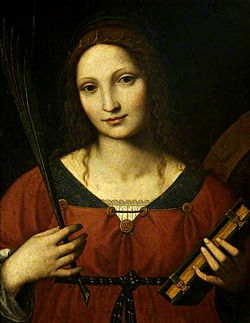
My friend Catherine Addington (who followed me as an editorial assistant at AmCon and wrote this nice piece on using Native American authors in English class there) has committed to blogging every day in November, and this essay on her difficult relationship with her name-saint is particularly excellent. I’m excerpting a piece of it here, to persuade you to pop over and read the whole thing.
The priest took my question [about why the parish banned female altar servers] seriously and answered it, I’m sure, but he told my mother when she came to pick me up that day: You definitely named her after the right woman. We knew the one he meant. Catherine of Siena, or as I called her through my adolescence, the woman who told the Pope where to go.
And in those earlier years that is how I thought of her. As a young teenager I was in love with my faith, going to Mass every day, leading a youth group, trying to take over religion class. It was my everything and I wore her name like a badge of honor: this is what women do in our church, they speak truth to power and demand unpopular holiness.
Then as now, though, there is something putrid in the mollifying of dissenters with their canonized predecessors. It started out as joking about an eleven-year-old named for Catherine of Siena but while I wasn’t paying attention it became asking a seventeen-year-old named for her not to cause scandal to the Church by testifying to her pain. Catherine of Siena had the dignity to ask Christ to make her stigmata invisible, remember.
I didn’t quite perceive then the violence done unto Catherine, not just by her Church but by history in general. It was only after my disillusionment with my faith, and a period of separation from it, that I came to uncover the darker side of my namesake’s life. I had proudly recognized her death at the age of thirty-three, Christ’s age when he died, as a passionate parallel to the God she loved more than anything. When I learned, in the darkest days of my own life, that she had starved herself to death, I began to carry her name on me like a set of chains. A set of chains that I felt a little too comfortable in.
I felt chained by our shared past. We had both vowed ourselves to Christ as young girls, entering into destructive solitude thinking it was in the service of God. Her condition was infinitely more dramatic than my own: she enclosed herself within her family home, speaking to no one for years on end, cutting her hair to dissuade suitors, whipping herself thrice daily until she bled, and subsisting on bread and raw vegetables alone through her formative years. She spoke of these years as living in a cell within her mind, rejecting her earthly family until she could join her true family in heaven. Whereas before she had seemed a lover of Christ unwilling to settle for anything less than His kingdom, she now sounded to me like a familiar tragedy. I knew what it was to retreat within myself, to isolate myself from the circumstances in which Providence had placed me in order to do what I thought He wanted. My struggles with eating, though they have never been remotely as intense as Catherine’s self-starvation, are a perpetual manifestation of that larger strategy of self-control.
Though I resented that her isolation led to canonization, and mine was driving me ever further into doubt, I resented the forces that convinced us of this course of action in the first place all the more. My own were fairly straightforward. I didn’t fully understand hers until I came across the work of Rudolph Bell in Holy Anorexia, a 1985 book on Italian woman mystics like Catherine. They shared similar practices of self-harm and starvation, as well as subsequent reputations for holiness and therefore a public voice not normally accorded to women. There is something of the fool-for-Christ in the idea, a person capable of such physical extremes that they are seen to be lowly enough, empty enough, to serve as vessel for God. In social practice, this intertwined female suffering with devotion and power: the bleeding and starving female body exemplified self-control and passionate piety, an external sign of inner holiness that justified her public presence. Her wounds were her credibility, the argument goes.
Call it pernicious misogyny, call it psychological torture, call it mass hysteria. All that mattered to me was that it was bad theology. At the heart of our faith is a man crucified, a suffering body, a dead God. Nothing is more central than suffering, transformed by love into redemption. It can expiate sin, it can substitute the willing sacrifice for the punishment of others. It is a cross to be taken up when the opportunity arises, but it is not something to be crafted and clung to. I didn’t see the difference until I lived it.
When I read Sigrid Undset’s biography of Catherine of Siena, I was kind of repulsed by the saint. Her expression of devotion might have been well suited to her time, but, like Catherine, I saw echoes of unhealthy tendencies in some of my friends, and suspected that some of her practices might be the kind of thing that many people were attracted to, but very few were called to. I didn’t know how to venerate her without endorsing her personal calling for others.
In her essay, Catherine goes on to make peace through a different Saint Catherine — Catherine of Alexandria, who I strongly considered choosing for my own confirmation saint, before settling on Augustine. So, go on, check out Catherine’s full essays — it’s a great Christian compliment to Leslie Jamison’s “Grand Unified Theory of Female Pain.”
Previous Post

November 15, 2014
When Should "Effective Altruism Day" Occur?
Next Post

November 17, 2014 Pope Francis's Judith Leaves Me A Little Lost
Browse Our Archives
Select a Category 7 Quick Takes Apologetics Atheism Book Conversion Debate Tactics Debates Epistemology/Philosophy Housekeeping Ideological Turing Test Marriage Morality in Practice Parsing Catholicism Possibly Heretical Radio Reviews/Recommendations Sequence Index Spiritual Practice Uncategorized
Select a Month April 2017 March 2017 January 2017 December 2016 September 2016 August 2016 July 2016 June 2016 May 2016 April 2016 March 2016 February 2016 January 2016 December 2015 November 2015 October 2015 September 2015 August 2015 July 2015 June 2015 May 2015 April 2015 March 2015 February 2015 January 2015 December 2014 November 2014 October 2014 September 2014 August 2014 July 2014 June 2014 May 2014 April 2014 March 2014 February 2014 January 2014 December 2013 November 2013 October 2013 September 2013 August 2013 July 2013 June 2013 May 2013 April 2013 March 2013 February 2013 January 2013 December 2012 November 2012 October 2012 September 2012 August 2012 July 2012 June 2012 May 2012 April 2012 March 2012 February 2012 January 2012 December 2011 November 2011 October 2011 September 2011 August 2011 July 2011 June 2011 May 2011 April 2011 March 2011 February 2011 January 2011 December 2010 November 2010 October 2010 September 2010 August 2010 July 2010 June 2010
Follow Us!
TAKE THE
Religious Wisdom Quiz
What is the "WCC," an international Christian organization founded in 1948?
Select your answer to see how you score.
World College of Catholics World Christian Crusade World Clergy Conference World Council of Churches
Related posts from Unequally Yoked

Starving Laypeople of Devotion in Church

Aunt Alberta And Being Right (but the boring...

The Virtues of Sad Songs (a piece for...

The (Extra) Mercy of My Conversion
TRENDING AT PATHEOS Catholic

Creation, Preservation, and Teleology in Catholic Theology
As I write this, it is very early Monday morning. Like millions...

The Parable Of The Sower And The Word...
One of Christ’s most famous parables is that of the sower who...

Rejecting Doom: Christian Hope And Human Action
Christianity is a religion of hope. We are to have hope and...

Why I Choose the Eucharist Over the Sermon
Choose the Eucharist, Not the Sermon What are we supposed to get...

5 Design Elements Found in Spiritually Rooted Homes
Putting Spirituality Into Home Decor Our homes are more than our living...

Credo: A Story of God Told with the...
About 10 years ago, I began to imagine a personal "Credo" that...
view all Catholic blogs
Ad-Free & Subscriber Log-In Subscription Support
- About Us
- 2026 Calendar
- Videos
- Podcasts
- Library of World Religions
- Faith In Media Tracker
- Advertise With Us
- Write for Us
- Privacy Policy
- Terms of Service
- Do Not Sell My Data
- Contact Us
- Radiant Digital
- Manage Newsletter Subscriptions
- Unsubscribe From Notifications
- Sitemap
Copyright 2008-2026, Patheos. All rights reserved.
Subscription Support Ad-Free & Subscriber Log-In
Follow Patheos