
BuddhistCatholicContemplativeEvangelicalGeneral ChristianHinduJewishLatter-day SaintMuslimNew VisionsProgressive Christian
Beliefs
- Buddhist
- Catholic
- Contemplative
- Evangelical
- General Christian
- Hindu
- Jewish
- Latter-day Saint
- More Voices
- Muslim
- New Visions
- Pagan
- Progressive Christian
Topics
- Religion News
- Food and Religion
- Sports and Religion
- Religious Art
- Religious Music and Entertainment
- Religious Events
- History and Religion
- Style and Religion
- Politics and Religion
- Women in Religion
- Recreation Outdoors and Religion
- Business Finance and Religion
- Careers Workplace and Religion
- Education and Religion
- Family Parenting and Religion
- Health Fitness and Religion
- Home and Religion
- Relationships and Religion
- Technology and Religion
- Travel and Religion
Columnists
- Buddhist Columnists
- Business Finance and Religion Columnists
- Careers Workplace and Religion Columnists
- Catholic Columnists
- Contemplative Columnists
- Education and Religion Columnists
- Evangelists Columnists
- Family Parenting and Religion Columnists
- General Christian Columnists
- Health Fitness and Religion Columnists
- Hindu Columnists
- History and Religion Columnists
- Home and Religion Columnists
- Jewish Columnists
- More Voices Columnists
- Latter Day Columnists
- Muslim Columnists
- New Visions Columnists
- Nonreligious Columnists
- Pagan Columnists
- Politics and Religion Columnists
- Progressive Columnists
- Recreation Outdoors and Religion Columnists
- Relationships and Religion Columnists
- Religion News Columnists
- Religious Art Columnists
- Religious Events Columnists
- Religious Music and Entertainment Columnists
- Sports and Religion Columnists
- Style and Religion Columnists
- Technology and Religion Columnists
- Travel and Religion Columnists
- Women in Religion Columnists
Resource Library
- 2026 Calendar
- Library of World Religions
- The 100 Most Holy Places on Earth
- Patheos Answers
- Podcasts
- Videos
- Faith Leaders Database
- Anglican Episcopalian
- Bahai
- Baptist
- Buddhism
- Christianity
- Confucianism
- Eastern Orthodoxy
- Hinduism
- Holiness and Pentecostal
- ISKCON
- Islam
- Judaism
- Lutheran
- Methodist
- The Church of Jesus Christ of Latter-day Saints
- New Age
- Paganism
- Presbytarian and Reformed
- Protestantism
- Religion Behind the Scenes
- Roman Catholic
- Scientology
- Shia Islam
- Sikhism
- Sufism
- Sunni Islam
- Taoism
- Zen
- See all religions
Research Tools
 Ad-Free & Subscriber Log-In Subscription Support
Ad-Free & Subscriber Log-In Subscription Support
Follow Patheos 

- Trending:
- Forgiveness
- |
- Marriage
- |
- Consciousness
- |
- Death Penalty
- |
- Election
- |
- Halloween
 Unequally Yoked
- Home
- Catholic
- Standing Naked Before God [Pope Francis Bookclub]
Standing Naked Before God [Pope Francis Bookclub]
Last updated on: November 10, 2014 at 11:58 am by Leah Libresco
Standing Naked Before God [Pope Francis Bookclub] 2014-11-10T11:58:13-05:00 Leah Libresco
Patheos Explore the world's faith through different perspectives on religion and spirituality! Patheos has the views of the prevalent religions and spiritualities of the world.
In 2014, I’m reading and blogging through Pope Francis/Cardinal Bergoglio’s Open Mind, Faithful Heart: Reflections on Following Jesus. Every Monday, I’ll be writing about the next meditation in the book, so you’re welcome to peruse them all and/or read along.
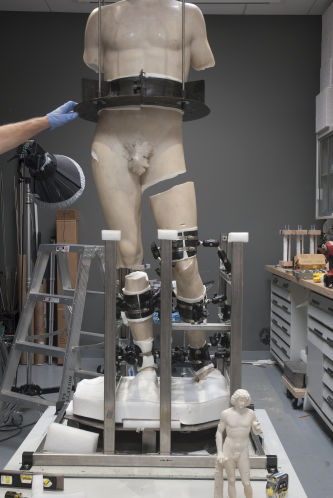
(from this fascinating article on art restoration)
When I read this week’s chapter of Pope Francis’s book, I was quickly drawn down a wikipedia rabbithole by one particular word Francis chose to use as he discussed how we speak with God in prayer:
By intercession, we gain access to the Father and discover new facets in concrete situations that allow us to change them…. What our intercession makes possible is greater clarity of revelation: God’s power, love, loyalty, and fidelity can never change, since he is always faithful–but they can become more creatively manifest to us in our world.
That is why intercession assumes familiarity with God and the ability to address God with that bold discourse (parrhesia) of which we spoke before.
I looked up parrhesia, and was particularly struck by these two parts of the relevant wikipedia page:
The Greek intellectual concept of parrhesia appears in Midrashic literature as an essential attribute in the transmission of Torah. Connoting open and public communication, parrhesia appears often in combination with the term, demos (publicly). As a mode of communication it is repeatedly described in terms analogous to a Public Domain or Commons. Dimus Parrhesia is closely associated with an ownerless wilderness of primary mytho-geographic import, the Midbar Sinai in which the Torah was initially received. The dissemination of Torah thus depends on its teachers cultivating a nature which is as open, ownerless, and sharing as that wilderness. The term is important to advocates of Open Source Judaism.
And then, this excerpt from Foucault’s Fearless Speech:
So you see, the parrhesiastes is someone who takes a risk. Of course, this risk is not always a risk of life. When, for example, you see a friend doing something wrong and you risk incurring his anger by telling him he is wrong, you are acting as a parrhesiastes. In such a case, you do not risk your life, but you may hurt him by your remarks, and your friendship may consequently suffer for it. If, in a political debate, an orator risks losing his popularity because his opinions are contrary to the majority’s opinion, or his opinions may usher in a political scandal, he uses parrhesia. Parrhesia, then, is linked to courage in the face of danger: it demands the courage to speak the truth in spite of some danger. And in its extreme form, telling the truth takes place in the “game” of life or death.
The funny thing is that the person who is a parrhesiastes before God, who speaks openly, reserving nothing of themself out of caution or desire for strategic advantage, has nothing to fear. The point of parrhesia is furthering total union/communion with God — our natural end. If we approach God in that way, he will receive us with love; there is no analogous danger to the one that Foucault describes if we approach another human in this way. The courage required is in recognizing that this relationship is different than all the other ones we share.
Carrying the openness we have before God into the other spheres of our life is a risk, but it’s also a witness, as the Midrashic discussion implies. Acting as a parrhesiastes is an eschatological sign of something beyond the ordinary functioning of this world. We develop this way of relating by praying in this spirit with God (or, asking to be led into this spirit, if we don’t feel up to it on the first, second, etc try), and then we get a little better at approximating this spirit of self-gift in our other relationships, and awakening a hunger for communion in others.
Previous Post

November 7, 2014
7QT: Tallying Rats, Robbing Houses, and Judging Barbers
Next Post

November 11, 2014 Falling in Love with the World through the Eyes of the Beloved
Browse Our Archives
Select a Category 7 Quick Takes Apologetics Atheism Book Conversion Debate Tactics Debates Epistemology/Philosophy Housekeeping Ideological Turing Test Marriage Morality in Practice Parsing Catholicism Possibly Heretical Radio Reviews/Recommendations Sequence Index Spiritual Practice Uncategorized
Select a Month April 2017 March 2017 January 2017 December 2016 September 2016 August 2016 July 2016 June 2016 May 2016 April 2016 March 2016 February 2016 January 2016 December 2015 November 2015 October 2015 September 2015 August 2015 July 2015 June 2015 May 2015 April 2015 March 2015 February 2015 January 2015 December 2014 November 2014 October 2014 September 2014 August 2014 July 2014 June 2014 May 2014 April 2014 March 2014 February 2014 January 2014 December 2013 November 2013 October 2013 September 2013 August 2013 July 2013 June 2013 May 2013 April 2013 March 2013 February 2013 January 2013 December 2012 November 2012 October 2012 September 2012 August 2012 July 2012 June 2012 May 2012 April 2012 March 2012 February 2012 January 2012 December 2011 November 2011 October 2011 September 2011 August 2011 July 2011 June 2011 May 2011 April 2011 March 2011 February 2011 January 2011 December 2010 November 2010 October 2010 September 2010 August 2010 July 2010 June 2010
Follow Us!
TAKE THE
Religious Wisdom Quiz
I saw the Promised Land from a mountain but was not allowed to enter it. Who am I?
Select your answer to see how you score.
Joshua Caleb Aaron Moses
Related posts from Unequally Yoked

Starving Laypeople of Devotion in Church

Aunt Alberta And Being Right (but the boring...

The Virtues of Sad Songs (a piece for...

The (Extra) Mercy of My Conversion
TRENDING AT PATHEOS Catholic

Rejecting Doom: Christian Hope And Human Action
Christianity is a religion of hope. We are to have hope and...

It’s What Comes From Within Which Matters
One of the most difficult things for us to understand is why...

Why I Choose the Eucharist Over the Sermon
Choose the Eucharist, Not the Sermon What are we supposed to get...

5 Design Elements Found in Spiritually Rooted Homes
Putting Spirituality Into Home Decor Our homes are more than our living...

Credo: A Story of God Told with the...
About 10 years ago, I began to imagine a personal "Credo" that...

The Anatomy of Divine Revelation in Catholic Thought
The claim that God has made Himself known to human beings is...
view all Catholic blogs
Ad-Free & Subscriber Log-In Subscription Support
- About Us
- 2026 Calendar
- Videos
- Podcasts
- Library of World Religions
- Faith In Media Tracker
- Advertise With Us
- Write for Us
- Privacy Policy
- Terms of Service
- Do Not Sell My Data
- Contact Us
- Radiant Digital
- Manage Newsletter Subscriptions
- Unsubscribe From Notifications
- Sitemap
Copyright 2008-2026, Patheos. All rights reserved.
Subscription Support Ad-Free & Subscriber Log-In
Follow Patheos