
BuddhistCatholicContemplativeEvangelicalGeneral ChristianHinduJewishLatter-day SaintMuslimNew VisionsProgressive Christian
Beliefs
- Buddhist
- Catholic
- Contemplative
- Evangelical
- General Christian
- Hindu
- Jewish
- Latter-day Saint
- More Voices
- Muslim
- New Visions
- Pagan
- Progressive Christian
Topics
- Religion News
- Food and Religion
- Sports and Religion
- Religious Art
- Religious Music and Entertainment
- Religious Events
- History and Religion
- Style and Religion
- Politics and Religion
- Women in Religion
- Recreation Outdoors and Religion
- Business Finance and Religion
- Careers Workplace and Religion
- Education and Religion
- Family Parenting and Religion
- Health Fitness and Religion
- Home and Religion
- Relationships and Religion
- Technology and Religion
- Travel and Religion
Columnists
- Buddhist Columnists
- Business Finance and Religion Columnists
- Careers Workplace and Religion Columnists
- Catholic Columnists
- Contemplative Columnists
- Education and Religion Columnists
- Evangelists Columnists
- Family Parenting and Religion Columnists
- General Christian Columnists
- Health Fitness and Religion Columnists
- Hindu Columnists
- History and Religion Columnists
- Home and Religion Columnists
- Jewish Columnists
- More Voices Columnists
- Latter Day Columnists
- Muslim Columnists
- New Visions Columnists
- Nonreligious Columnists
- Pagan Columnists
- Politics and Religion Columnists
- Progressive Columnists
- Recreation Outdoors and Religion Columnists
- Relationships and Religion Columnists
- Religion News Columnists
- Religious Art Columnists
- Religious Events Columnists
- Religious Music and Entertainment Columnists
- Sports and Religion Columnists
- Style and Religion Columnists
- Technology and Religion Columnists
- Travel and Religion Columnists
- Women in Religion Columnists
Resource Library
- 2026 Calendar
- Library of World Religions
- The 100 Most Holy Places on Earth
- Patheos Answers
- Podcasts
- Videos
- Faith Leaders Database
- Anglican Episcopalian
- Bahai
- Baptist
- Buddhism
- Christianity
- Confucianism
- Eastern Orthodoxy
- Hinduism
- Holiness and Pentecostal
- ISKCON
- Islam
- Judaism
- Lutheran
- Methodist
- The Church of Jesus Christ of Latter-day Saints
- New Age
- Paganism
- Presbytarian and Reformed
- Protestantism
- Religion Behind the Scenes
- Roman Catholic
- Scientology
- Shia Islam
- Sikhism
- Sufism
- Sunni Islam
- Taoism
- Zen
- See all religions
Research Tools
 Ad-Free & Subscriber Log-In Subscription Support
Ad-Free & Subscriber Log-In Subscription Support
Follow Patheos 

- Trending:
- Forgiveness
- |
- Marriage
- |
- Consciousness
- |
- Death Penalty
- |
- Election
- |
- Halloween
 Unequally Yoked
- Home
- Catholic
- Give Us Bread, Roses, and Benedict Options
Give Us Bread, Roses, and Benedict Options
Last updated on: February 17, 2015 at 10:47 am by Leah Libresco
Give Us Bread, Roses, and Benedict Options 2015-02-17T10:47:57-05:00 Leah Libresco
Patheos Explore the world's faith through different perspectives on religion and spirituality! Patheos has the views of the prevalent religions and spiritualities of the world.
Pascal-Emmanuel Gobry has posted a question on his blog for people who like “the Benedict Option” and I’d like to take a crack at answering it. PEG asks:
You have two extremes on the spectrum. On the one side, you have what you might call (humorously! don’t freak out!) the “David Koresh Option”: complete sectarian withdrawal, the Barbarians are flooding the Empire, and all we can do is huddle in the ark (mixing up my metaphors over here) and wait for the flood to end. And I think everyone involved in this discussion would agree that this extreme is wrong and that nobody is talking about that.
And then on the other end of the spectrum, you have: people basically living the same lives, but with more piety, and a greater emphasis of community ties between Christians, and a stronger sense of being “in the world but not of it.” And this is the language that Rod uses most often when talking about the Benedict Option.
But here’s the thing about that other end of the spectrum: if what the Benedict Option is is just Christians having more piety, and being more involved in their parish, and having a greater sense of their “dual citizenship” of Heaven and Earth–is there anybody who opposes that? Is there anyone saying Christians should be less pious, or less involved in their church, or less critical of, or complicit in the evil that surrounds them? It seems to me that if that’s what you’re talking about you’re not talking about “the Benedict Option”, you’re just talking about “Christianity.”
So I guess the question that I would like the “Benedicters” to answer is: sincerely granted that you’re not about the David Koresh Option, then what is it that you’re about that’s not just Christians being more pious, such that it makes sense to not just call for more piety, but for something more specific called “the Benedict Option”? What is on the spectrum between the David Koresh Option and what you might call the “Mere Christianity Option” that you find so interesting, and how do your interlocutors distinguish that from not just one of them, but both?
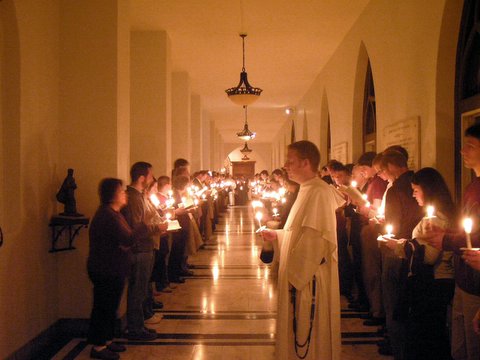
When Rod Dreher profiled model Benedict Optioners, he wasn’t focused on the monks in the monastery, but the people who had deliberately settled in the shadow of the monastery, so that they could lean on the brothers while engaging with the world. I find myself living in a similar situation as a Washington D.C. resident, living within the orbit of the Dominican House of Studies — only a short metro ride away from my home and my office.
My parish hosts two Dominican brothers, who assist at Mass and run an Adult Sunday School, where they give excellent weekly talks on matters of faith. They’re so integrated in to the parish that, when our RCIA director was choosing sponsors for my class of converts, she had a Dominican step in to be my godfather. Once a month, I go to the “Christopolis” lecture, where a Dominican father introduces a speaker (not infrequently a Dominican) to speak on the underpinnings of our religion and how to live them out. When I had a free afternoon, I stopped by the House of Studies to join the friars and their guests for Evening Prayer (and used to do it a lot more often, when I had a job with “summer hours”). A Dominican friar has stopped by the monthly debates I host, chatted with my friends, and helped us consider the question “R: Send Your Kids to Public School” (which touched on Benedict Option themes). And, just a couple months ago, I saw a lot of my friends when we all gathered at the priory for the Dominicans’ Vigil of All Saints.
Let’s pause for a moment for a video of them caroling at DC metro stations:
Living supported by the Dominicans does more for me than cultivating piety on my own or even being involved in my church. The brothers (and the sisters studying at their school) offer infusions both of knowledge and of joy for us. They open up the faith so we can study in in greater detail, not just in order to amass more knowledge, but so that we can delight in beauty. They also clear out space for us to experience this delight. And they serve as a Schelling Point where we can find people we can share philia bonds with (“You, too? I thought I was the only one!”). I even went so far as to recommend to one Catholic friend (currently in law school) that he might want to prioritize finding a summer job in DC, so he could have the experience of being in such a rich and lively Catholic community, so he could decide if he wanted to prioritize living here, or someplace like it, when he did longer-term career planning.
The Benedict Option I wanted my eventually-esquired friend to try out was the experience of having some places in his life where Catholicism was an assumption, a community where asking if people wanted to pray Night Office on the way back from a bar wasn’t an unusual request, and there were ready helpers to lead us “further up and further in!”
If I were giving a very short answer to PEG’s question, I would say the Benedict Option isn’t about just working on being more pious (whether alone or in community) but about rearranging your life and community so there are spaces where joyful piety happens to you more often; a few spaces where your Catholicism doesn’t feel like an act of resistance, any more than eating does.
The danger of being besieged by mainstream culture is as much the development of a siege mentality as the actual dangers of the assault. People trapped in a siege mentality let their opponents choose the field, conceding (implicitly) that the most important parts of their faith are the ones that attract the most political pushback — after all, if they weren’t we wouldn’t spend all our time talking about them, right? Feeling besieged encourages Christians (and anyone else) to develop fear, suspicion, and defensiveness. It gives faith a cramped feeling if you mostly experience in contexts of conflict and contrast.
I like to visit the Dominicans because it usually gives me something new to think about and share when I leave the House of Studies and the Catholic friends who gather there. I might enter a Christopolis with my last few conversations all having been about media coverage of the Synod and having spend a lot of time just untangling distorted descriptions of what happened and what will happen next. Then, the lecture I attend gives me something to consider that’s much closer to home — how to cultivate honest gratitude, to God and to others, and how to make it easier for others to develop this virtue, too. Now, the next time I wind up in a discussion whose topic was chosen by the zeitgeist, it’s easier for me to parry with joy, and to say, “Honestly, I don’t care very much about parsing the relatio the Synod released, but I did hear a lecture last week I’d love to talk to you about, especially if you have any advice about how I can be less prickly about accepting gifts from other people.”
Christians are called to be in this world, but not of the world, and, in our diaspora, it helps to have some moments and places where we get a sense of what it would be like to be at rest, to whet our longing, and to remember that struggle and resistance might be necessary now, but aren’t our ultimate end.
Final bonus Dominican singing:
Previous Post
November 12, 2014
Interviewing Eve Tushnet on Vocations of Love
Next Post
November 14, 2014 7QT: Artful Illusion and Clever Construction
Browse Our Archives
Select a Category 7 Quick Takes Apologetics Atheism Book Conversion Debate Tactics Debates Epistemology/Philosophy Housekeeping Ideological Turing Test Marriage Morality in Practice Parsing Catholicism Possibly Heretical Radio Reviews/Recommendations Sequence Index Spiritual Practice Uncategorized
Select a Month April 2017 March 2017 January 2017 December 2016 September 2016 August 2016 July 2016 June 2016 May 2016 April 2016 March 2016 February 2016 January 2016 December 2015 November 2015 October 2015 September 2015 August 2015 July 2015 June 2015 May 2015 April 2015 March 2015 February 2015 January 2015 December 2014 November 2014 October 2014 September 2014 August 2014 July 2014 June 2014 May 2014 April 2014 March 2014 February 2014 January 2014 December 2013 November 2013 October 2013 September 2013 August 2013 July 2013 June 2013 May 2013 April 2013 March 2013 February 2013 January 2013 December 2012 November 2012 October 2012 September 2012 August 2012 July 2012 June 2012 May 2012 April 2012 March 2012 February 2012 January 2012 December 2011 November 2011 October 2011 September 2011 August 2011 July 2011 June 2011 May 2011 April 2011 March 2011 February 2011 January 2011 December 2010 November 2010 October 2010 September 2010 August 2010 July 2010 June 2010
Follow Us!
TAKE THE
Religious Wisdom Quiz
Which book comes before Amos in the Old Testament?
Select your answer to see how you score.
Obadiah Joel Hosea Micah
Related posts from Unequally Yoked

How do you throw a fasting and silence...

Starving Laypeople of Devotion in Church

Aunt Alberta And Being Right (but the boring...

The Virtues of Sad Songs (a piece for...
TRENDING AT PATHEOS Catholic

Rejecting Doom: Christian Hope And Human Action
Christianity is a religion of hope. We are to have hope and...

It’s What Comes From Within Which Matters
One of the most difficult things for us to understand is why...

Why I Choose the Eucharist Over the Sermon
Choose the Eucharist, Not the Sermon What are we supposed to get...

5 Design Elements Found in Spiritually Rooted Homes
Putting Spirituality Into Home Decor Our homes are more than our living...

Credo: A Story of God Told with the...
About 10 years ago, I began to imagine a personal "Credo" that...

The Anatomy of Divine Revelation in Catholic Thought
The claim that God has made Himself known to human beings is...
view all Catholic blogs
Ad-Free & Subscriber Log-In Subscription Support
- About Us
- 2026 Calendar
- Videos
- Podcasts
- Library of World Religions
- Faith In Media Tracker
- Advertise With Us
- Write for Us
- Privacy Policy
- Terms of Service
- Do Not Sell My Data
- Contact Us
- Radiant Digital
- Manage Newsletter Subscriptions
- Unsubscribe From Notifications
- Sitemap
Copyright 2008-2026, Patheos. All rights reserved.
Subscription Support Ad-Free & Subscriber Log-In
Follow Patheos