
BuddhistCatholicContemplativeEvangelicalGeneral ChristianHinduJewishLatter-day SaintMuslimNew VisionsProgressive Christian
Beliefs
- Buddhist
- Catholic
- Contemplative
- Evangelical
- General Christian
- Hindu
- Jewish
- Latter-day Saint
- More Voices
- Muslim
- New Visions
- Pagan
- Progressive Christian
Topics
- Religion News
- Food and Religion
- Sports and Religion
- Religious Art
- Religious Music and Entertainment
- Religious Events
- History and Religion
- Style and Religion
- Politics and Religion
- Women in Religion
- Recreation Outdoors and Religion
- Business Finance and Religion
- Careers Workplace and Religion
- Education and Religion
- Family Parenting and Religion
- Health Fitness and Religion
- Home and Religion
- Relationships and Religion
- Technology and Religion
- Travel and Religion
Columnists
- Buddhist Columnists
- Business Finance and Religion Columnists
- Careers Workplace and Religion Columnists
- Catholic Columnists
- Contemplative Columnists
- Education and Religion Columnists
- Evangelists Columnists
- Family Parenting and Religion Columnists
- General Christian Columnists
- Health Fitness and Religion Columnists
- Hindu Columnists
- History and Religion Columnists
- Home and Religion Columnists
- Jewish Columnists
- More Voices Columnists
- Latter Day Columnists
- Muslim Columnists
- New Visions Columnists
- Nonreligious Columnists
- Pagan Columnists
- Politics and Religion Columnists
- Progressive Columnists
- Recreation Outdoors and Religion Columnists
- Relationships and Religion Columnists
- Religion News Columnists
- Religious Art Columnists
- Religious Events Columnists
- Religious Music and Entertainment Columnists
- Sports and Religion Columnists
- Style and Religion Columnists
- Technology and Religion Columnists
- Travel and Religion Columnists
- Women in Religion Columnists
Resource Library
- 2026 Calendar
- Library of World Religions
- The 100 Most Holy Places on Earth
- Patheos Answers
- Podcasts
- Videos
- Faith Leaders Database
- Anglican Episcopalian
- Bahai
- Baptist
- Buddhism
- Christianity
- Confucianism
- Eastern Orthodoxy
- Hinduism
- Holiness and Pentecostal
- ISKCON
- Islam
- Judaism
- Lutheran
- Methodist
- The Church of Jesus Christ of Latter-day Saints
- New Age
- Paganism
- Presbytarian and Reformed
- Protestantism
- Religion Behind the Scenes
- Roman Catholic
- Scientology
- Shia Islam
- Sikhism
- Sufism
- Sunni Islam
- Taoism
- Zen
- See all religions
Research Tools
 Ad-Free & Subscriber Log-In Subscription Support
Ad-Free & Subscriber Log-In Subscription Support
Follow Patheos 

- Trending:
- Forgiveness
- |
- Marriage
- |
- Consciousness
- |
- Death Penalty
- |
- Election
- |
- Halloween
 Unequally Yoked
- Home
- Catholic
- 7QT: Tallying Rats, Robbing Houses, and Judging Barbers
7QT: Tallying Rats, Robbing Houses, and Judging Barbers
Last updated on: November 7, 2014 at 8:01 am by Leah Libresco
7QT: Tallying Rats, Robbing Houses, and Judging Barbers 2014-11-07T08:01:55-05:00 Leah Libresco
Patheos Explore the world's faith through different perspectives on religion and spirituality! Patheos has the views of the prevalent religions and spiritualities of the world.

— 1 —
I know we’re all done with Halloween, but I wanted to share these delightful, historical costumes with you all. I love the “Radio Queen” one (which reminds me of the set direction in Rocky Horror), but my favorite has to be this plane.

You could plan to do a less naked one next year, if it suits your fancy! Halloween is less than twelve months away!
— 2 —
I love clever construction, whether physical or methodological. And, speaking of the latter category, the NYT had a fun thing on how scientists try to estimate the number of rats in the world’s greatest city. Including an explanations of how they don’t do the count:
He faced other methodological problems. He could not capture a large number of rats, mark them for identification purposes, release them, capture a second batch and count the number of marked rats in that batch. “Unfortunately,” he wrote, the health department “is unlikely to approve a large-scale rat-releasing experiment (I know, because I asked).”
— 3 —
Of course, rats and other vermin (pigeons have always been known in my family as “rats with wings”) have their uses. A thief in Venice has worked out how to make good use of them:
When he got to the window he’d spotted from the San Marco bell tower, it was locked, as expected. But the wooden frame was old, rotted in places, and gave easily. On some jobs he brought a pigeon with him, which he would release inside the house to determine if there were motion detectors. This time, he was close to busy Campo San Barnaba. If an alarm went off, he figured he could just run out the back door and disappear into a crowd.
This was merely the shortest interesting thing I could excerpt from this story, I strongly recommend reading the whole thing. A mafioso tries to steal a relic as a hostage in this story.
— 4 —
The thief in the story is trying to steal a piece of art, but he might have faced additional complications if he’d been trying to rob the Mariners’ Museum in Newport News, Virginia. They’re mounting an exhibit of the works of James E. Butterworth.
Well, mostly Butterworth.
The museum also got ahold of a forgery. On purpose.
On entering the exhibition, visitors approach a high-resolution digital image of “Magic and Gracie off Castle Garden,” an 1871 Butterworth that shows two yachts, sails taut in the wind, racing neck and neck in New York Harbor. On a nearby television screen, a photo of Buttersworth pops up, and “hot spots,” activated with the touch of a finger, explain the fine points: the signature, size, background features, sky and weather, seas and sea gulls, composition and meticulous detailing of the ships.
Visitors, prompted by clues in the wall texts, then try to identify the lone forgery. At two voting booths, they can test their suspicions by entering the number of the suspected forgery on touch screens that tell them whether they are right or wrong and offer to give them the correct answer. Then the honor system applies. Those in the know are asked not to give away the secret.
— 5 —
If I lived closer, I’d love to visit that show. The whole thing reminds me a little of a documentary I recently saw: Art and Craft, about a serial art forger who donated his fraudulent works to museums for the pleasure of seeing them exhibited, rather than any financial gain. Here’s the trailer.
I’m really glad I saw it, though it turned out to be sadder and somberer than I expected.
— 6 —
If you’ve got a sickening feeling like someone bait-and-switched you, you might have been visited by that prolific art forger, or you might be locked in an argument with someone using the motte-and-bailey trick. Scott of Slate Star Codex has written it up here:
The original Shackel paper is intended as a critique of post-modernism. Post-modernists sometimes say things like “reality is socially constructed”, and there’s an uncontroversially correct meaning there. We don’t experience the world directly, but through the categories and prejudices implicit to our society; for example, I might view a certain shade of bluish-green as blue, and someone raised in a different culture might view it as green. Okay.
Then post-modernists go on to say that if someone in a different culture thinks that the sun is light glinting off the horns of the Sky Ox, that’s just as real as our own culture’s theory that the sun is a mass of incandescent gas a great big nuclear furnace. If you challenge them, they’ll say that you’re denying reality is socially constructed, which means you’re clearly very naive and think you have perfect objectivity and the senses perceive reality directly.
The writers of the paper compare this to a form of medieval castle, where there would be a field of desirable and economically productive land called a bailey, and a big ugly tower in the middle called the motte. If you were a medieval lord, you would do most of your economic activity in the bailey and get rich. If an enemy approached, you would retreat to the motte and rain down arrows on the enemy until they gave up and went away. Then you would go back to the bailey, which is the place you wanted to be all along.
So the motte-and-bailey doctrine is when you make a bold, controversial statement. Then when somebody challenges you, you claim you were just making an obvious, uncontroversial statement, so you are clearly right and they are silly for challenging you. Then when the argument is over you go back to making the bold, controversial statement.
I’ll mention, as a cautionary note, that I think I run into people accusing others of motte-and-baileying them more often than I run into people actually using this trick to win an argument. It’s pretty common, in conversations I’ve seen, for an interlocutor to expect you to defend other statements made by people “on your team” and to accuse you of wussing out when you point out that, no, you don’t believe what the last democrat/Catholic/transhumanist they met thinks, and you’re not sneakily giving them the runaround.
I’ve had plenty of conversations of the type of, “Well, if you don’t endorse everything Andrea Dworkin ever said, why don’t you show a little intellectual honesty, get out of the bailey, and stop calling yourself a feminist?” This strikes me as silly, in that the edges/creeds of a lot of groups are blurry, and it’s not worth derailing a conversation about what your friend believes and why with a big drag-out fight about which litmus tests should be applied to which ideological labels. So, use with caution.
— 7 —
Finally, while you’re working on logical thinking, try this puzzle from Cowbirds in Love. The answer is at the link.
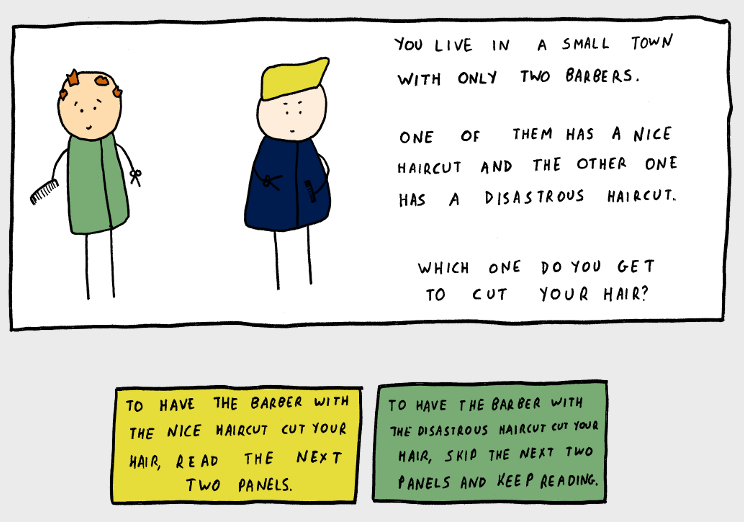
From Cowbirds in Love
And, if you recognize this puzzle, you should still click through — it ends a little differently than you may remember.
For more Quick Takes, visit Conversion Diary!
Previous Post

November 6, 2014
Prelude to a (Platonic) Kiss
Next Post
November 10, 2014 Standing Naked Before God [Pope Francis Bookclub]
Browse Our Archives
Select a Category 7 Quick Takes Apologetics Atheism Book Conversion Debate Tactics Debates Epistemology/Philosophy Housekeeping Ideological Turing Test Marriage Morality in Practice Parsing Catholicism Possibly Heretical Radio Reviews/Recommendations Sequence Index Spiritual Practice Uncategorized
Select a Month April 2017 March 2017 January 2017 December 2016 September 2016 August 2016 July 2016 June 2016 May 2016 April 2016 March 2016 February 2016 January 2016 December 2015 November 2015 October 2015 September 2015 August 2015 July 2015 June 2015 May 2015 April 2015 March 2015 February 2015 January 2015 December 2014 November 2014 October 2014 September 2014 August 2014 July 2014 June 2014 May 2014 April 2014 March 2014 February 2014 January 2014 December 2013 November 2013 October 2013 September 2013 August 2013 July 2013 June 2013 May 2013 April 2013 March 2013 February 2013 January 2013 December 2012 November 2012 October 2012 September 2012 August 2012 July 2012 June 2012 May 2012 April 2012 March 2012 February 2012 January 2012 December 2011 November 2011 October 2011 September 2011 August 2011 July 2011 June 2011 May 2011 April 2011 March 2011 February 2011 January 2011 December 2010 November 2010 October 2010 September 2010 August 2010 July 2010 June 2010
Follow Us!
TAKE THE
Religious Wisdom Quiz
How many books does the Old Testament have?
Select your answer to see how you score.
39 51 50 41
Related posts from Unequally Yoked

7QT: Fake Bears, Faker Weapons, and Austen

7QT: Moms, Pacifist Pilots, and other superheroes

7QT: Remixes, Underwear, & Fake Fingers

7QT: The Peculiar Virtues of Daredevil, Pool Table...
TRENDING AT PATHEOS Catholic

The Parable Of The Sower And The Word...
One of Christ’s most famous parables is that of the sower who...

Rejecting Doom: Christian Hope And Human Action
Christianity is a religion of hope. We are to have hope and...

Why I Choose the Eucharist Over the Sermon
Choose the Eucharist, Not the Sermon What are we supposed to get...

5 Design Elements Found in Spiritually Rooted Homes
Putting Spirituality Into Home Decor Our homes are more than our living...

Credo: A Story of God Told with the...
About 10 years ago, I began to imagine a personal "Credo" that...

The Anatomy of Divine Revelation in Catholic Thought
The claim that God has made Himself known to human beings is...
view all Catholic blogs
Ad-Free & Subscriber Log-In Subscription Support
- About Us
- 2026 Calendar
- Videos
- Podcasts
- Library of World Religions
- Faith In Media Tracker
- Advertise With Us
- Write for Us
- Privacy Policy
- Terms of Service
- Do Not Sell My Data
- Contact Us
- Radiant Digital
- Manage Newsletter Subscriptions
- Unsubscribe From Notifications
- Sitemap
Copyright 2008-2026, Patheos. All rights reserved.
Subscription Support Ad-Free & Subscriber Log-In
Follow Patheos