
BuddhistCatholicContemplativeEvangelicalGeneral ChristianHinduJewishLatter-day SaintMuslimNew VisionsProgressive Christian
Beliefs
- Buddhist
- Catholic
- Contemplative
- Evangelical
- General Christian
- Hindu
- Jewish
- Latter-day Saint
- More Voices
- Muslim
- New Visions
- Pagan
- Progressive Christian
Topics
- Religion News
- Food and Religion
- Sports and Religion
- Religious Art
- Religious Music and Entertainment
- Religious Events
- History and Religion
- Style and Religion
- Politics and Religion
- Women in Religion
- Recreation Outdoors and Religion
- Business Finance and Religion
- Careers Workplace and Religion
- Education and Religion
- Family Parenting and Religion
- Health Fitness and Religion
- Home and Religion
- Relationships and Religion
- Technology and Religion
- Travel and Religion
Columnists
- Buddhist Columnists
- Business Finance and Religion Columnists
- Careers Workplace and Religion Columnists
- Catholic Columnists
- Contemplative Columnists
- Education and Religion Columnists
- Evangelists Columnists
- Family Parenting and Religion Columnists
- General Christian Columnists
- Health Fitness and Religion Columnists
- Hindu Columnists
- History and Religion Columnists
- Home and Religion Columnists
- Jewish Columnists
- More Voices Columnists
- Latter Day Columnists
- Muslim Columnists
- New Visions Columnists
- Nonreligious Columnists
- Pagan Columnists
- Politics and Religion Columnists
- Progressive Columnists
- Recreation Outdoors and Religion Columnists
- Relationships and Religion Columnists
- Religion News Columnists
- Religious Art Columnists
- Religious Events Columnists
- Religious Music and Entertainment Columnists
- Sports and Religion Columnists
- Style and Religion Columnists
- Technology and Religion Columnists
- Travel and Religion Columnists
- Women in Religion Columnists
Resource Library
- 2026 Calendar
- Library of World Religions
- The 100 Most Holy Places on Earth
- Patheos Answers
- Podcasts
- Videos
- Faith Leaders Database
- Anglican Episcopalian
- Bahai
- Baptist
- Buddhism
- Christianity
- Confucianism
- Eastern Orthodoxy
- Hinduism
- Holiness and Pentecostal
- ISKCON
- Islam
- Judaism
- Lutheran
- Methodist
- The Church of Jesus Christ of Latter-day Saints
- New Age
- Paganism
- Presbytarian and Reformed
- Protestantism
- Religion Behind the Scenes
- Roman Catholic
- Scientology
- Shia Islam
- Sikhism
- Sufism
- Sunni Islam
- Taoism
- Zen
- See all religions
Research Tools
 Ad-Free & Subscriber Log-In Subscription Support
Ad-Free & Subscriber Log-In Subscription Support
Follow Patheos 

- Trending:
- Forgiveness
- |
- Marriage
- |
- Consciousness
- |
- Death Penalty
- |
- Election
- |
- Halloween
 Unequally Yoked
- Home
- Catholic
- Nice Guys and Failed Tries
Nice Guys and Failed Tries
Last updated on: September 4, 2014 at 1:01 pm by Leah Libresco
Nice Guys and Failed Tries 2014-09-04T13:01:39-04:00 Leah Libresco
Patheos Explore the world's faith through different perspectives on religion and spirituality! Patheos has the views of the prevalent religions and spiritualities of the world.
ETA: Given the topic of the post and the tenor of some of the comments so far, just want to remind all y’all that the best use of your commenting time/energy tends to be responding to people when you have a unique insight to offer/question to ask, rather than letting the most inflammatory posts jump to the front of your attentional queue.
SlateStarCodex’s recent post (“Radicalizing the Romanceless”) touches on a lot of issues surrounding the “Nice Guy” syndrome (which usually involves way less calculation than that xkcd implies). It’s a long post, and I want to mostly focus on the section I’m excerpting below [and yes, Scott never actually betrays confidentiality of patients, people are composites or translated so as to be unidentifiable]:
I had a patient, let’s call him ‘Henry’ for reasons that are to become clear, who came to hospital after being picked up for police for beating up his fifth wife.
So I asked the obvious question: “What happened to your first four wives?”
“Oh,” said the patient, “Domestic violence issues. Two of them left me. One of them I got put in jail, and she’d moved on once I got out. One I just grew tired of.”
“You’ve beaten up all five of your wives?” I asked in disbelief.
“Yeah,” he said, without sounding very apologetic.
“And why, exactly, were you beating your wife this time?” I asked.
“She was yelling at me, because I was cheating on her with one of my exes.”
“With your ex-wife? One of the ones you beat up?”
“Yeah.”
“So you beat up your wife, she left you, you married someone else, and then she came back and had an affair on the side with you?” I asked him.
“Yeah,” said Henry.
…
When I was younger – and I mean from teeanger hood all the way until about three years ago – I was a nice guy. In fact, I’m still a nice guy at heart, I just happen to mysteriously have picked up girlfriends. And I said the same thing as every other nice guy, which is “I am a nice guy, how come girls don’t like me?”
There seems to be some confusion about this, so let me explain what it means, to everyone, for all time.
It does not mean “I am nice in some important cosmic sense, therefore I am entitled to sex with whomever I want.”
It means: “I am a nicer guy than Henry.”
Or to spell it out very carefully, Henry clearly has no trouble with women. He has been married five times and had multiple extra-marital affairs and pre-marital partners, many of whom were well aware of his past domestic violence convictions and knew exactly what they were getting into. Meanwhile, here I was, twenty-five years old, never been on a date in my life, every time I ask someone out I get laughed at, I’m constantly teased and mocked for being a virgin and a nerd whom no one could ever love, starting to develop a serious neurosis about it.
And here I was, tried my best never to be mean to anyone, gave to charity, pursuing a productive career, worked hard to help all of my friends. I didn’t think I deserved to have the prettiest girl in school prostrate herself at my feet. But I did think I deserved to not be doing worse than Henry.
No, I didn’t know Henry at the time. But everyone knows a Henry. Most people know several. Even three years ago, I knew there were Henry-like people – your abusers, your rapists, your bullies – and it wasn’t hard to notice that none of them seemed to be having the crushing loneliness problem I was suffering from.
I pretty much agree with what a friend of mine said, “Henry clearly has trouble with women.” Henry isn’t hitting the same failure mode as “Nice Guys” but he’s still reached some kind of relationship rut that is bad for him and for his partners.
Pretty much no one who envies Henry wants to make a full swap of circumstances with him, but I think there’s an idea that Henry has cleared some great relationship filter, reached the point on the other side where relationships (good and bad) exist, and then has made poor choices that resulted in toxic relationships. If the nice guys could get past this filter, they would raise the quality of the average relationship out in Relationshipville. Therefore, whatever the solution is (women changing their standards, guys altering their approach) it’s just kind of ridiculous that they’re not making it through.
But I have a problem with that model, and I’d like to explain it using the Oregon Trail. Let’s say that you’re playing the game, and for whatever reason, you never make it very far past Independence Rock.
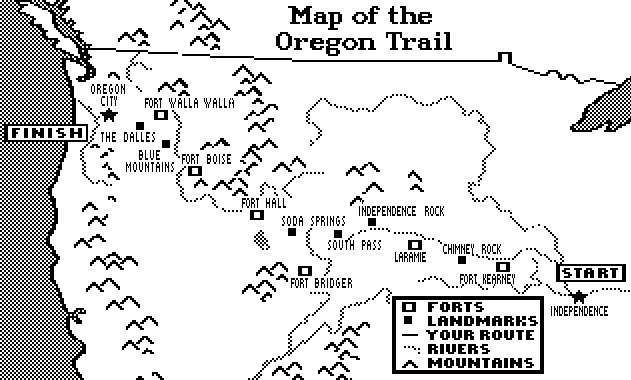
Sometimes your oxen drown fording a river, sometimes your whole family dies of cholera–it’s hard to pin down a single cause, but, one way or the other, you keep dying before you ever reach South Pass. However, when you pass through the fort at Laramie, there are often letters waiting for you from Henry, who set out only a couple months before you and has sent back messages to you, whenever he meets a traveler going the opposite direction. His letters have been sent from Fort Hall, Fort Boise, and even Fort Walla Walla. You just don’t know what Henry is doing that lets him get past Independence Rock while you keep flaming out, and, if he replies to your increasingly desperate letters, his couriers don’t make it back to you before you’ve died. Again.
Except, if you were able to make it out to the coast on every play-through, you’d notice you always pass an emaciated, festering corpse near The Dalles. It’s Henry. The solution he came up with to pass Independence Rock dooms him later on (maybe he kept solving his problems with money, not skills, and his funds ran out). Henry isn’t any more successful than you (especially when you consider that dead people don’t really care how many landmarks they passed); he just invented a different failure mode.
Getting a little more specific — I’ve looked at PUA (pick up artist) blogs and ideas, and some of the tricks are clever: e.g. speak to your crush under a false time limit (“I’ve got to run for my ride in five minutes, but, before I go, I wanted to ask you…”) so that you and she both can focus on the conversation/connection without being distracted by wondering how you’ll extricate yourself if it gets awkward/boring. But some of them seem pretty Henryish–inventing new failure modes. For example, most PUA recommend making sure you maintain an unbalanced (often 1:3) communication ratio, e.g. you should only send one text for every three you receive.
A lot of PUA focuses on cultivating a feeling of scarcity, so that you seem more valuable as a romantic partner, but anxiety isn’t the bond most people are seeking from even a hookup buddy, let alone a long term partner. On-edge attentiveness might get you physical attention, but there’s an odd, strained dynamic. These techniques “work” to a certain point–they might make it a lot easier to score short term sex partners, but they don’t actually represent a way past the big filter into the kinds of relationships you may want, just a detour around it to a totally different destination.
Henry (and some PUA) may get mistaken for success because a lot of our stories about romance and relationships get their catharsis from the two principles beginning (or rebeginning) a relationship. We see the girl’s tearful nod “Yes” as the boy lifts the Sportsball trophy over his head, but not the general business of the relationship (which might expose the Henries at the extremes, and the distant/nervous PUAs a little closer). By picking the wrong outcome variable, we misclassify a lot of failures as win conditions, and wind up wondering why someone like Henry has “no trouble with women” rather than what can be done for Henry to get him out of the torturous rut he’s chosen.
I’m on day 8 of a Norbertine novena, in honor of my friend Michael Hannon, who just entered the abbey. Please feel free to pray along.
Previous Post

September 3, 2014
Plato Disappoints at the Googleplex
Next Post

September 5, 2014 7QT: Reasonable Answers to Patently Crazy Questions
Browse Our Archives
Select a Category 7 Quick Takes Apologetics Atheism Book Conversion Debate Tactics Debates Epistemology/Philosophy Housekeeping Ideological Turing Test Marriage Morality in Practice Parsing Catholicism Possibly Heretical Radio Reviews/Recommendations Sequence Index Spiritual Practice Uncategorized
Select a Month April 2017 March 2017 January 2017 December 2016 September 2016 August 2016 July 2016 June 2016 May 2016 April 2016 March 2016 February 2016 January 2016 December 2015 November 2015 October 2015 September 2015 August 2015 July 2015 June 2015 May 2015 April 2015 March 2015 February 2015 January 2015 December 2014 November 2014 October 2014 September 2014 August 2014 July 2014 June 2014 May 2014 April 2014 March 2014 February 2014 January 2014 December 2013 November 2013 October 2013 September 2013 August 2013 July 2013 June 2013 May 2013 April 2013 March 2013 February 2013 January 2013 December 2012 November 2012 October 2012 September 2012 August 2012 July 2012 June 2012 May 2012 April 2012 March 2012 February 2012 January 2012 December 2011 November 2011 October 2011 September 2011 August 2011 July 2011 June 2011 May 2011 April 2011 March 2011 February 2011 January 2011 December 2010 November 2010 October 2010 September 2010 August 2010 July 2010 June 2010
Follow Us!
TAKE THE
Religious Wisdom Quiz
Who said, "Do not be afraid, for those who are with us are more than those who are with them"?
Select your answer to see how you score.
Joshua Elisha Elijah Gideon
Related posts from Unequally Yoked

Beyoncé's "Lemonade" And The Fertility Of Forgiveness

When a Wedding Guide Leaves Out The Wedding...

A Good Marriage Isn't A Mutual Admiration Society

Can't I Love You Into Being Happy?
TRENDING AT PATHEOS Catholic

Rejecting Doom: Christian Hope And Human Action
Christianity is a religion of hope. We are to have hope and...

It’s What Comes From Within Which Matters
One of the most difficult things for us to understand is why...

Why I Choose the Eucharist Over the Sermon
Choose the Eucharist, Not the Sermon What are we supposed to get...

5 Design Elements Found in Spiritually Rooted Homes
Putting Spirituality Into Home Decor Our homes are more than our living...

Credo: A Story of God Told with the...
About 10 years ago, I began to imagine a personal "Credo" that...

The Anatomy of Divine Revelation in Catholic Thought
The claim that God has made Himself known to human beings is...
view all Catholic blogs
Ad-Free & Subscriber Log-In Subscription Support
- About Us
- 2026 Calendar
- Videos
- Podcasts
- Library of World Religions
- Faith In Media Tracker
- Advertise With Us
- Write for Us
- Privacy Policy
- Terms of Service
- Do Not Sell My Data
- Contact Us
- Radiant Digital
- Manage Newsletter Subscriptions
- Unsubscribe From Notifications
- Sitemap
Copyright 2008-2026, Patheos. All rights reserved.
Subscription Support Ad-Free & Subscriber Log-In
Follow Patheos