
BuddhistCatholicContemplativeEvangelicalGeneral ChristianHinduJewishLatter-day SaintMuslimNew VisionsProgressive Christian
Beliefs
- Buddhist
- Catholic
- Contemplative
- Evangelical
- General Christian
- Hindu
- Jewish
- Latter-day Saint
- More Voices
- Muslim
- New Visions
- Pagan
- Progressive Christian
Topics
- Religion News
- Food and Religion
- Sports and Religion
- Religious Art
- Religious Music and Entertainment
- Religious Events
- History and Religion
- Style and Religion
- Politics and Religion
- Women in Religion
- Recreation Outdoors and Religion
- Business Finance and Religion
- Careers Workplace and Religion
- Education and Religion
- Family Parenting and Religion
- Health Fitness and Religion
- Home and Religion
- Relationships and Religion
- Technology and Religion
- Travel and Religion
Columnists
- Buddhist Columnists
- Business Finance and Religion Columnists
- Careers Workplace and Religion Columnists
- Catholic Columnists
- Contemplative Columnists
- Education and Religion Columnists
- Evangelists Columnists
- Family Parenting and Religion Columnists
- General Christian Columnists
- Health Fitness and Religion Columnists
- Hindu Columnists
- History and Religion Columnists
- Home and Religion Columnists
- Jewish Columnists
- More Voices Columnists
- Latter Day Columnists
- Muslim Columnists
- New Visions Columnists
- Nonreligious Columnists
- Pagan Columnists
- Politics and Religion Columnists
- Progressive Columnists
- Recreation Outdoors and Religion Columnists
- Relationships and Religion Columnists
- Religion News Columnists
- Religious Art Columnists
- Religious Events Columnists
- Religious Music and Entertainment Columnists
- Sports and Religion Columnists
- Style and Religion Columnists
- Technology and Religion Columnists
- Travel and Religion Columnists
- Women in Religion Columnists
Resource Library
- 2026 Calendar
- Library of World Religions
- The 100 Most Holy Places on Earth
- Patheos Answers
- Podcasts
- Videos
- Faith Leaders Database
- Anglican Episcopalian
- Bahai
- Baptist
- Buddhism
- Christianity
- Confucianism
- Eastern Orthodoxy
- Hinduism
- Holiness and Pentecostal
- ISKCON
- Islam
- Judaism
- Lutheran
- Methodist
- The Church of Jesus Christ of Latter-day Saints
- New Age
- Paganism
- Presbytarian and Reformed
- Protestantism
- Religion Behind the Scenes
- Roman Catholic
- Scientology
- Shia Islam
- Sikhism
- Sufism
- Sunni Islam
- Taoism
- Zen
- See all religions
Research Tools
 Ad-Free & Subscriber Log-In Subscription Support
Ad-Free & Subscriber Log-In Subscription Support
Follow Patheos 

- Trending:
- Forgiveness
- |
- Marriage
- |
- Consciousness
- |
- Death Penalty
- |
- Election
- |
- Halloween
 Unequally Yoked
- Home
- Catholic
- 7QT: Necromancy, Vaccination, Love, and other high stakes games
7QT: Necromancy, Vaccination, Love, and other high stakes games
Last updated on: August 1, 2014 at 1:02 pm by Leah Libresco
7QT: Necromancy, Vaccination, Love, and other high stakes games 2014-08-01T13:02:56-04:00 Leah Libresco
Patheos Explore the world's faith through different perspectives on religion and spirituality! Patheos has the views of the prevalent religions and spiritualities of the world.

— 1 —
In the course of promoting his new book, Full Fathom Five, Max Gladstone recently did an AMA on reddit, in which someone asked him why he decided to write his necromancers as lawyerly types. His reply:
[N]ecromancy and bankruptcy law in specific have a lot in common: take something that’s dead, surround it with a circle of protection, carve it up, argue with other people about what parts of the dead thing work and what don’t, remove the stuff that doesn’t, wire together the stuff that does, hook corpse up to lightning generator, and viola! Instant restructuring. Except what the process produces can, if you’re not careful, be very different from what came before.
— 2 —
In Books and Culture, there’s an interesting profile of the National Museum of Funeral History. The rituals and expectations surrounding death aren’t uniform across the world, or even across the very short period (relatively speaking) of American history. The article (presumably like the museum) is a good tour of the logic of other practices.
Fearing the demon that took possession of the body after death, Zoroastrians in Iran, Afghanistan, and India built squat “towers of silence” for their dead. The remains were considered dangerously polluted. When Islamic Iran made such practices illegal and mandated burial, its Zoroastrian citizens lined graves with stones and then poured in concrete to prevent contact of the polluted body with the earth.
If you want to read more about America’s changing attitude towards death and burial, I strongly recommend Drew Gilpin Faust’s This Republic of Suffering.
— 3 —
If you’d like to save the dying–well, little circles that represent the dying–I’ve been really enjoying Vax, a network analysis and vaccination game. As an outbreak spread, you as player has to decide where to disrupt a mesh of social ties to prevent a malady from taking hold. It’s fun to play, and I like the challenge of quickly scanning a network for critical disruption points.
— 4 —
If you’d like your online games to be a little more directly helpful to scientists, you might like Eyewire, in which volunteers help scientists trace out the connections of individual neurons. (Computers are still having trouble with this task).
Anyone can sign up online, learn to use the software and start working on what Amy Robinson, the creative director of Eyewire, calls a “3-D coloring book.” The task is something like tracing one piece of yarn through an extremely tangled ball.
More than 130,000 players in 145 countries, at last count, work on a cube that represents a bit of retinal tissue 4.5 microns on a side. The many branches of neurons are densely packed within. A micron is .00004 inches or, in Eyewire’s calculus, about one-tenth the width of a human hair. Some of the players spend upward of 40 hours a week on Eyewire.
These cubes are created by an automated process in which electron microscopes make images of ultrathin slices of brain tissue. Computers then analyze and compile the data to create a three-dimensional representation of a cube of tissue with every neuron and connection visible.
But while computers can reconstruct much of the structure, so far humans are needed as well because their ability to see patterns is much better. The players, as well as paid technicians, color in all the branches of an individual neuron.
Who knows, maybe this will become the new CAPTCHA.
— 5 —
While volunteers tease out finegrained connections between neurons, Claire Halpine has been doing the same thing for dating slang. Her Devil’s Dictionary of Dating in First Things includes these gems:
Date, n. Indicate or expose as being old-fashioned
Friend zone, n. Section of the School of Athens occupied by Platonists
Sexual Revolution, n. A non-consensual exchange of bourgeois and bohemian norms
Soul mate, n. One who assists on the ship ferrying a soul to Hades
— 6 —
Meanwhile, Mike Blume reminds me of this excerpt from Stephanie Coontz, about all the kinds of love that used to be natural between friends, before our society reserved many of them to sexual relationships only.
Perfectly respectable Victorian women wrote to each other in terms such as these: ‘I hope for you so much, and feel so eager for you…that the expectation once more to see your face again, makes me feel hot and feverish.’ They recorded the ‘furnace blast’ of their ‘passionate attachments’ to each other… They carved their initials into trees, set flowers in front of one another’s portraits, danced together, kissed, held hands, and endured intense jealousies over rivals or small slights… Today if a woman died and her son or husband found such diaries or letters in her effects, he would probably destroy them in rage or humiliation. In the nineteenth century, these sentiments were so respectable that surviving relatives often published them in elegies…. [In the 1920s] people’s interpretation of physical contact became extraordinarily ‘privatized and sexualized,’ so that all types of touching, kissing, and holding were seen as sexual foreplay rather than accepted as ordinary means of communication that carried different meanings in different contexts… It is not that homosexuality was acceptable before; but now a wider range of behavior opened a person up to being branded as a homosexual… The romantic friendships that had existed among many unmarried men in the nineteenth century were no longer compatible with heterosexual identity.
— 7 —
Finally, I said I’d post costume updates (to force myself to make progress). Here I am holding the bolt of fabric I bought this week, and, once this is posted, I’ll start cutting out the pattern I’m using, along with the muslin I bought for a test run.
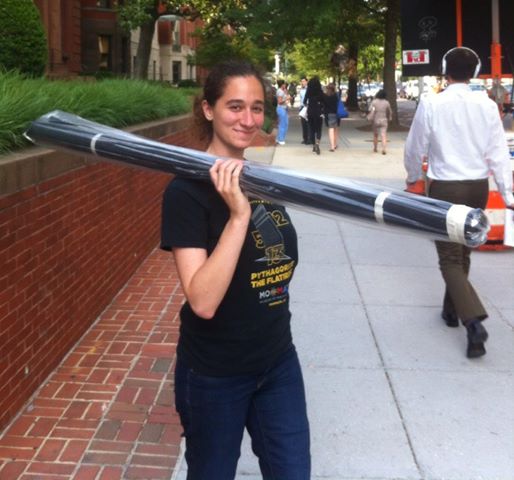
And while I begin at the beginning, here are some finished costumes, filmed in bullet time, for you to enjoy:
https://www.youtube.com/watch?v=sisGqMf7G7Y
For more Quick Takes, visit Conversion Diary!
Previous Post

July 31, 2014
Must We Reclaim Lydia Bennett?
Next Post

August 3, 2014 A Countervailing Saint for My Comfortable Month
Browse Our Archives
Select a Category 7 Quick Takes Apologetics Atheism Book Conversion Debate Tactics Debates Epistemology/Philosophy Housekeeping Ideological Turing Test Marriage Morality in Practice Parsing Catholicism Possibly Heretical Radio Reviews/Recommendations Sequence Index Spiritual Practice Uncategorized
Select a Month April 2017 March 2017 January 2017 December 2016 September 2016 August 2016 July 2016 June 2016 May 2016 April 2016 March 2016 February 2016 January 2016 December 2015 November 2015 October 2015 September 2015 August 2015 July 2015 June 2015 May 2015 April 2015 March 2015 February 2015 January 2015 December 2014 November 2014 October 2014 September 2014 August 2014 July 2014 June 2014 May 2014 April 2014 March 2014 February 2014 January 2014 December 2013 November 2013 October 2013 September 2013 August 2013 July 2013 June 2013 May 2013 April 2013 March 2013 February 2013 January 2013 December 2012 November 2012 October 2012 September 2012 August 2012 July 2012 June 2012 May 2012 April 2012 March 2012 February 2012 January 2012 December 2011 November 2011 October 2011 September 2011 August 2011 July 2011 June 2011 May 2011 April 2011 March 2011 February 2011 January 2011 December 2010 November 2010 October 2010 September 2010 August 2010 July 2010 June 2010
Follow Us!
TAKE THE
Religious Wisdom Quiz
I saw the Lord seated on a throne, high and exalted, while six-winged beings called out 'Holy, holy, holy.' What were these creatures?
Select your answer to see how you score.
Angels Seraphim Leviathan Cherubim
Related posts from Unequally Yoked

7QT: Fake Bears, Faker Weapons, and Austen

7QT: Moms, Pacifist Pilots, and other superheroes

7QT: Remixes, Underwear, & Fake Fingers

7QT: The Peculiar Virtues of Daredevil, Pool Table...
TRENDING AT PATHEOS Catholic

Creation, Preservation, and Teleology in Catholic Theology
As I write this, it is very early Monday morning. Like millions...

The Parable Of The Sower And The Word...
One of Christ’s most famous parables is that of the sower who...

Rejecting Doom: Christian Hope And Human Action
Christianity is a religion of hope. We are to have hope and...

Why I Choose the Eucharist Over the Sermon
Choose the Eucharist, Not the Sermon What are we supposed to get...

5 Design Elements Found in Spiritually Rooted Homes
Putting Spirituality Into Home Decor Our homes are more than our living...

Credo: A Story of God Told with the...
About 10 years ago, I began to imagine a personal "Credo" that...
view all Catholic blogs
Ad-Free & Subscriber Log-In Subscription Support
- About Us
- 2026 Calendar
- Videos
- Podcasts
- Library of World Religions
- Faith In Media Tracker
- Advertise With Us
- Write for Us
- Privacy Policy
- Terms of Service
- Do Not Sell My Data
- Contact Us
- Radiant Digital
- Manage Newsletter Subscriptions
- Unsubscribe From Notifications
- Sitemap
Copyright 2008-2026, Patheos. All rights reserved.
Subscription Support Ad-Free & Subscriber Log-In
Follow Patheos