
BuddhistCatholicContemplativeEvangelicalGeneral ChristianHinduJewishLatter-day SaintMuslimNew VisionsProgressive Christian
Beliefs
- Buddhist
- Catholic
- Contemplative
- Evangelical
- General Christian
- Hindu
- Jewish
- Latter-day Saint
- More Voices
- Muslim
- New Visions
- Pagan
- Progressive Christian
Topics
- Religion News
- Food and Religion
- Sports and Religion
- Religious Art
- Religious Music and Entertainment
- Religious Events
- History and Religion
- Style and Religion
- Politics and Religion
- Women in Religion
- Recreation Outdoors and Religion
- Business Finance and Religion
- Careers Workplace and Religion
- Education and Religion
- Family Parenting and Religion
- Health Fitness and Religion
- Home and Religion
- Relationships and Religion
- Technology and Religion
- Travel and Religion
Columnists
- Buddhist Columnists
- Business Finance and Religion Columnists
- Careers Workplace and Religion Columnists
- Catholic Columnists
- Contemplative Columnists
- Education and Religion Columnists
- Evangelists Columnists
- Family Parenting and Religion Columnists
- General Christian Columnists
- Health Fitness and Religion Columnists
- Hindu Columnists
- History and Religion Columnists
- Home and Religion Columnists
- Jewish Columnists
- More Voices Columnists
- Latter Day Columnists
- Muslim Columnists
- New Visions Columnists
- Nonreligious Columnists
- Pagan Columnists
- Politics and Religion Columnists
- Progressive Columnists
- Recreation Outdoors and Religion Columnists
- Relationships and Religion Columnists
- Religion News Columnists
- Religious Art Columnists
- Religious Events Columnists
- Religious Music and Entertainment Columnists
- Sports and Religion Columnists
- Style and Religion Columnists
- Technology and Religion Columnists
- Travel and Religion Columnists
- Women in Religion Columnists
Resource Library
- 2026 Calendar
- Library of World Religions
- The 100 Most Holy Places on Earth
- Patheos Answers
- Podcasts
- Videos
- Faith Leaders Database
- Anglican Episcopalian
- Bahai
- Baptist
- Buddhism
- Christianity
- Confucianism
- Eastern Orthodoxy
- Hinduism
- Holiness and Pentecostal
- ISKCON
- Islam
- Judaism
- Lutheran
- Methodist
- The Church of Jesus Christ of Latter-day Saints
- New Age
- Paganism
- Presbytarian and Reformed
- Protestantism
- Religion Behind the Scenes
- Roman Catholic
- Scientology
- Shia Islam
- Sikhism
- Sufism
- Sunni Islam
- Taoism
- Zen
- See all religions
Research Tools
 Ad-Free & Subscriber Log-In Subscription Support
Ad-Free & Subscriber Log-In Subscription Support
Follow Patheos 

- Trending:
- Forgiveness
- |
- Marriage
- |
- Consciousness
- |
- Death Penalty
- |
- Election
- |
- Halloween
 Unequally Yoked
- Home
- Catholic
- 7QT: Answers to Questions I Didn’t Think to Ask
7QT: Answers to Questions I Didn’t Think to Ask
Last updated on: August 15, 2014 at 2:53 pm by Leah Libresco
7QT: Answers to Questions I Didn’t Think to Ask 2014-08-15T14:53:01-04:00 Leah Libresco
Patheos Explore the world's faith through different perspectives on religion and spirituality! Patheos has the views of the prevalent religions and spiritualities of the world.

— 1 —
When I was in school, it wasn’t uncommon for my teachers to have access to smart whiteboards and computers, but it was seldom that there seemed to anything useful to do with them. But dy/dan, a math teacher and blogger, has a great project for students, where they designed their own vases and then tried to plot the rate at which the water level would rise in their classmates’ designs. Reading his post makes me want to putter around with the problem.
— 2 —
Meanwhile, in other fascinating modelling problems, I found, via MBlume, this animation that explains how constant rotational motion can be translated into intermittent motion (i.e. how your second hand gets its tick). It’s called the Geneva Drive.
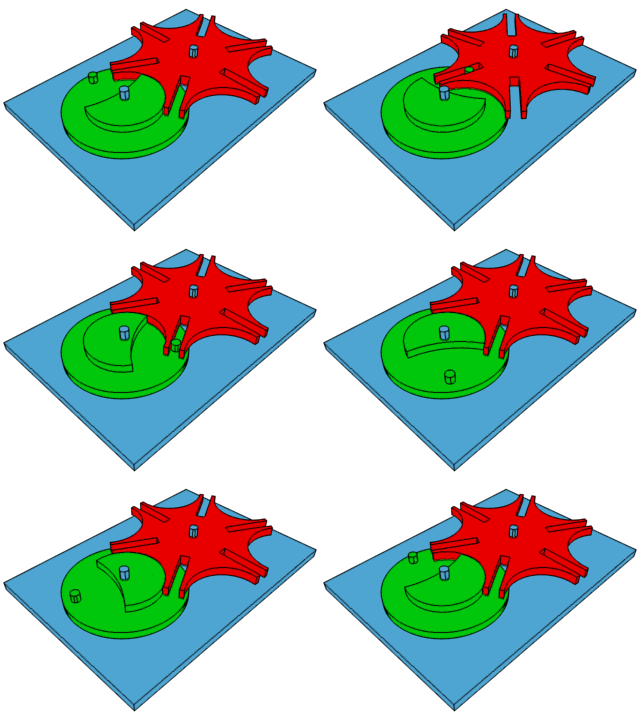
Reading the wikipedia page, I found out this is also how film projectors used to advance one frame at a time.
— 3 —
The Geneva Device is the answer to a question I never asked. Over at Scottbot, Scott wonders how many other questions about the past we’re missing the answers to because we’re neglecting cross-disciplinary questions. He tells the story of a Gutenberg mystery and then goes on to say:
At the end of his talk, Blaise made an offhand comment: how is it that historians/bibliographers/librarians have been looking at these Gutenbergs for so long, discussing the triumph of their identical characters, and not noticed that the characters are anything but uniform? Or, of those who had noticed it, why hadn’t they raised any red flags?
The insights they produced weren’t staggering feats of technology. He used a nice camera, a light shining through the pages of an old manuscript, and a few simple image recognition and clustering algorithms. The clustering part could even have been done by hand, and actually had been, by Paul Needham. And yes, it’s true, everything is obvious in hindsight, but there were a lot of eyes on these bibles, and odds are if some of them had been historians who were trained in these techniques, this insight could have come sooner. Every year students do final projects and theses and dissertations, but what percent of those use techniques from outside historiography?
In short, there’s a lot of very basic assumptions we make about the past that could probably be updated significantly if we had the right skillset, or knew how to collaborate with those who did. I think people like William Newman, whoperforms Newton’s alchemical experiments, is on the right track. As is Shawn Graham, who reanimates the trade networks of ancient Rome using agent-based simulations, or Devon Elliott, who creates computational and physical models of objects from the history of stage magic. Elliott’s models have shown that certain magic tricks couldn’t possibly have worked as they were described to.
— 4 —
Columbia’s magazine has a nice feature on a researcher who tried to study the United States’ approach to classifying information without relying on leakers, but just by taking a careful look at the gaps in what was available:
Then Connelly had an idea: could he use data mining to infer what types of information were being left out of the public record? In theory, this seemed plausible, if he could compile enough materials to work with. He figured he could start by asking Columbia Libraries to give him special access to several commercial databases that the University licenses from academic publishers and which contain federal records. He could then download a wealth of material from government websites. Maybe he could even gather up documents that fellow scholars, journalists, and citizens had acquired directly from the government under the Freedom of Information Act (FOIA). No one had ever tried to analyze the entire corpus of government records as one big database before. The promise of data mining now made it seem like a worthwhile endeavor to Connelly. He thought that if he were to recruit an interdisciplinary team of data analysts and fellow historians, he might create the first system for highlighting gaps in the National Archives. Perhaps this would even shame the government into releasing more classified materials.
— 5 —
I also enjoyed this story of tracking down hidden data… well, technically people. Wired has a fascinating profile of a skip tracer — a woman who is the real life equivalent of Boba Fett.
At 4’11” and just over 100 pounds, Michelle Gomez doesn’t look like the sort of person you’d hire to retrieve earthmoving equipment stolen by a Peruvian crime family. But in the summer of 2013, that’s exactly what she was doing.
Gomez, the proprietor of a one-woman operation in Lockhart, Texas, called Unlimited Recoveries, is one of the best skip tracers in the world. A combination bill collector, bounty hunter, and private investigator, a skip tracer finds people and things that have disappeared on purpose. Gomez specializes in “hard-to-locate recoveries”—she prefers cases others can’t solve. To track down the fleet of Caterpillar wheel loaders taken by the Peruvians, Gomez reached out to the estranged wife of the family’s patriarch, telling the woman that she was pregnant with her husband’s child. The ruse worked: Eventually the wife told Gomez that the heavy equipment was on its way to a construction site in South America.
— 6 —
But some mysteries that researchers explore are a little more quotidian. Business Insider has the video coverage on a study that tried to pin down what male dance moves were most alluring.
— 7 —
Pretty much no progress on the Halloween costume front (I was only at home Tues-Thurs this week — travelling to see my brother in a Midsummer variant and for an alumni debate). So I really need to work on altering the pattern next week. In the meantime, and apropos of the preceding quick take, here’s a bunch of people with finished costumes who are awfully happy about what they’ve put together:
Today is the second day of my novena to St. Maximilian Kolbe. Free free to pray along.
For more Quick Takes, visit Conversion Diary!
Previous Post

August 14, 2014
We Can't Be 'Sanctimonious' About Torture
Next Post

August 16, 2014 Learning the Wrong Lessons from St. Maximilian Kolbe
Browse Our Archives
Select a Category 7 Quick Takes Apologetics Atheism Book Conversion Debate Tactics Debates Epistemology/Philosophy Housekeeping Ideological Turing Test Marriage Morality in Practice Parsing Catholicism Possibly Heretical Radio Reviews/Recommendations Sequence Index Spiritual Practice Uncategorized
Select a Month April 2017 March 2017 January 2017 December 2016 September 2016 August 2016 July 2016 June 2016 May 2016 April 2016 March 2016 February 2016 January 2016 December 2015 November 2015 October 2015 September 2015 August 2015 July 2015 June 2015 May 2015 April 2015 March 2015 February 2015 January 2015 December 2014 November 2014 October 2014 September 2014 August 2014 July 2014 June 2014 May 2014 April 2014 March 2014 February 2014 January 2014 December 2013 November 2013 October 2013 September 2013 August 2013 July 2013 June 2013 May 2013 April 2013 March 2013 February 2013 January 2013 December 2012 November 2012 October 2012 September 2012 August 2012 July 2012 June 2012 May 2012 April 2012 March 2012 February 2012 January 2012 December 2011 November 2011 October 2011 September 2011 August 2011 July 2011 June 2011 May 2011 April 2011 March 2011 February 2011 January 2011 December 2010 November 2010 October 2010 September 2010 August 2010 July 2010 June 2010
Follow Us!
TAKE THE
Religious Wisdom Quiz
Who built the first temple for God?
Select your answer to see how you score.
David Pilate Moses Solomon
Related posts from Unequally Yoked

7QT: Fake Bears, Faker Weapons, and Austen

7QT: Moms, Pacifist Pilots, and other superheroes

7QT: Remixes, Underwear, & Fake Fingers

7QT: The Peculiar Virtues of Daredevil, Pool Table...
TRENDING AT PATHEOS Catholic

The Parable Of The Sower And The Word...
One of Christ’s most famous parables is that of the sower who...

Rejecting Doom: Christian Hope And Human Action
Christianity is a religion of hope. We are to have hope and...

Why I Choose the Eucharist Over the Sermon
Choose the Eucharist, Not the Sermon What are we supposed to get...

5 Design Elements Found in Spiritually Rooted Homes
Putting Spirituality Into Home Decor Our homes are more than our living...

Credo: A Story of God Told with the...
About 10 years ago, I began to imagine a personal "Credo" that...

The Anatomy of Divine Revelation in Catholic Thought
The claim that God has made Himself known to human beings is...
view all Catholic blogs
Ad-Free & Subscriber Log-In Subscription Support
- About Us
- 2026 Calendar
- Videos
- Podcasts
- Library of World Religions
- Faith In Media Tracker
- Advertise With Us
- Write for Us
- Privacy Policy
- Terms of Service
- Do Not Sell My Data
- Contact Us
- Radiant Digital
- Manage Newsletter Subscriptions
- Unsubscribe From Notifications
- Sitemap
Copyright 2008-2026, Patheos. All rights reserved.
Subscription Support Ad-Free & Subscriber Log-In
Follow Patheos