
BuddhistCatholicContemplativeEvangelicalGeneral ChristianHinduJewishLatter-day SaintMuslimNew VisionsProgressive Christian
Beliefs
- Buddhist
- Catholic
- Contemplative
- Evangelical
- General Christian
- Hindu
- Jewish
- Latter-day Saint
- More Voices
- Muslim
- New Visions
- Pagan
- Progressive Christian
Topics
- Religion News
- Food and Religion
- Sports and Religion
- Religious Art
- Religious Music and Entertainment
- Religious Events
- History and Religion
- Style and Religion
- Politics and Religion
- Women in Religion
- Recreation Outdoors and Religion
- Business Finance and Religion
- Careers Workplace and Religion
- Education and Religion
- Family Parenting and Religion
- Health Fitness and Religion
- Home and Religion
- Relationships and Religion
- Technology and Religion
- Travel and Religion
Columnists
- Buddhist Columnists
- Business Finance and Religion Columnists
- Careers Workplace and Religion Columnists
- Catholic Columnists
- Contemplative Columnists
- Education and Religion Columnists
- Evangelists Columnists
- Family Parenting and Religion Columnists
- General Christian Columnists
- Health Fitness and Religion Columnists
- Hindu Columnists
- History and Religion Columnists
- Home and Religion Columnists
- Jewish Columnists
- More Voices Columnists
- Latter Day Columnists
- Muslim Columnists
- New Visions Columnists
- Nonreligious Columnists
- Pagan Columnists
- Politics and Religion Columnists
- Progressive Columnists
- Recreation Outdoors and Religion Columnists
- Relationships and Religion Columnists
- Religion News Columnists
- Religious Art Columnists
- Religious Events Columnists
- Religious Music and Entertainment Columnists
- Sports and Religion Columnists
- Style and Religion Columnists
- Technology and Religion Columnists
- Travel and Religion Columnists
- Women in Religion Columnists
Resource Library
- 2026 Calendar
- Library of World Religions
- The 100 Most Holy Places on Earth
- Patheos Answers
- Podcasts
- Videos
- Faith Leaders Database
- Anglican Episcopalian
- Bahai
- Baptist
- Buddhism
- Christianity
- Confucianism
- Eastern Orthodoxy
- Hinduism
- Holiness and Pentecostal
- ISKCON
- Islam
- Judaism
- Lutheran
- Methodist
- The Church of Jesus Christ of Latter-day Saints
- New Age
- Paganism
- Presbytarian and Reformed
- Protestantism
- Religion Behind the Scenes
- Roman Catholic
- Scientology
- Shia Islam
- Sikhism
- Sufism
- Sunni Islam
- Taoism
- Zen
- See all religions
Research Tools
 Ad-Free & Subscriber Log-In Subscription Support
Ad-Free & Subscriber Log-In Subscription Support
Follow Patheos 

- Trending:
- Forgiveness
- |
- Marriage
- |
- Consciousness
- |
- Death Penalty
- |
- Election
- |
- Halloween
 Unequally Yoked
- Home
- Catholic
- Of Morality and Mandelbrot [Pope Francis Bookclub]
Of Morality and Mandelbrot [Pope Francis Bookclub]
Last updated on: July 14, 2014 at 4:58 pm by Leah Libresco
Of Morality and Mandelbrot [Pope Francis Bookclub] 2014-07-14T16:58:56-04:00 Leah Libresco
Patheos Explore the world's faith through different perspectives on religion and spirituality! Patheos has the views of the prevalent religions and spiritualities of the world.
In 2014, I’m reading and blogging through Pope Francis/Cardinal Bergoglio’s Open Mind, Faithful Heart: Reflections on Following Jesus. Every Monday, I’ll be writing about the next meditation in the book, so you’re welcome to peruse them all and/or read along.
This week, in my Pope Francis reading, I found his description of… for lack of a better word, the discretion of higher truths a little confusing:
Truth has great value, but it lacks immediate clout, whereas power coerces. Paradoxically, the more noble the truth is, the less power it has. Even simple truths have some power, because they confirm certain needs and tendencies–think, for example, of the truths that relate to our immediate vital needs. But the more elevated the truth, the less coercive force it possesses; the spirit must grow in freedom simply in order to grasp it. The nobler a truth, the easier it is for cruder realities to discount it or even ridicule it; it must rely even more on nobility of spirit.
I found this argument a little odd, especially when Pope Francis extends it to say that holy truth, as the most exalted, has the least power to coerce. The way I’ve always thought of these non-coercive truths is that abstract truths have less power over us simply because we don’t bump into them very much. It took a long time to discover that Newton wasn’t the whole story, because the cases where his theory failed, and relativity turned out to be needed, were fairly rare in everyday experience. And we still haven’t quite nailed down the truth or falsity of the Riemann Hypothesis because its consequences don’t intrude into our lives the way the consequences of, let’s say, the “Is Breathing really necessary?” Hypothesis.
However, moral truths also seem to have only a weak power to compel, even though those questions are, without doubt, relevant moment to moment. I might say that the reason that we don’t feel as compelled as we do by simple, bodily truths is that the truth has a kind of complex structure. Let me explain using a math analogy.
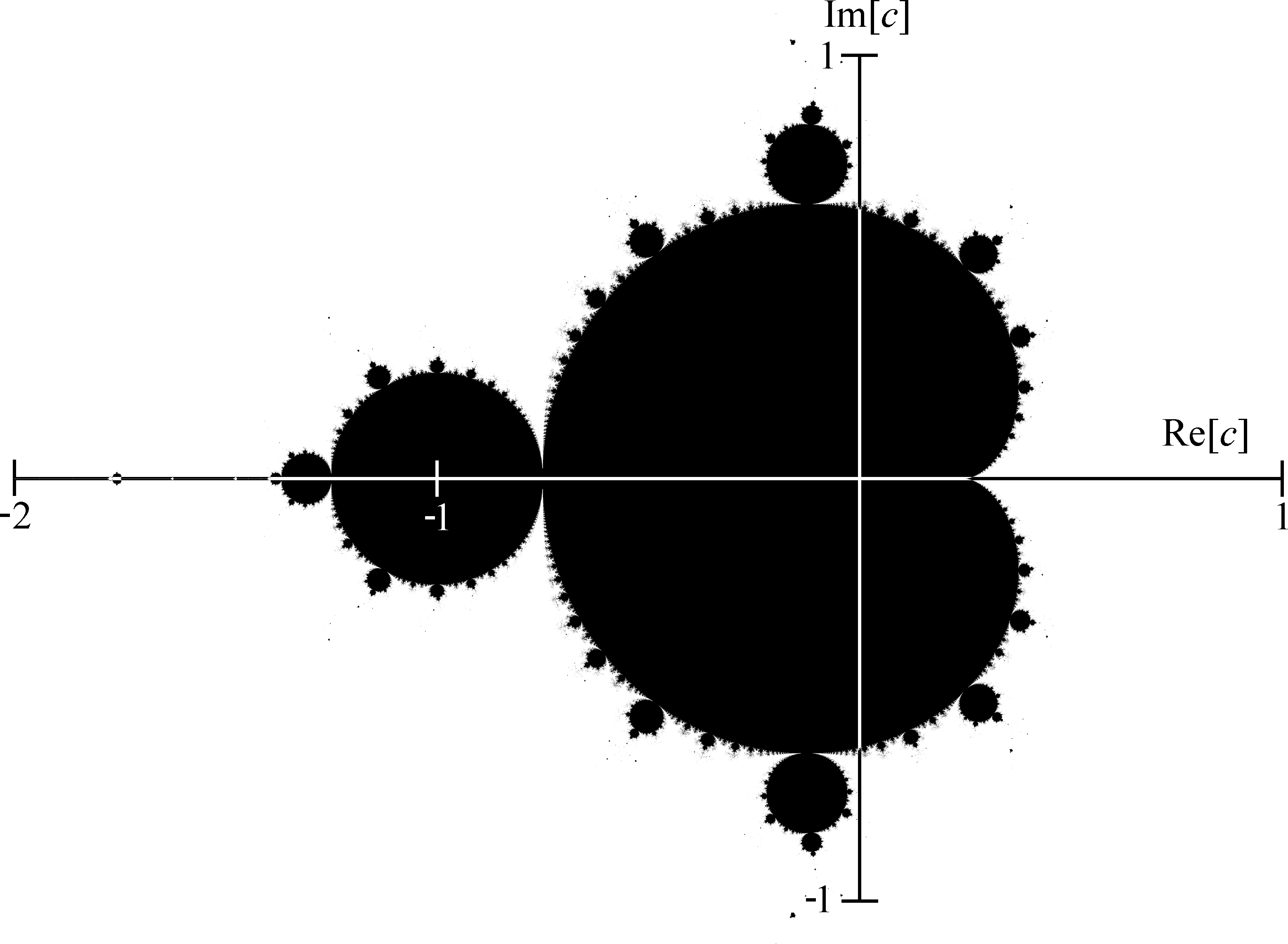
The Mandelbrot set is pretty simple, if you just want to describe it algorithmically: wikipedia summarizes it as “the set of complex numbers ‘c’ for which the sequence ( c , c² + c , (c²+c)² + c , ((c²+c)²+c)² + c , (((c²+c)²+c)²+c)² + c , …) does not approach infinity.” If I were to say it with a bit less notation, I’d say that you take a complex number (one with i — the root of -1 in it) and square it, and then add itself. Then you square the sum and add the original number again, and you just keep doing it. You’re checking to see if the sums you keep producing are going to stay below some arbitrary number, or it they keep increasing forever, without limit. The Mandelbrot set is what you get when you start checking every point on the complex plane and coloring it black if it satisfies these conditions.
Describing the rule is easy. Drawing the shape is harder. And predicting whether an arbitrary point will be black or white also takes a bit of computation (though there are some pretty reliable heuristics). In a similar way, we know some general rules about ethics — don’t harm someone without cause, do easy kindnesses without cause, etc — but might struggle to figure out how to implement them vis a vis a particular person or situation. We know the relationship we’re supposed to cultivate (one of agape) but we have to do a few experiments to see if our present course of action trends in that direction.
That’s not the whole story of why we struggle to do the right thing, but it seems plausible to me as one of the factors that causes us to not obey ethics the way we do physics. The truth is present, and more accessible than, say, physics in a Bose-Einstein condensate, but it’s very complex at the fine-grained level, so we usually work with approximations and generalized rules, instead of the fullness of the truth. It’s not necessarily very far from us; we just have to get farther away, retreating and retrenching in abstraction, to get a better sense of the picture.
Previous Post

July 13, 2014
You're Invited! To My Birthday Argument!
Next Post

July 15, 2014 Three Priestesses Deciding Whom to Sacrifice
Browse Our Archives
Select a Category 7 Quick Takes Apologetics Atheism Book Conversion Debate Tactics Debates Epistemology/Philosophy Housekeeping Ideological Turing Test Marriage Morality in Practice Parsing Catholicism Possibly Heretical Radio Reviews/Recommendations Sequence Index Spiritual Practice Uncategorized
Select a Month April 2017 March 2017 January 2017 December 2016 September 2016 August 2016 July 2016 June 2016 May 2016 April 2016 March 2016 February 2016 January 2016 December 2015 November 2015 October 2015 September 2015 August 2015 July 2015 June 2015 May 2015 April 2015 March 2015 February 2015 January 2015 December 2014 November 2014 October 2014 September 2014 August 2014 July 2014 June 2014 May 2014 April 2014 March 2014 February 2014 January 2014 December 2013 November 2013 October 2013 September 2013 August 2013 July 2013 June 2013 May 2013 April 2013 March 2013 February 2013 January 2013 December 2012 November 2012 October 2012 September 2012 August 2012 July 2012 June 2012 May 2012 April 2012 March 2012 February 2012 January 2012 December 2011 November 2011 October 2011 September 2011 August 2011 July 2011 June 2011 May 2011 April 2011 March 2011 February 2011 January 2011 December 2010 November 2010 October 2010 September 2010 August 2010 July 2010 June 2010
Follow Us!
TAKE THE
Religious Wisdom Quiz
In 2 Corinthians, Paul describes a man being caught up to the third heaven. How many years before writing did this happen?
Select your answer to see how you score.
Fourteen years Seven years Twelve years Ten years
Related posts from Unequally Yoked

Rational Faith: More working hypothesis than logical proof

Life Lessons that Can't be Taught at College's...

Books that Change the Way You Think [Radio...

Catching the Joy of Others [Pope Francis Bookclub]
TRENDING AT PATHEOS Catholic

Creation, Preservation, and Teleology in Catholic Theology
As I write this, it is very early Monday morning. Like millions...

The Parable Of The Sower And The Word...
One of Christ’s most famous parables is that of the sower who...

Rejecting Doom: Christian Hope And Human Action
Christianity is a religion of hope. We are to have hope and...

Why I Choose the Eucharist Over the Sermon
Choose the Eucharist, Not the Sermon What are we supposed to get...

5 Design Elements Found in Spiritually Rooted Homes
Putting Spirituality Into Home Decor Our homes are more than our living...

Credo: A Story of God Told with the...
About 10 years ago, I began to imagine a personal "Credo" that...
view all Catholic blogs
Ad-Free & Subscriber Log-In Subscription Support
- About Us
- 2026 Calendar
- Videos
- Podcasts
- Library of World Religions
- Faith In Media Tracker
- Advertise With Us
- Write for Us
- Privacy Policy
- Terms of Service
- Do Not Sell My Data
- Contact Us
- Radiant Digital
- Manage Newsletter Subscriptions
- Unsubscribe From Notifications
- Sitemap
Copyright 2008-2026, Patheos. All rights reserved.
Subscription Support Ad-Free & Subscriber Log-In
Follow Patheos