
BuddhistCatholicContemplativeEvangelicalGeneral ChristianHinduJewishLatter-day SaintMuslimNew VisionsProgressive Christian
Beliefs
- Buddhist
- Catholic
- Contemplative
- Evangelical
- General Christian
- Hindu
- Jewish
- Latter-day Saint
- More Voices
- Muslim
- New Visions
- Pagan
- Progressive Christian
Topics
- Religion News
- Food and Religion
- Sports and Religion
- Religious Art
- Religious Music and Entertainment
- Religious Events
- History and Religion
- Style and Religion
- Politics and Religion
- Women in Religion
- Recreation Outdoors and Religion
- Business Finance and Religion
- Careers Workplace and Religion
- Education and Religion
- Family Parenting and Religion
- Health Fitness and Religion
- Home and Religion
- Relationships and Religion
- Technology and Religion
- Travel and Religion
Columnists
- Buddhist Columnists
- Business Finance and Religion Columnists
- Careers Workplace and Religion Columnists
- Catholic Columnists
- Contemplative Columnists
- Education and Religion Columnists
- Evangelists Columnists
- Family Parenting and Religion Columnists
- General Christian Columnists
- Health Fitness and Religion Columnists
- Hindu Columnists
- History and Religion Columnists
- Home and Religion Columnists
- Jewish Columnists
- More Voices Columnists
- Latter Day Columnists
- Muslim Columnists
- New Visions Columnists
- Nonreligious Columnists
- Pagan Columnists
- Politics and Religion Columnists
- Progressive Columnists
- Recreation Outdoors and Religion Columnists
- Relationships and Religion Columnists
- Religion News Columnists
- Religious Art Columnists
- Religious Events Columnists
- Religious Music and Entertainment Columnists
- Sports and Religion Columnists
- Style and Religion Columnists
- Technology and Religion Columnists
- Travel and Religion Columnists
- Women in Religion Columnists
Resource Library
- 2026 Calendar
- Library of World Religions
- The 100 Most Holy Places on Earth
- Patheos Answers
- Podcasts
- Videos
- Faith Leaders Database
- Anglican Episcopalian
- Bahai
- Baptist
- Buddhism
- Christianity
- Confucianism
- Eastern Orthodoxy
- Hinduism
- Holiness and Pentecostal
- ISKCON
- Islam
- Judaism
- Lutheran
- Methodist
- The Church of Jesus Christ of Latter-day Saints
- New Age
- Paganism
- Presbytarian and Reformed
- Protestantism
- Religion Behind the Scenes
- Roman Catholic
- Scientology
- Shia Islam
- Sikhism
- Sufism
- Sunni Islam
- Taoism
- Zen
- See all religions
Research Tools
 Ad-Free & Subscriber Log-In Subscription Support
Ad-Free & Subscriber Log-In Subscription Support
Follow Patheos 

- Trending:
- Forgiveness
- |
- Marriage
- |
- Consciousness
- |
- Death Penalty
- |
- Election
- |
- Halloween
 Unequally Yoked
- Home
- Catholic
- Suspicious Hermits, Gruesome Creativity, and Just Enough E Coli
Suspicious Hermits, Gruesome Creativity, and Just Enough E Coli
Last updated on: June 20, 2014 at 12:00 pm by Leah Libresco
Suspicious Hermits, Gruesome Creativity, and Just Enough E Coli 2014-06-20T12:00:04-04:00 Leah Libresco
Patheos Explore the world's faith through different perspectives on religion and spirituality! Patheos has the views of the prevalent religions and spiritualities of the world.

— 1 —
There’s a bit of luck in my starting this week’s quick takes late, because it meant I had time to spot this article from Marginal Revolution about a Swiss town trying to hire a hermit. Naturally, I was reminded of this exchange from Tom Stoppard’s Arcadia:
LADY CROOM: You surely do not supply an hermitage without a hermit?
NOAKES: Indeed, madam —
LADY CROOM: Come, come, Mr Noakes. If I am promised a fountain I expect it to come with water. What hermits do you have?
NOAKES: I have no hermits, my lady.
LADY CROOM: Not one? I am speechless.
NOAKES: I am sure a hermit can be found. One could advertise.
LADY CROOM: Advertise?
NOAKES: In the newspapers.
LADY CROOM: But surely a hermit who takes a newspaper is not a hermit in whom one can have complete confidence.
— 2 —
If Euclid the Game didn’t have only twenty levels, I might have turned hermit myself when I found it this week. This is a very well designed game that lets you use virtual compasses and straightedges to construct the midpoint of a line segment, or a circle inscribed in a triangle, etc. Once you master a construction, it gets added to your set of tools, so, once I bisected an angle once, I got a new button added to my topline.
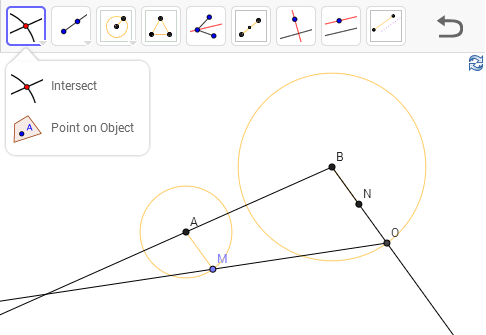
I managed to play through to level 20, but then got stuck. So I’ve peeked at one of the solutions, and I’m going to puzzle out why it works, once I have a pencil and paper on hand, so I can mark it up. In the meantime, I replicated it in-game and was able to modify it and poke around to test my hypothesis. (All wrong, so far).
A friend also recommended another geometrical construction game, once I finish Euclid.
— 3 —
Speaking of exercises in construction, Vanity Fair has a fascinating feature on how the practical effects were pulled off for a particularly gruesome death on Game of Thrones. Here’s the most entertaining, not as spoiler-y, pullquote I could manage:
Gower: We cut to the actor, he was lying down, and the effects department . . . they had several little blood tubes and various gags which they actually put inside [REDACTED] hands, up into his thumbs, so it could pump blood around [REDACTED]’s actual eyes—and he had protection around his eyes.
Bauer: We had to make C.G. thumbs that would stay in the eyes, because the actor playing [REDACTED] was so cautious about getting his thumbs near [REDACTED]’s eyes, that they were always hovering over the top, so we had to get the thumbs really dug far into the prosthetic.
— 4 —
And if you like your grotesqueries spoiler free, perhaps you’ll prefer this NYT feature on the resurgence of taxidermy in England.
While her workshops are popular, they are also controversial; she began to use a pseudonym after receiving death threats and would not give her real name.
“I think that people are interested in the bizarre,” she said during a recent class as she bared a tattoo of a rat on her arm, its bright red tongue matching her hair. “They sit at their desks all day and they stare at a computer, and they want to get into something else and do something manual with their hands and be creative.”
There is a bit of a taboo around dead animals, she said, which adds to the thrill of the class. People want to have a “hands-on experience with death.”
“We don’t have that at all in our culture. It’s sort of Victorian, and it’s quirky,” she said. “Dressing up death is in a way reviving life into something, and that’s what I think is the art in it.”
— 5 —
But if you’d like your artistic endeavors to involve less… skinning, you may want to join Simcha Fisher in her summer project to work through Drawing on the Right Side of the Brain. I’ve done one exercise from this book in high school, and it was a better drawing than anything else I’ve done. The whole thing kicks off this coming Tuesday.
— 6 —
Nautilus has a nice feature on how scientists can tell whether a particular evolutionary kludge is mere happenstance or would be very likely to be repeated if you could roll back the clock, and start again. Of course, for some species, no guesswork is required, just an awful lot of freezers.
Rather than attempt to reconstruct history with fossils, Richard Lenski, an evolutionary biologist at Michigan State University, decided to watch convergence and contingency unfold in real time, in the controlled environment of his laboratory. In 1988, he separated a single population of Escherichia coli bacteria into 12 separate flasks containing liquid nutrients, and let them each evolve separately. Every few months for the past 26 years, he or one of his students has frozen a sample of the bacteria. This archive of frozen microbes gives Lenski the ability to replay E. coli’s tape of life from any point he wishes, simply by thawing out the samples. Along the way, he can examine how the bacteria change both genetically and in ways that are visible under a microscope. Lenski says, “The whole experiment was set up to test how reproducible evolution was.”
…
In 2003, another contingent event took place. The number of E. coli in one of the flasks increased to the point where the normally translucent nutrient solution turned cloudy. At first Lenski thought that the flask had been contaminated, but it turned out that the E. coli, which normally just feed on glucose in the solution, had developed a way to consume a different chemical in the flasks, called citrate. After 15 years, or 31,500 generations, just one of the populations was able to consume the substance.2 Its population size quickly expanded by a factor of five.
This “historical contingency” gave Lenski and his graduate student Zachary Blount a chance to examine the likelihood that it would happen again if they rewound the tape. Blount went to the archive of frozen E. coli, and selected 72 samples collected at different periods in the experiment from the population that later evolved citrate metabolism. He thawed them out, and let them grow. Eventually, four out of the 72 samples acquired the ability. What’s more, the mutations only occurred in populations that had been frozen after 30,500 generations. Genetic analysis showed that several genes had undergone mutations that “potentiated” the evolution of citrate metabolism before that point. In other words, the ability to consume citrate was contingent upon other mutations that had come before it. Those formed a fork in the road, altering the path that generations after would be able to travel.
— 7 —
Finally, I’m very amused to say that I organized a group of fourteen people to see Freud’s Last Session at Theatre J last night and, during the Q&A, the producer mentioned that this two-hander featuring Freud and C.S. Lewis had attracted a different group of theatregoers than other recent productions. “In fact,” he said, “I believe we have a group here tonight,” and he gestured to my bloc of seats. “Where are you all from?”
One of my seatmates piped up, “We’re all here with Leah!” and I just added that I like shanghaiing my friends to shows.
As I was leaving the theatre, a woman stopped me, handed me her business card, and told me that she was an executive at a Maryland theatre, and wanted to me to know she had group rates available as well. This is probably the most I will ever feel like a VIP.
For more Quick Takes, visit Conversion Diary!
Previous Post

June 19, 2014
Trigger Warnings and Coal Mine Canaries
Next Post
June 22, 2014 Call for Guest Posts Next Week!
Browse Our Archives
Select a Category 7 Quick Takes Apologetics Atheism Book Conversion Debate Tactics Debates Epistemology/Philosophy Housekeeping Ideological Turing Test Marriage Morality in Practice Parsing Catholicism Possibly Heretical Radio Reviews/Recommendations Sequence Index Spiritual Practice Uncategorized
Select a Month April 2017 March 2017 January 2017 December 2016 September 2016 August 2016 July 2016 June 2016 May 2016 April 2016 March 2016 February 2016 January 2016 December 2015 November 2015 October 2015 September 2015 August 2015 July 2015 June 2015 May 2015 April 2015 March 2015 February 2015 January 2015 December 2014 November 2014 October 2014 September 2014 August 2014 July 2014 June 2014 May 2014 April 2014 March 2014 February 2014 January 2014 December 2013 November 2013 October 2013 September 2013 August 2013 July 2013 June 2013 May 2013 April 2013 March 2013 February 2013 January 2013 December 2012 November 2012 October 2012 September 2012 August 2012 July 2012 June 2012 May 2012 April 2012 March 2012 February 2012 January 2012 December 2011 November 2011 October 2011 September 2011 August 2011 July 2011 June 2011 May 2011 April 2011 March 2011 February 2011 January 2011 December 2010 November 2010 October 2010 September 2010 August 2010 July 2010 June 2010
Follow Us!
TAKE THE
Religious Wisdom Quiz
Which book comes before Amos in the Old Testament?
Select your answer to see how you score.
Obadiah Joel Hosea Micah
Related posts from Unequally Yoked

7QT: Fake Bears, Faker Weapons, and Austen

7QT: Moms, Pacifist Pilots, and other superheroes

7QT: Remixes, Underwear, & Fake Fingers

7QT: The Peculiar Virtues of Daredevil, Pool Table...
TRENDING AT PATHEOS Catholic

Rejecting Doom: Christian Hope And Human Action
Christianity is a religion of hope. We are to have hope and...

It’s What Comes From Within Which Matters
One of the most difficult things for us to understand is why...

Why I Choose the Eucharist Over the Sermon
Choose the Eucharist, Not the Sermon What are we supposed to get...

5 Design Elements Found in Spiritually Rooted Homes
Putting Spirituality Into Home Decor Our homes are more than our living...

Credo: A Story of God Told with the...
About 10 years ago, I began to imagine a personal "Credo" that...

The Anatomy of Divine Revelation in Catholic Thought
The claim that God has made Himself known to human beings is...
view all Catholic blogs
Ad-Free & Subscriber Log-In Subscription Support
- About Us
- 2026 Calendar
- Videos
- Podcasts
- Library of World Religions
- Faith In Media Tracker
- Advertise With Us
- Write for Us
- Privacy Policy
- Terms of Service
- Do Not Sell My Data
- Contact Us
- Radiant Digital
- Manage Newsletter Subscriptions
- Unsubscribe From Notifications
- Sitemap
Copyright 2008-2026, Patheos. All rights reserved.
Subscription Support Ad-Free & Subscriber Log-In
Follow Patheos