
BuddhistCatholicContemplativeEvangelicalGeneral ChristianHinduJewishLatter-day SaintMuslimNew VisionsProgressive Christian
Beliefs
- Buddhist
- Catholic
- Contemplative
- Evangelical
- General Christian
- Hindu
- Jewish
- Latter-day Saint
- More Voices
- Muslim
- New Visions
- Pagan
- Progressive Christian
Topics
- Religion News
- Food and Religion
- Sports and Religion
- Religious Art
- Religious Music and Entertainment
- Religious Events
- History and Religion
- Style and Religion
- Politics and Religion
- Women in Religion
- Recreation Outdoors and Religion
- Business Finance and Religion
- Careers Workplace and Religion
- Education and Religion
- Family Parenting and Religion
- Health Fitness and Religion
- Home and Religion
- Relationships and Religion
- Technology and Religion
- Travel and Religion
Columnists
- Buddhist Columnists
- Business Finance and Religion Columnists
- Careers Workplace and Religion Columnists
- Catholic Columnists
- Contemplative Columnists
- Education and Religion Columnists
- Evangelists Columnists
- Family Parenting and Religion Columnists
- General Christian Columnists
- Health Fitness and Religion Columnists
- Hindu Columnists
- History and Religion Columnists
- Home and Religion Columnists
- Jewish Columnists
- More Voices Columnists
- Latter Day Columnists
- Muslim Columnists
- New Visions Columnists
- Nonreligious Columnists
- Pagan Columnists
- Politics and Religion Columnists
- Progressive Columnists
- Recreation Outdoors and Religion Columnists
- Relationships and Religion Columnists
- Religion News Columnists
- Religious Art Columnists
- Religious Events Columnists
- Religious Music and Entertainment Columnists
- Sports and Religion Columnists
- Style and Religion Columnists
- Technology and Religion Columnists
- Travel and Religion Columnists
- Women in Religion Columnists
Resource Library
- 2026 Calendar
- Library of World Religions
- The 100 Most Holy Places on Earth
- Patheos Answers
- Podcasts
- Videos
- Faith Leaders Database
- Anglican Episcopalian
- Bahai
- Baptist
- Buddhism
- Christianity
- Confucianism
- Eastern Orthodoxy
- Hinduism
- Holiness and Pentecostal
- ISKCON
- Islam
- Judaism
- Lutheran
- Methodist
- The Church of Jesus Christ of Latter-day Saints
- New Age
- Paganism
- Presbytarian and Reformed
- Protestantism
- Religion Behind the Scenes
- Roman Catholic
- Scientology
- Shia Islam
- Sikhism
- Sufism
- Sunni Islam
- Taoism
- Zen
- See all religions
Research Tools
 Ad-Free & Subscriber Log-In Subscription Support
Ad-Free & Subscriber Log-In Subscription Support
Follow Patheos 

- Trending:
- Forgiveness
- |
- Marriage
- |
- Consciousness
- |
- Death Penalty
- |
- Election
- |
- Halloween
 Unequally Yoked
- Home
- Catholic
- In the Moral Landscape, There Still Be Dragons
In the Moral Landscape, There Still Be Dragons
Last updated on: June 4, 2014 at 8:53 am by Leah Libresco
In the Moral Landscape, There Still Be Dragons 2014-06-04T08:53:24-04:00 Leah Libresco
Patheos Explore the world's faith through different perspectives on religion and spirituality! Patheos has the views of the prevalent religions and spiritualities of the world.
Sam Harris has announced the winning entry in his contest for critiques of The Moral Landscape: How Science Can Determine Human Values. The winner (from a philosophy M.A. and blogger at Point of Controversy) is the obvious complaint, which seems just. Here’s an excerpt:
First, your analogy between epistemic axioms and moral axioms fails. The former merely motivate scientific inquiry and frame its development, whereas the latter predetermine your science of morality’s most basic findings. Epistemic axioms direct science to favor theories that are logically consistent, empirically supported, and so on, but they do not dictate which theories those will be. Meanwhile, your two moral axioms have already declared that (i) the only thing of intrinsic value is well-being, and (ii) the correct moral theory is consequentialist and, seemingly, some version of utilitarianism—rather than, say, virtue ethics, a non-consequentialist candidate for a naturalized moral framework. Further, both (i) and (ii) resist the sort of self-justification attributed above to science’s epistemic axioms; that is, neither is any more self-affirming than the value of health and the goal of promoting it. You might reply that the non-epistemic axioms of the science of medicine enjoy the sort of self-justification you have in mind for the moral (and likewise non-epistemic) axioms of your science of morality. But then your second analogy, between the science of medicine and your science of morality, fails. The former must presuppose that health is good and ought to be promoted; otherwise, the science of medicine would seem to defy conception. In contrast, a science of morality, insofar as it admits of conception, does not have to presuppose that well-being is the highest good and ought to be maximized. Serious competing theories of value and morality exist. If a science of morality elucidates moral reality, as you suggest, then presumably it must work out, not simply presuppose, the correct theory of moral reality, just as the science of physics must work out the correct theory of physical reality.
This summed up a lot of my frustrations with Harris’s book (which I wanted to bang Whose Justice? Which Rationality? against), but there was one other critique I wanted to add, that lets a bunch of Harris’s objections stand unquestioned. Harris’s book takes it’s title from his vision of a giant function graphing human happiness laid out over all possible worlds and actions. Let’s wildly simplify it, for the sake of arguement:
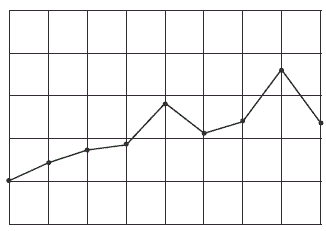
Here, the y-axis is happiness/well-being as Harris defines it (and he assumes that, given a few years, we can take these readings straight from an fMRI, without the confounding factor of people self-reporting their feelings). The x-axis varies along anything we like. It could be volume of music we’re playing for our test subject, number of hugs administered, or tablets of soma prescribed.
Ideally, we’d test all of these at once, and get a function that looked more like a rumpled carper (or, really, a higher-dimensional rumpled carpet), but the essential point is that some values of f(x,y,z,…..,Ω) would be higher than others, and we aim to, as Mama Rose said, “hit the heights.”
Maximizing out a function is a common problem, so there are a lot of known strategies (and known weaknesses). It’s easy to get stuck at local maximums (like the second highest peak in the graph above). In order to find the higher, better peak, you have to do a fair amount of sampling from the whole rest of the graph.
Or, you could know something about the function itself, instead of just sampling by taking readings as you go. But figuring out what makes people flourish is firmly back in the realm of philosophy and theology, and out of the realm of Harris’s fMRIs, which don’t tell stories at the level of humans, just neurons. To make the generalizations that would guide his theory, he has to bring in the disciplines he’s trying to make redundant.
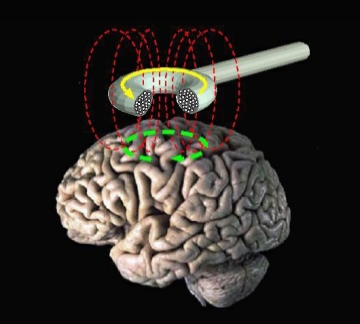
Transcranial magnetic stimulation isn’t hypothetical
And there’s a worse objection right behind that one. I’ve been writing as though this happiness function is static. We can zip around to other points in the landscape, but there’s no chance of, shall we say, moral terraforming. That’s not really true. In addition to changing the experiences we offer, we can change the experiencing subject so s/he is pleased or displeased by new things.
We already do. No one things that we should leave the happiness function of a person with depression or a psychopath where we found them. In one case, we think the person shouldn’t find all the uses of the world quite so “weary, stale, flat, and unprofitable.” In the second, we think our subject is taking pleasure in the wrong things.
If we’re just maximizing the output of the needle on the happiness dial, we have no guidance about what kind of changes we should make to people to change what makes them happy. (Arguably, stoicism is the low-hanging intervention, here). Once again, to set limits on how to change the moral landscape, Harris needs philosophy, theology, or both, but can’t proceed by neuroscience alone.
Today is the eighth day of my Novena to Mary, Undoer of Knots, and you’re welcome to join in.
Previous Post

June 3, 2014
Christ's Loyal Widows [Pope Francis Bookclub]
Next Post

June 5, 2014 An Exhaustion with Epics
Browse Our Archives
Select a Category 7 Quick Takes Apologetics Atheism Book Conversion Debate Tactics Debates Epistemology/Philosophy Housekeeping Ideological Turing Test Marriage Morality in Practice Parsing Catholicism Possibly Heretical Radio Reviews/Recommendations Sequence Index Spiritual Practice Uncategorized
Select a Month April 2017 March 2017 January 2017 December 2016 September 2016 August 2016 July 2016 June 2016 May 2016 April 2016 March 2016 February 2016 January 2016 December 2015 November 2015 October 2015 September 2015 August 2015 July 2015 June 2015 May 2015 April 2015 March 2015 February 2015 January 2015 December 2014 November 2014 October 2014 September 2014 August 2014 July 2014 June 2014 May 2014 April 2014 March 2014 February 2014 January 2014 December 2013 November 2013 October 2013 September 2013 August 2013 July 2013 June 2013 May 2013 April 2013 March 2013 February 2013 January 2013 December 2012 November 2012 October 2012 September 2012 August 2012 July 2012 June 2012 May 2012 April 2012 March 2012 February 2012 January 2012 December 2011 November 2011 October 2011 September 2011 August 2011 July 2011 June 2011 May 2011 April 2011 March 2011 February 2011 January 2011 December 2010 November 2010 October 2010 September 2010 August 2010 July 2010 June 2010
Follow Us!
TAKE THE
Religious Wisdom Quiz
What did Job maintain throughout his speeches?
Select your answer to see how you score.
His wealth His innocence His silence His guilt
Related posts from Unequally Yoked



The Boring, Quiet Rituals That Sustain Us Spiritually

Starving Laypeople of Devotion in Church
TRENDING AT PATHEOS Catholic

Rejecting Doom: Christian Hope And Human Action
Christianity is a religion of hope. We are to have hope and...

It’s What Comes From Within Which Matters
One of the most difficult things for us to understand is why...

Why I Choose the Eucharist Over the Sermon
Choose the Eucharist, Not the Sermon What are we supposed to get...

5 Design Elements Found in Spiritually Rooted Homes
Putting Spirituality Into Home Decor Our homes are more than our living...

Credo: A Story of God Told with the...
About 10 years ago, I began to imagine a personal "Credo" that...

The Anatomy of Divine Revelation in Catholic Thought
The claim that God has made Himself known to human beings is...
view all Catholic blogs
Ad-Free & Subscriber Log-In Subscription Support
- About Us
- 2026 Calendar
- Videos
- Podcasts
- Library of World Religions
- Faith In Media Tracker
- Advertise With Us
- Write for Us
- Privacy Policy
- Terms of Service
- Do Not Sell My Data
- Contact Us
- Radiant Digital
- Manage Newsletter Subscriptions
- Unsubscribe From Notifications
- Sitemap
Copyright 2008-2026, Patheos. All rights reserved.
Subscription Support Ad-Free & Subscriber Log-In
Follow Patheos