
BuddhistCatholicContemplativeEvangelicalGeneral ChristianHinduJewishLatter-day SaintMuslimNew VisionsProgressive Christian
Beliefs
- Buddhist
- Catholic
- Contemplative
- Evangelical
- General Christian
- Hindu
- Jewish
- Latter-day Saint
- More Voices
- Muslim
- New Visions
- Pagan
- Progressive Christian
Topics
- Religion News
- Food and Religion
- Sports and Religion
- Religious Art
- Religious Music and Entertainment
- Religious Events
- History and Religion
- Style and Religion
- Politics and Religion
- Women in Religion
- Recreation Outdoors and Religion
- Business Finance and Religion
- Careers Workplace and Religion
- Education and Religion
- Family Parenting and Religion
- Health Fitness and Religion
- Home and Religion
- Relationships and Religion
- Technology and Religion
- Travel and Religion
Columnists
- Buddhist Columnists
- Business Finance and Religion Columnists
- Careers Workplace and Religion Columnists
- Catholic Columnists
- Contemplative Columnists
- Education and Religion Columnists
- Evangelists Columnists
- Family Parenting and Religion Columnists
- General Christian Columnists
- Health Fitness and Religion Columnists
- Hindu Columnists
- History and Religion Columnists
- Home and Religion Columnists
- Jewish Columnists
- More Voices Columnists
- Latter Day Columnists
- Muslim Columnists
- New Visions Columnists
- Nonreligious Columnists
- Pagan Columnists
- Politics and Religion Columnists
- Progressive Columnists
- Recreation Outdoors and Religion Columnists
- Relationships and Religion Columnists
- Religion News Columnists
- Religious Art Columnists
- Religious Events Columnists
- Religious Music and Entertainment Columnists
- Sports and Religion Columnists
- Style and Religion Columnists
- Technology and Religion Columnists
- Travel and Religion Columnists
- Women in Religion Columnists
Resource Library
- 2026 Calendar
- Library of World Religions
- The 100 Most Holy Places on Earth
- Patheos Answers
- Podcasts
- Videos
- Faith Leaders Database
- Anglican Episcopalian
- Bahai
- Baptist
- Buddhism
- Christianity
- Confucianism
- Eastern Orthodoxy
- Hinduism
- Holiness and Pentecostal
- ISKCON
- Islam
- Judaism
- Lutheran
- Methodist
- The Church of Jesus Christ of Latter-day Saints
- New Age
- Paganism
- Presbytarian and Reformed
- Protestantism
- Religion Behind the Scenes
- Roman Catholic
- Scientology
- Shia Islam
- Sikhism
- Sufism
- Sunni Islam
- Taoism
- Zen
- See all religions
Research Tools
 Ad-Free & Subscriber Log-In Subscription Support
Ad-Free & Subscriber Log-In Subscription Support
Follow Patheos 

- Trending:
- Forgiveness
- |
- Marriage
- |
- Consciousness
- |
- Death Penalty
- |
- Election
- |
- Halloween
 Unequally Yoked
- Home
- Catholic
- If Only Angels Would Prevail: The Ballad of Sweeney Todd
If Only Angels Would Prevail: The Ballad of Sweeney Todd
Last updated on: March 3, 2014 at 5:28 pm by Leah Libresco
If Only Angels Would Prevail: The Ballad of Sweeney Todd 2014-03-03T17:28:12-05:00 Leah Libresco
Patheos Explore the world's faith through different perspectives on religion and spirituality! Patheos has the views of the prevalent religions and spiritualities of the world.
The Pope Francis bookclub post will run on Wednesday, since the chapter seemed apropos for the beginning of Lent.
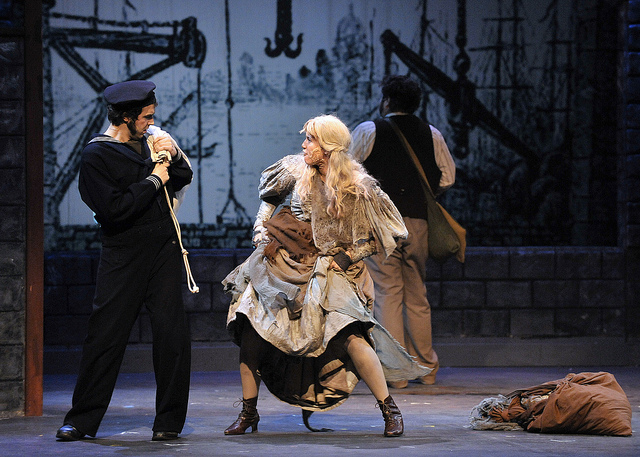
In a time when Hollywood is producing gritty remakes of well nigh everything, it might be appropriate to look back at one of my favorite works on how to live in an irrevocable corrupt world. Today, at Ethika Politika, I’m discussing the tragic love that the Demon Barber of Fleet Street still bears the Moral Law in Sweeney Todd.
Bond’s Sweeney, when confronted by bloodshed, has a tendency to sound like an office worker, supremely distanced from his work, discussing his killings in the language of necessity. When contemplating Johanna-in-disguise’s imminent death, he uses only the passive voice, saying, “Here’s another must complete the score … He forces me to hurry … he must die.” This Sweeney avoids statements that would acknowledge his own agency like “I will” or “I choose.” Instead of the Demon Barber promised in the title, Bond’s Todd more closely resembles the little Eichmanns described by Hannah Arendt. There is a banality to his evil that lets him see it as separate from himself and his identity.
Ultimately, Bond’s Sweeney believes that he can shuck off his Sweeney persona as easily as he put it on. After the murder of the Judge, Todd sheathes his razors and declares, “Now that my vengeance is assuaged I long to see Johanna.” This line could never be delivered by Sondheim’s Sweeney. Unlike Bond’s murderer, Sondheim’s Sweeney understands that the evil he embraces will warp him and prevent him ever seeing his daughter again. In “Epiphany,” the song in which Sweeney decides he will kill at will, rather than only destroying the Beadle and the Judge, he declares, “We all deserve to die./And I’ll never see Johanna/No I’ll never hug my girl to me—finished!” Although most of the song is performed in a desperate rasp, in these sections, the music drops into a resonant register and is sung more sweetly, symbolizing the humanity Sweeney is putting aside. His decision to kill sunders him from his morally pure daughter.
In order to adapt the essay for the web (it’s based on a paper I wrote in a college Sondheim seminar), I ended up getting rid of a digression in the footnotes, so let’s just say it’s exclusive content for you blog readers. After saying that “The mass of people at the pie shop richly deserve the Greek epithet of ‘mere bellies.'” I was pleased to be able to cite the source in which I learned that phrase: Lewis Hyde’s Trickster Makes This World: Mischief, Myth, and Art.
I loved Hyde’s book, was pleased to get to cite it, and couldn’t resist adding some quotes in my footnote. So, here they are for you:
[1]“At the beginning of Hesiod’s Theogony, the Muses come down from Mount Helicon and speak to the poet… and address [him] with scorn—‘Shepherds living in the fields, base objects of reproach, mere bellies!’—and go on to point out how different are those who live on the high mountain: ‘We know how to say many falsehoods that look like genuine things, but we can also… proclaim true things.’
“The Muses believe human beings are unlikely to tell the truth because they are ‘mere bellies,’ ridden by their appetite.” (excerpted from Trickster Makes this World: Mischief, Myth, and Art by Lewis Hyde, p. 66).
[2] “Trickster lies because he has a belly, the stories say; expect truth only from those whose belly is full or those who have escaped the belly altogether.” (Ibid, p. 77).
Turns out that the “mere bellies” epithet has some interesting connections to Richard Beck’s The Slavery of Death (which would make for excellent Lenten reading, if you’re interested), but I’ll hold off on that point for its own post.
DarwinCatholic is praying a novena for Ordering Lives Wisely by St. Thomas Aquinas, that will end on Ash Wednesday. If you’d like to join her and me, you can find the prayers here.
Previous Post

March 2, 2014
Looking toward Lent with St. Ulrich
Next Post

March 4, 2014 Sex as a How Do You Do?
Browse Our Archives
Select a Category 7 Quick Takes Apologetics Atheism Book Conversion Debate Tactics Debates Epistemology/Philosophy Housekeeping Ideological Turing Test Marriage Morality in Practice Parsing Catholicism Possibly Heretical Radio Reviews/Recommendations Sequence Index Spiritual Practice Uncategorized
Select a Month April 2017 March 2017 January 2017 December 2016 September 2016 August 2016 July 2016 June 2016 May 2016 April 2016 March 2016 February 2016 January 2016 December 2015 November 2015 October 2015 September 2015 August 2015 July 2015 June 2015 May 2015 April 2015 March 2015 February 2015 January 2015 December 2014 November 2014 October 2014 September 2014 August 2014 July 2014 June 2014 May 2014 April 2014 March 2014 February 2014 January 2014 December 2013 November 2013 October 2013 September 2013 August 2013 July 2013 June 2013 May 2013 April 2013 March 2013 February 2013 January 2013 December 2012 November 2012 October 2012 September 2012 August 2012 July 2012 June 2012 May 2012 April 2012 March 2012 February 2012 January 2012 December 2011 November 2011 October 2011 September 2011 August 2011 July 2011 June 2011 May 2011 April 2011 March 2011 February 2011 January 2011 December 2010 November 2010 October 2010 September 2010 August 2010 July 2010 June 2010
Follow Us!
TAKE THE
Religious Wisdom Quiz
If you show me, you will show your faith. Without me, faith is dead. What am I?
Select your answer to see how you score.
Love Works Prayer Obedience
Related posts from Unequally Yoked



The Boring, Quiet Rituals That Sustain Us Spiritually

Starving Laypeople of Devotion in Church
TRENDING AT PATHEOS Catholic

Creation, Preservation, and Teleology in Catholic Theology
As I write this, it is very early Monday morning. Like millions...

The Parable Of The Sower And The Word...
One of Christ’s most famous parables is that of the sower who...

Rejecting Doom: Christian Hope And Human Action
Christianity is a religion of hope. We are to have hope and...

Why I Choose the Eucharist Over the Sermon
Choose the Eucharist, Not the Sermon What are we supposed to get...

5 Design Elements Found in Spiritually Rooted Homes
Putting Spirituality Into Home Decor Our homes are more than our living...

Credo: A Story of God Told with the...
About 10 years ago, I began to imagine a personal "Credo" that...
view all Catholic blogs
Ad-Free & Subscriber Log-In Subscription Support
- About Us
- 2026 Calendar
- Videos
- Podcasts
- Library of World Religions
- Faith In Media Tracker
- Advertise With Us
- Write for Us
- Privacy Policy
- Terms of Service
- Do Not Sell My Data
- Contact Us
- Radiant Digital
- Manage Newsletter Subscriptions
- Unsubscribe From Notifications
- Sitemap
Copyright 2008-2026, Patheos. All rights reserved.
Subscription Support Ad-Free & Subscriber Log-In
Follow Patheos