
BuddhistCatholicContemplativeEvangelicalGeneral ChristianHinduJewishLatter-day SaintMuslimNew VisionsProgressive Christian
Beliefs
- Buddhist
- Catholic
- Contemplative
- Evangelical
- General Christian
- Hindu
- Jewish
- Latter-day Saint
- More Voices
- Muslim
- New Visions
- Pagan
- Progressive Christian
Topics
- Religion News
- Food and Religion
- Sports and Religion
- Religious Art
- Religious Music and Entertainment
- Religious Events
- History and Religion
- Style and Religion
- Politics and Religion
- Women in Religion
- Recreation Outdoors and Religion
- Business Finance and Religion
- Careers Workplace and Religion
- Education and Religion
- Family Parenting and Religion
- Health Fitness and Religion
- Home and Religion
- Relationships and Religion
- Technology and Religion
- Travel and Religion
Columnists
- Buddhist Columnists
- Business Finance and Religion Columnists
- Careers Workplace and Religion Columnists
- Catholic Columnists
- Contemplative Columnists
- Education and Religion Columnists
- Evangelists Columnists
- Family Parenting and Religion Columnists
- General Christian Columnists
- Health Fitness and Religion Columnists
- Hindu Columnists
- History and Religion Columnists
- Home and Religion Columnists
- Jewish Columnists
- More Voices Columnists
- Latter Day Columnists
- Muslim Columnists
- New Visions Columnists
- Nonreligious Columnists
- Pagan Columnists
- Politics and Religion Columnists
- Progressive Columnists
- Recreation Outdoors and Religion Columnists
- Relationships and Religion Columnists
- Religion News Columnists
- Religious Art Columnists
- Religious Events Columnists
- Religious Music and Entertainment Columnists
- Sports and Religion Columnists
- Style and Religion Columnists
- Technology and Religion Columnists
- Travel and Religion Columnists
- Women in Religion Columnists
Resource Library
- 2026 Calendar
- Library of World Religions
- The 100 Most Holy Places on Earth
- Patheos Answers
- Podcasts
- Videos
- Faith Leaders Database
- Anglican Episcopalian
- Bahai
- Baptist
- Buddhism
- Christianity
- Confucianism
- Eastern Orthodoxy
- Hinduism
- Holiness and Pentecostal
- ISKCON
- Islam
- Judaism
- Lutheran
- Methodist
- The Church of Jesus Christ of Latter-day Saints
- New Age
- Paganism
- Presbytarian and Reformed
- Protestantism
- Religion Behind the Scenes
- Roman Catholic
- Scientology
- Shia Islam
- Sikhism
- Sufism
- Sunni Islam
- Taoism
- Zen
- See all religions
Research Tools
 Ad-Free & Subscriber Log-In Subscription Support
Ad-Free & Subscriber Log-In Subscription Support
Follow Patheos 

- Trending:
- Forgiveness
- |
- Marriage
- |
- Consciousness
- |
- Death Penalty
- |
- Election
- |
- Halloween
 Unequally Yoked
- Home
- Catholic
- Mammograms, University Lapses, and the Limits of Big Data
Mammograms, University Lapses, and the Limits of Big Data
Last updated on: February 22, 2014 at 12:11 pm by Leah Libresco
Mammograms, University Lapses, and the Limits of Big Data 2014-02-22T12:11:32-05:00 Leah Libresco
Patheos Explore the world's faith through different perspectives on religion and spirituality! Patheos has the views of the prevalent religions and spiritualities of the world.
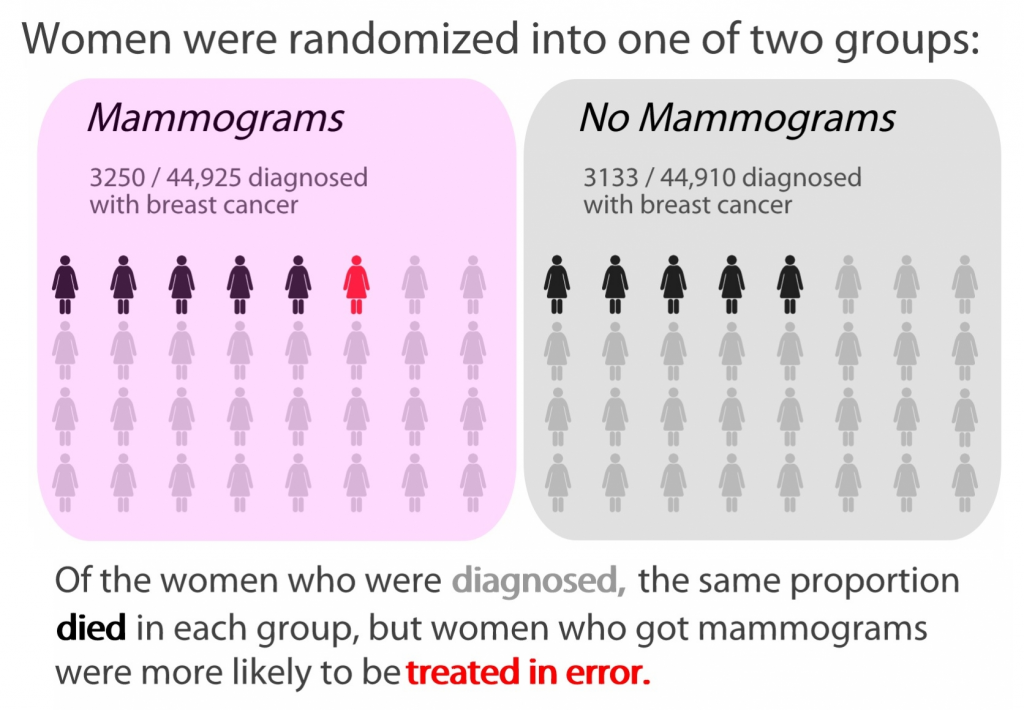
Over at my day job, I’ve gotten to write about two of my major hobbyhorses recently. First in “Did We Mess Up on Mammograms?” I got to gloss the big study on the efficacy of breast cancer screening, nerd out about history/philosophy of medicine, and design an infographic.
While we remain torn between the old recommendation and the new, it’s tempting to stick which the more interventionist option. Doctors and patients would like the comfort of knowing they did something even if what they did wasn’t very good. In fact, breast cancer treatment, as well as its diagnosis, has fallen prey to this rationale.
Women used to receive the Halstead procedure, a particularly radical form of mastectomy in which the doctor would remove the breast, underlying chest muscle, and even, sometimes, muscle in the neck and arm. William Steward Halstead performed the operation in good faith, thinking it was better to do everything he could for his patients, seeking to make the extremity of his surgery match the intensity of his intentions.
The same diseased thinking spreads through our body politic. War hawks accuse non-interventionists of being indifferent to humanitarian causes or national interest, when, in fact, the most ballistically satisfying solution may do more to calm our nerves than to quiet regional tensions. Politicians, like medical regulatory boards, become fearful of admitting that facts on the ground have changed since they made a decision, and the employer mandate doesn’t make much sense in a slack labor market.
And here’s the infographic:
Meanwhile, this week, I made a connection between the rape allegations at Patrick Henry College and the broader issue of “How Universities Fail Students in Crisis” and, unfortunately, having plenty of examples from my own alma mater to draw upon:
When students at my alma mater discussed the mental health or sexual assault resources, it might have sounded like we were cribbing from the “Never Ever Talk to the Police” lecture by Professor James Duane of the Regent University School of Law that was taking a tour of campuses. You’re talking to someone who’s job is to safeguard the community, not you, if, in their opinion, you present a legal, physical, or reputational risk to the institution…
Students who seek help, especially students suffering from mental health issue or the lingering trauma of rape, are rolling the dice that the counselor assigned to them will be willing to take a risk on their recovery, instead of limiting the liability of their school.
And I also evaluated the new GOP push to finally use Big Data in their election efforts, and even used a sports metaphor, in “Republicans Try to Bridge the Big Data Gap.”
The Democrats’ playbook resembled the sabermetric approach of Billy Beane, the Oakland A’s coach profiled in Moneyball. By taking a finer-grained approach to a market (of persuadable voters, in the Democrats case, of free agents and draftees, in Beane’s), the quants were able to steal a march on their opponents.
But Billy Beane’s Oakland A’s only benefited from his Moneyball strategies for a few seasons before the rest of the league caught up, and his advantage didn’t last long enough to reach the World Series. His data-intensive approach only helped as long as players were systematically mispriced. Once the other general managers wised up, the market for players settled into a new equilibrium and the richer teams were able to outbid their rivals for better players.
And, speaking of Big Data, I’ve taken on a volunteer comms role at Code for DC, so I’ll sometimes be reporting on the projects these programmers are building to serve our local community. I just did a post to celebrate Open Data Day and profile some of the projects in development.
Previous Post

February 21, 2014
Of Love, Spiders, and Natural Law
Next Post

February 23, 2014 Mercy is Not Intransitive
Browse Our Archives
Select a Category 7 Quick Takes Apologetics Atheism Book Conversion Debate Tactics Debates Epistemology/Philosophy Housekeeping Ideological Turing Test Marriage Morality in Practice Parsing Catholicism Possibly Heretical Radio Reviews/Recommendations Sequence Index Spiritual Practice Uncategorized
Select a Month April 2017 March 2017 January 2017 December 2016 September 2016 August 2016 July 2016 June 2016 May 2016 April 2016 March 2016 February 2016 January 2016 December 2015 November 2015 October 2015 September 2015 August 2015 July 2015 June 2015 May 2015 April 2015 March 2015 February 2015 January 2015 December 2014 November 2014 October 2014 September 2014 August 2014 July 2014 June 2014 May 2014 April 2014 March 2014 February 2014 January 2014 December 2013 November 2013 October 2013 September 2013 August 2013 July 2013 June 2013 May 2013 April 2013 March 2013 February 2013 January 2013 December 2012 November 2012 October 2012 September 2012 August 2012 July 2012 June 2012 May 2012 April 2012 March 2012 February 2012 January 2012 December 2011 November 2011 October 2011 September 2011 August 2011 July 2011 June 2011 May 2011 April 2011 March 2011 February 2011 January 2011 December 2010 November 2010 October 2010 September 2010 August 2010 July 2010 June 2010
Follow Us!
TAKE THE
Religious Wisdom Quiz
Who said, "Your people will be my people and your God my God"?
Select your answer to see how you score.
Ruth Bathsheba Leah Esther
Related posts from Unequally Yoked

Running the numbers on smokers, migrants, cancer, and...
I've taken a job at FiveThirtyEight!

Plato Disappoints at the Googleplex

Amazon Foreshadows Internet Fights to Come
TRENDING AT PATHEOS Catholic

Creation, Preservation, and Teleology in Catholic Theology
As I write this, it is very early Monday morning. Like millions...

The Parable Of The Sower And The Word...
One of Christ’s most famous parables is that of the sower who...

Rejecting Doom: Christian Hope And Human Action
Christianity is a religion of hope. We are to have hope and...

Why I Choose the Eucharist Over the Sermon
Choose the Eucharist, Not the Sermon What are we supposed to get...

5 Design Elements Found in Spiritually Rooted Homes
Putting Spirituality Into Home Decor Our homes are more than our living...

Credo: A Story of God Told with the...
About 10 years ago, I began to imagine a personal "Credo" that...
view all Catholic blogs
Ad-Free & Subscriber Log-In Subscription Support
- About Us
- 2026 Calendar
- Videos
- Podcasts
- Library of World Religions
- Faith In Media Tracker
- Advertise With Us
- Write for Us
- Privacy Policy
- Terms of Service
- Do Not Sell My Data
- Contact Us
- Radiant Digital
- Manage Newsletter Subscriptions
- Unsubscribe From Notifications
- Sitemap
Copyright 2008-2026, Patheos. All rights reserved.
Subscription Support Ad-Free & Subscriber Log-In
Follow Patheos