
BuddhistCatholicContemplativeEvangelicalGeneral ChristianHinduJewishLatter-day SaintMuslimNew VisionsProgressive Christian
Beliefs
- Buddhist
- Catholic
- Contemplative
- Evangelical
- General Christian
- Hindu
- Jewish
- Latter-day Saint
- More Voices
- Muslim
- New Visions
- Pagan
- Progressive Christian
Topics
- Religion News
- Food and Religion
- Sports and Religion
- Religious Art
- Religious Music and Entertainment
- Religious Events
- History and Religion
- Style and Religion
- Politics and Religion
- Women in Religion
- Recreation Outdoors and Religion
- Business Finance and Religion
- Careers Workplace and Religion
- Education and Religion
- Family Parenting and Religion
- Health Fitness and Religion
- Home and Religion
- Relationships and Religion
- Technology and Religion
- Travel and Religion
Columnists
- Buddhist Columnists
- Business Finance and Religion Columnists
- Careers Workplace and Religion Columnists
- Catholic Columnists
- Contemplative Columnists
- Education and Religion Columnists
- Evangelists Columnists
- Family Parenting and Religion Columnists
- General Christian Columnists
- Health Fitness and Religion Columnists
- Hindu Columnists
- History and Religion Columnists
- Home and Religion Columnists
- Jewish Columnists
- More Voices Columnists
- Latter Day Columnists
- Muslim Columnists
- New Visions Columnists
- Nonreligious Columnists
- Pagan Columnists
- Politics and Religion Columnists
- Progressive Columnists
- Recreation Outdoors and Religion Columnists
- Relationships and Religion Columnists
- Religion News Columnists
- Religious Art Columnists
- Religious Events Columnists
- Religious Music and Entertainment Columnists
- Sports and Religion Columnists
- Style and Religion Columnists
- Technology and Religion Columnists
- Travel and Religion Columnists
- Women in Religion Columnists
Resource Library
- 2026 Calendar
- Library of World Religions
- The 100 Most Holy Places on Earth
- Patheos Answers
- Podcasts
- Videos
- Faith Leaders Database
- Anglican Episcopalian
- Bahai
- Baptist
- Buddhism
- Christianity
- Confucianism
- Eastern Orthodoxy
- Hinduism
- Holiness and Pentecostal
- ISKCON
- Islam
- Judaism
- Lutheran
- Methodist
- The Church of Jesus Christ of Latter-day Saints
- New Age
- Paganism
- Presbytarian and Reformed
- Protestantism
- Religion Behind the Scenes
- Roman Catholic
- Scientology
- Shia Islam
- Sikhism
- Sufism
- Sunni Islam
- Taoism
- Zen
- See all religions
Research Tools
 Ad-Free & Subscriber Log-In Subscription Support
Ad-Free & Subscriber Log-In Subscription Support
Follow Patheos 

- Trending:
- Forgiveness
- |
- Marriage
- |
- Consciousness
- |
- Death Penalty
- |
- Election
- |
- Halloween
 Unequally Yoked
- Home
- Catholic
- Rolling Stone Misses the Source of Francis’s Joy
Rolling Stone Misses the Source of Francis’s Joy
Last updated on: January 29, 2014 at 11:45 am by Leah Libresco
Rolling Stone Misses the Source of Francis’s Joy 2014-01-29T11:45:52-05:00 Leah Libresco
Patheos Explore the world's faith through different perspectives on religion and spirituality! Patheos has the views of the prevalent religions and spiritualities of the world.
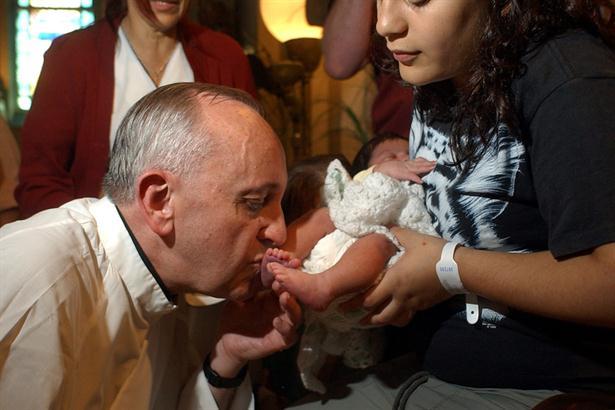
The Rolling Stone cover story on Pope Francis is frustrating. A big, researched feature piece should be better fact checked than to repeat misconceptions about the Pope’s “near absolute” power and to imply that the Pope is frequently infallible or, worse, all knowing. The author is a bit distant from Pope Francis himself, mostly using him as a cudgel to beat Pope Benedict, Cardinal Dolan, Opus Dei, and others.
The profile makes Francis, and his alleged antagonists both bigger and smaller than life. They become archetypes, instead of people. Benedict is described as “a staunch traditionalist who looked like he should be wearing a striped shirt with knife-fingered gloves and menacing teenagers in their nightmares.” Benedict certainly wasn’t as smiley, but there is palpable joy (albeit bookish — wait, why would that ever be tempered with ‘albeit?) in his three-volume reflection on the life of Christ (The Infancy Narratives, From the Baptism in the Jordan to the Transfiguration, Holy Week: From the Entrance Into Jerusalem To The Resurrection).
The author of the profile seems a more ready foil to Pope Francis’s personal, generous approach. In his interviews, Pope Francis talks about himself as a sinner, and his introspection seems to fuel his sympathy for and joy in others. If Pope Francis had written this feature, I imagine it would have been a lot longer, with frequent digressions, a fascination with each subject, and an effort to appreciate the good they sought, even if correction was needed. But, ultimately, the mismatch between the subject of the piece and its tone left me feeling jangled.
Though I did really like this excerpt:
Eventually, he moves to greet the crowd. Benedict, a dour academic, kept this portion of the general audience to a minimum. But Francis, like Bill Clinton, thrives on personal contact, and he spends the better part of an hour greeting believers. Next to the dais, a rowdy hometown team of Italians, a couple of whom spoke loudly on their cellphones throughout the pope’s sermon, have their cameras out like paparazzi. “Papa Francesco! Papa Francesco!” they shout, shrilly and incessantly, trying to get the Holy Father of the Catholic Church to gaze in their direction. The most shameless hold up children. “Papa Francesco!” they cry. “I bambini! I bambini!”
Because of course the crowd knows that Pope Francis can be easily summoned by babies. Even better if you’re feeding them.
Instead of the Rolling Stone profile, I heartily recommend today’s post on Dominicana by Br. Innocent Smith. The media have been fascinated by Pope Francis’s tendency to carry his own briefcase, but Br. Innocent reflects on the contents of the valise:
A week later, when asked by a journalist what was in the now famous briefcase, Pope Francis responded with characteristic good humor:
It wasn’t the key for the atom bomb! Well! I was carrying it because that’s what I’ve always done. When I travel, I carry it. And inside, what was there? There was a razor, a breviary, an appointment book, a book to read, I brought one about Saint Thérèse, to whom I have a devotion. I have always taken a bag with me when travelling—it’s normal. But we must be normal…I don’t know…what you say is a bit strange for me, that the photograph went all over the world. But we must get used to being normal. The normality of life.
…The attention of the public may have been caught by the briefcase, but I am more intrigued by the breviary. As a cleric and religious, Pope Francis is obliged to recite the Divine Office (also known as the Liturgy of the Hours), a form of Catholic prayer that is contained in a book frequently referred to as a “breviary.” The breviary is a collection of psalms, prayers, scriptural readings, and writings of the Fathers and saints of the Church. These different elements are arranged to be sung or read at different times throughout the day in a cycle that parallels the different seasons and feasts observed in the Mass. The recitation of the breviary immerses the reader into the Bible and the spiritual tradition of the Church, allowing the reader to be nourished not only by the readings and prayers of the Mass but also by a whole constellation of psalms and prayers that extend the praise and thanksgiving of the Mass throughout the whole day.
For Pope Francis, reciting the breviary, like carrying a briefcase, is something normal—after all, he’s been doing it for more than fifty years! In addition to its being part of the normality of life, the Pope has indicated that praying the Divine Office is something he enjoys: “I pray the breviary every morning. I like to pray with the psalms.”
That is what I like best about Pope Francis. He makes joy and charity look normal, until the most surprising thing is that we ever came to believe this spirit wasn’t our natural inheritance. But he isn’t just a good man for generic reasons; he connects back his kindness and hope to his faith, and to the rich spiritual traditions of the church. And, once again, makes this look as natural as turning at a cry of “I bambini!”
This is part of why I asked you for advice about how to talk about my religion when someone asks me a question that is, to them, unrelated. There’s a lovely honesty in Pope Francis’s approach, where his faith spills out of him as immediately as his joy. There are plenty of jokes about his tendency to sound unfiltered when he gives interviews, but this openness seems to be the fruit of being so true internally that he “cannot then be false to any man.” As someone who’s a good deal more distant and guarded, I’d like to have the ability to share my happiness at Pope Francis’s level of person-to-person communion, but I think I more closely resemble the Rolling Stone writer.
Previous Post
January 28, 2014
Feasting with the Angelic Doctor
Next Post
January 30, 2014 Starving for Communal Spaces and Communion
Browse Our Archives
Select a Category 7 Quick Takes Apologetics Atheism Book Conversion Debate Tactics Debates Epistemology/Philosophy Housekeeping Ideological Turing Test Marriage Morality in Practice Parsing Catholicism Possibly Heretical Radio Reviews/Recommendations Sequence Index Spiritual Practice Uncategorized
Select a Month April 2017 March 2017 January 2017 December 2016 September 2016 August 2016 July 2016 June 2016 May 2016 April 2016 March 2016 February 2016 January 2016 December 2015 November 2015 October 2015 September 2015 August 2015 July 2015 June 2015 May 2015 April 2015 March 2015 February 2015 January 2015 December 2014 November 2014 October 2014 September 2014 August 2014 July 2014 June 2014 May 2014 April 2014 March 2014 February 2014 January 2014 December 2013 November 2013 October 2013 September 2013 August 2013 July 2013 June 2013 May 2013 April 2013 March 2013 February 2013 January 2013 December 2012 November 2012 October 2012 September 2012 August 2012 July 2012 June 2012 May 2012 April 2012 March 2012 February 2012 January 2012 December 2011 November 2011 October 2011 September 2011 August 2011 July 2011 June 2011 May 2011 April 2011 March 2011 February 2011 January 2011 December 2010 November 2010 October 2010 September 2010 August 2010 July 2010 June 2010
Follow Us!
TAKE THE
Religious Wisdom Quiz
Which book of the Bible contains the most chapters of any prophetic book?
Select your answer to see how you score.
Ezekiel Jeremiah Daniel Isaiah
Related posts from Unequally Yoked
How To Offer Community Without Communion

It's Hard To Be A Priest In America,...
A Dominican Invitation to Witness [Saints Bookclub]
Running the (Terrible for Catholics) Numbers on Conversion
TRENDING AT PATHEOS Catholic

Rejecting Doom: Christian Hope And Human Action
Christianity is a religion of hope. We are to have hope and...

It’s What Comes From Within Which Matters
One of the most difficult things for us to understand is why...

Why I Choose the Eucharist Over the Sermon
Choose the Eucharist, Not the Sermon What are we supposed to get...

5 Design Elements Found in Spiritually Rooted Homes
Putting Spirituality Into Home Decor Our homes are more than our living...

Credo: A Story of God Told with the...
About 10 years ago, I began to imagine a personal "Credo" that...

The Anatomy of Divine Revelation in Catholic Thought
The claim that God has made Himself known to human beings is...
view all Catholic blogs
Ad-Free & Subscriber Log-In Subscription Support
- About Us
- 2026 Calendar
- Videos
- Podcasts
- Library of World Religions
- Faith In Media Tracker
- Advertise With Us
- Write for Us
- Privacy Policy
- Terms of Service
- Do Not Sell My Data
- Contact Us
- Radiant Digital
- Manage Newsletter Subscriptions
- Unsubscribe From Notifications
- Sitemap
Copyright 2008-2026, Patheos. All rights reserved.
Subscription Support Ad-Free & Subscriber Log-In
Follow Patheos