
BuddhistCatholicContemplativeEvangelicalGeneral ChristianHinduJewishLatter-day SaintMuslimNew VisionsProgressive Christian
Beliefs
- Buddhist
- Catholic
- Contemplative
- Evangelical
- General Christian
- Hindu
- Jewish
- Latter-day Saint
- More Voices
- Muslim
- New Visions
- Pagan
- Progressive Christian
Topics
- Religion News
- Food and Religion
- Sports and Religion
- Religious Art
- Religious Music and Entertainment
- Religious Events
- History and Religion
- Style and Religion
- Politics and Religion
- Women in Religion
- Recreation Outdoors and Religion
- Business Finance and Religion
- Careers Workplace and Religion
- Education and Religion
- Family Parenting and Religion
- Health Fitness and Religion
- Home and Religion
- Relationships and Religion
- Technology and Religion
- Travel and Religion
Columnists
- Buddhist Columnists
- Business Finance and Religion Columnists
- Careers Workplace and Religion Columnists
- Catholic Columnists
- Contemplative Columnists
- Education and Religion Columnists
- Evangelists Columnists
- Family Parenting and Religion Columnists
- General Christian Columnists
- Health Fitness and Religion Columnists
- Hindu Columnists
- History and Religion Columnists
- Home and Religion Columnists
- Jewish Columnists
- More Voices Columnists
- Latter Day Columnists
- Muslim Columnists
- New Visions Columnists
- Nonreligious Columnists
- Pagan Columnists
- Politics and Religion Columnists
- Progressive Columnists
- Recreation Outdoors and Religion Columnists
- Relationships and Religion Columnists
- Religion News Columnists
- Religious Art Columnists
- Religious Events Columnists
- Religious Music and Entertainment Columnists
- Sports and Religion Columnists
- Style and Religion Columnists
- Technology and Religion Columnists
- Travel and Religion Columnists
- Women in Religion Columnists
Resource Library
- 2026 Calendar
- Library of World Religions
- The 100 Most Holy Places on Earth
- Patheos Answers
- Podcasts
- Videos
- Faith Leaders Database
- Anglican Episcopalian
- Bahai
- Baptist
- Buddhism
- Christianity
- Confucianism
- Eastern Orthodoxy
- Hinduism
- Holiness and Pentecostal
- ISKCON
- Islam
- Judaism
- Lutheran
- Methodist
- The Church of Jesus Christ of Latter-day Saints
- New Age
- Paganism
- Presbytarian and Reformed
- Protestantism
- Religion Behind the Scenes
- Roman Catholic
- Scientology
- Shia Islam
- Sikhism
- Sufism
- Sunni Islam
- Taoism
- Zen
- See all religions
Research Tools
 Ad-Free & Subscriber Log-In Subscription Support
Ad-Free & Subscriber Log-In Subscription Support
Follow Patheos 

- Trending:
- Forgiveness
- |
- Marriage
- |
- Consciousness
- |
- Death Penalty
- |
- Election
- |
- Halloween
 Unequally Yoked
- Home
- Catholic
- An Inheritance of Joy [Pope Francis bookclub]
An Inheritance of Joy [Pope Francis bookclub]
Last updated on: January 6, 2014 at 3:00 pm by Leah Libresco
An Inheritance of Joy [Pope Francis bookclub] 2014-01-06T15:00:21-05:00 Leah Libresco
Patheos Explore the world's faith through different perspectives on religion and spirituality! Patheos has the views of the prevalent religions and spiritualities of the world.
In 2014, I’m reading and blogging through Pope Francis/Cardinal Bergoglio’s Open Mind, Faithful Heart: Reflections on Following Jesus. Every Monday, I’ll be writing about the next meditation in the book, so you’re welcome to peruse them all and/or read along.
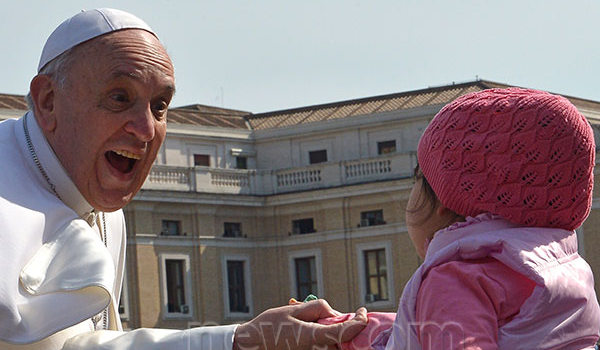
After the introductions, the prefaces, and the translator’s notes, the first two words I read by Pope Francis were “Apostolic joy.”
His reflections on living the Christian faith begins with this sentence:
Apostolic joy is nourished by the contemplation of Jesus Christ, that is, by observing how he moved about, how he preached, how he healed, how he saw the world… The heart of the priest should be steeped in this contemplation and through it resolve the main challenge of his life: his friendship with Jesus Christ.
In order to set us dialogue with Christ, Pope Francis begins by meditating on the kinds of conversations that Christ has in the Gospels. But before I move on the the main content of this chapter, I still want to linger on the opening words.
The main context in which I hear the slightly-jargony ‘apostolic’ is the Nicene Creed, when, at Mass, the congregation says that we believe in “one holy, catholic, and apostolic church.” So, as I use it, it’s a word about lineage and provenance. When we talk about something being apostolic, we mean something handed down carefully from the apostles to now, something safeguarded and precious.
It’s hard for me to not assume anything that important must be something solemn. Maybe something fiddly and detailed like canon law, maybe something mysterious and easy to be confused by, like the Trinity. But in the opening words of his book, Pope Francis reminds us that our birthright is joy as much as it is anything else. And we get an example of how we can stumblingly inherit that joy, when Pope Francis begins to narrate how Christ dealt in dialogue with those who sought to entrap him.
In Luke 20, some Sadducees ask Christ what would become of a woman who married the first of seven brothers, and then, when he died, married the next one in line, and so on and so forth, til she’d married and been widowed by them all. In the afterlife, would she be married to all of them? Just the first?
Francis writes that this question was not asked in good faith, and so,
[T]he Lord responds by looking toward the eschatological horizon… This ploy is so shameful that the Lord doesn’t even bother to argue with the tricksters: he responds by simply asserting the sublimity of the glorified life (Luke 20:27-40)
Jesus said to them, “Those who belong to this age marry and are given in marriage; but those who are considered worthy of a place in that age and in the resurrection from the dead neither marry nor are given in marriage. Indeed they cannot die anymore, because they are like angels and are children of God, being children of the resurrection. And the fact that the dead are raised Moses himself showed, in the story about the bush, where he speaks of the Lord as the God of Abraham, the God of Isaac, and the God of Jacob. Now he is God not of the dead, but of the living; for to him all of them are alive.” Then some of the scribes answered, “Teacher, you have spoken well.” For they no longer dared to ask him another question.
Even under interrogation, Christ is offering the inheritance of apostolic joy. Instead of responding in anger or withdrawing from the gotcha-conversation, He is pointing to something beyond the current conflict, a vision of joy and peace that makes the argument on the table seem small.
Whenever we are hemmed in in argument (theological or not), we always have the option to respond with joy. Instead to becoming angry or frightened in defense of the idea we are trying to protect, we can offer it to our interlocutor with joy, in the same way you hold out your favorite book to loan to a friend, or sneak sideways looks at your child, when showing them your favorite movie, hoping for an opportunity to share your joy.
When I am in this frame of mind, I’m not only taking the chance to kindle delight in my debating partner, but to strengthen my own happiness and raise it to the level of my attention. It’s why I love doing alumni interviews or organizing theatre trips.
When I’m in an argument or debate, I want to follow Christ’s example and try to offer the person the source of my joy, not a rebuke to their approach or a gotcha of my own. I want to offer them the truth or beauty I’m fighting to share, and see them take it up with joy, not to knuckle under on a technicality. And I want to approach disagreements in a way that makes it easy and inviting for my opponent to share their joy, so I can happily notice and admit when I’ve erred.
Previous Post
January 5, 2014
Missing the Cues for My Amens
Next Post
January 6, 2014 Reading through 2014 with Pope Francis [Index Post]
Browse Our Archives
Select a Category 7 Quick Takes Apologetics Atheism Book Conversion Debate Tactics Debates Epistemology/Philosophy Housekeeping Ideological Turing Test Marriage Morality in Practice Parsing Catholicism Possibly Heretical Radio Reviews/Recommendations Sequence Index Spiritual Practice Uncategorized
Select a Month April 2017 March 2017 January 2017 December 2016 September 2016 August 2016 July 2016 June 2016 May 2016 April 2016 March 2016 February 2016 January 2016 December 2015 November 2015 October 2015 September 2015 August 2015 July 2015 June 2015 May 2015 April 2015 March 2015 February 2015 January 2015 December 2014 November 2014 October 2014 September 2014 August 2014 July 2014 June 2014 May 2014 April 2014 March 2014 February 2014 January 2014 December 2013 November 2013 October 2013 September 2013 August 2013 July 2013 June 2013 May 2013 April 2013 March 2013 February 2013 January 2013 December 2012 November 2012 October 2012 September 2012 August 2012 July 2012 June 2012 May 2012 April 2012 March 2012 February 2012 January 2012 December 2011 November 2011 October 2011 September 2011 August 2011 July 2011 June 2011 May 2011 April 2011 March 2011 February 2011 January 2011 December 2010 November 2010 October 2010 September 2010 August 2010 July 2010 June 2010
Follow Us!
TAKE THE
Religious Wisdom Quiz
I saw the Promised Land from a mountain but was not allowed to enter it. Who am I?
Select your answer to see how you score.
Joshua Caleb Aaron Moses
Related posts from Unequally Yoked

Starting Conversations During Francis's Visit

Desiring Abundance of Life, Not Just Absence of...

Why Not Refer to ISIS by an Epithet?

Life Lessons that Can't be Taught at College's...
TRENDING AT PATHEOS Catholic

Rejecting Doom: Christian Hope And Human Action
Christianity is a religion of hope. We are to have hope and...

It’s What Comes From Within Which Matters
One of the most difficult things for us to understand is why...

Why I Choose the Eucharist Over the Sermon
Choose the Eucharist, Not the Sermon What are we supposed to get...

5 Design Elements Found in Spiritually Rooted Homes
Putting Spirituality Into Home Decor Our homes are more than our living...

Credo: A Story of God Told with the...
About 10 years ago, I began to imagine a personal "Credo" that...

The Anatomy of Divine Revelation in Catholic Thought
The claim that God has made Himself known to human beings is...
view all Catholic blogs
Ad-Free & Subscriber Log-In Subscription Support
- About Us
- 2026 Calendar
- Videos
- Podcasts
- Library of World Religions
- Faith In Media Tracker
- Advertise With Us
- Write for Us
- Privacy Policy
- Terms of Service
- Do Not Sell My Data
- Contact Us
- Radiant Digital
- Manage Newsletter Subscriptions
- Unsubscribe From Notifications
- Sitemap
Copyright 2008-2026, Patheos. All rights reserved.
Subscription Support Ad-Free & Subscriber Log-In
Follow Patheos