
BuddhistCatholicContemplativeEvangelicalGeneral ChristianHinduJewishLatter-day SaintMuslimNew VisionsProgressive Christian
Beliefs
- Buddhist
- Catholic
- Contemplative
- Evangelical
- General Christian
- Hindu
- Jewish
- Latter-day Saint
- More Voices
- Muslim
- New Visions
- Pagan
- Progressive Christian
Topics
- Religion News
- Food and Religion
- Sports and Religion
- Religious Art
- Religious Music and Entertainment
- Religious Events
- History and Religion
- Style and Religion
- Politics and Religion
- Women in Religion
- Recreation Outdoors and Religion
- Business Finance and Religion
- Careers Workplace and Religion
- Education and Religion
- Family Parenting and Religion
- Health Fitness and Religion
- Home and Religion
- Relationships and Religion
- Technology and Religion
- Travel and Religion
Columnists
- Buddhist Columnists
- Business Finance and Religion Columnists
- Careers Workplace and Religion Columnists
- Catholic Columnists
- Contemplative Columnists
- Education and Religion Columnists
- Evangelists Columnists
- Family Parenting and Religion Columnists
- General Christian Columnists
- Health Fitness and Religion Columnists
- Hindu Columnists
- History and Religion Columnists
- Home and Religion Columnists
- Jewish Columnists
- More Voices Columnists
- Latter Day Columnists
- Muslim Columnists
- New Visions Columnists
- Nonreligious Columnists
- Pagan Columnists
- Politics and Religion Columnists
- Progressive Columnists
- Recreation Outdoors and Religion Columnists
- Relationships and Religion Columnists
- Religion News Columnists
- Religious Art Columnists
- Religious Events Columnists
- Religious Music and Entertainment Columnists
- Sports and Religion Columnists
- Style and Religion Columnists
- Technology and Religion Columnists
- Travel and Religion Columnists
- Women in Religion Columnists
Resource Library
- 2026 Calendar
- Library of World Religions
- The 100 Most Holy Places on Earth
- Patheos Answers
- Podcasts
- Videos
- Faith Leaders Database
- Anglican Episcopalian
- Bahai
- Baptist
- Buddhism
- Christianity
- Confucianism
- Eastern Orthodoxy
- Hinduism
- Holiness and Pentecostal
- ISKCON
- Islam
- Judaism
- Lutheran
- Methodist
- The Church of Jesus Christ of Latter-day Saints
- New Age
- Paganism
- Presbytarian and Reformed
- Protestantism
- Religion Behind the Scenes
- Roman Catholic
- Scientology
- Shia Islam
- Sikhism
- Sufism
- Sunni Islam
- Taoism
- Zen
- See all religions
Research Tools
 Ad-Free & Subscriber Log-In Subscription Support
Ad-Free & Subscriber Log-In Subscription Support
Follow Patheos 

- Trending:
- Forgiveness
- |
- Marriage
- |
- Consciousness
- |
- Death Penalty
- |
- Election
- |
- Halloween
 Unequally Yoked
- Home
- Catholic
- 7 Quick Takes (1/24/14)
7 Quick Takes (1/24/14)
Last updated on: January 24, 2014 at 1:06 am by Leah Libresco
7 Quick Takes (1/24/14) 2014-01-24T01:06:44-05:00 Leah Libresco
Patheos Explore the world's faith through different perspectives on religion and spirituality! Patheos has the views of the prevalent religions and spiritualities of the world.

— 1 —
This weeks links are all about love and storytelling (as if there’s a difference). First up, a story I found charming about a geek who decided to datamine his way to OkCupid success:
OkCupid’s algorithms use only the questions that both potential matches decide to answer, and the match questions McKinlay had chosen—more or less at random—had proven unpopular. When he scrolled through his matches, fewer than 100 women would appear above the 90 percent compatibility mark. And that was in a city containing some 2 million women (approximately 80,000 of them on OkCupid). On a site where compatibility equals visibility, he was practically a ghost.
He realized he’d have to boost that number. If, through statistical sampling, McKinlay could ascertain which questions mattered to the kind of women he liked, he could construct a new profile that honestly answered those questions and ignored the rest. He could match every woman in LA who might be right for him, and none that weren’t…
He text-mined the two clusters to learn what interested them; teaching turned out to be a popular topic, so he wrote a bio that emphasized his work as a math professor. The important part, though, would be the survey. He picked out the 500 questions that were most popular with both clusters. He’d already decided he would fill out his answers honestly—he didn’t want to build his future relationship on a foundation of computer-generated lies. But he’d let his computer figure out how much importance to assign each question, using a machine-learning algorithm called adaptive boosting to derive the best weightings.
You’ll have to read the article yourself to see if his mathematical approach paid off.
— 2 —
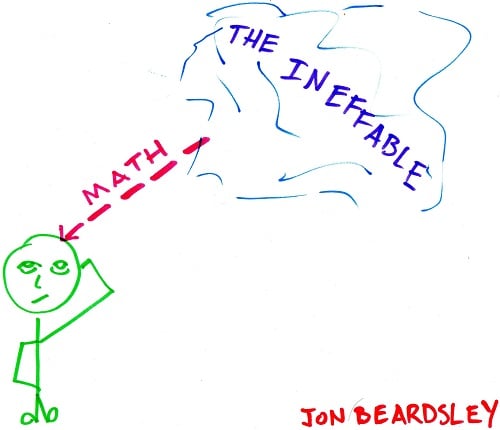
Meanwhile, perennial favorite Math With Bad Drawings also cast a wide net recently, asking passerby at a math conference to illustrate why they loved math in a single sheet of paper. He has 39 images up in his gallery, but this was one of my favorites.
— 3 —
But perhaps you’re not in love with math. Perhaps you find it hard to date and settle down with any academic discipline.
Then you might enjoy this choral rendition of “Every Major’s Terrible” performed by the Simon Fraser University Choir and inspired by this XKCD.
— 4 —
The song doesn’t bemoan extracurriculars, and I found a delightful little article related to one of mine: Dungeons and Dragons. Tony DiTerlizzi explains that a bunch of Prehistoric Animal figurines wound up being the inspiration for many of the inhabitants of the Monster Manual:
There once was an unknown company in Hong Kong that made a bag of weird animal-things that were then sold in what once were called dime stores or variety stores for like $.99. I know of four other very early monsters based on them. Gary and I talked about how hard it was to find monster figures, and how one day he came upon this bag of weird beasts…He nearly ran home, eager as a kid to get home and open his baseball cards. Then he proceeded to invent the carrion crawler, umber hulk, rust monster and purple worm, all based on those silly plastic figures. The one that I chose was known in the Greyhawk campaign as “the bullet” (for it’s shape) but had only amorphous stats and abilities, not being developed. Gary told me to take it home, study it, and decide what it was and what it could do.
Alas, no mention of my favorite figurine in my friends’ set of minatures: the Abyssal Maw.

Isn’t it adorable?
— 5 —
I’ve been completely uninterested in The Wolf of Wall Street, but Max Gladstone has an essay up that has me intrigued for the first time since the trailers hit.
So, am I giving monarch-apologist fiction a free pass? No. The spiritual self-rule I’m talking about (which by the way also plays nice with Christian theology; if you think what I’m describing sounds awfully prideful I humbly submit to you Augustine’s discussion about standing upright in The City of God, not to mention Dostoyevsky’s Grand Inquisitor scene from Bros. K) is the absolute reality; secular kingship is the shadow that reality casts on the cave wall. To play in this territory, stories need to guide the reader away from the shadow, to the reality. To make Arthur a secular Christ, storytellers gave him a mystic birth, a wizard advisor, draconic signifiers, a magical sword, tragedy and destiny and the Holy Grail and Green Men and all the like precisely because these things were weird. These are symbols that Arthur exists in the realm of the sublime, of the archetype—White’s “Island of Gramarye” where you and I shall fare.
No, no, it turns out be about The Wolf of Wall Street, I swear!
Wolf of Wall Street, I think, is a brilliant depiction of the Wasteland of the Evil King. In Belfort’s world, no one is old. In Belfort’s world, no one is wise. In Belfort’s world, there are no black people except for his female housekeeper. In Belfort’s world, women exist entirely for sex and money laundering—and (this is my favorite bit) he’s not even any good at the sex! Sexuality defines his physical life and the few times we see him get busy, he’s horrible at it. Like, fourteen-year-old-boy-in-back-of-Dad’s-Camero, “um-shit-where-does-this-bit-go” horrible. And at the apex of Belfort’s anti-initiation, the moment of grail-finding in a spiritual kingship narrative? He finds his Grail, the ur-Quaalude, consumes it and transforms into an infant, unable to speak or walk or even crawl, in one of the best sequences of physical comedy I’ve ever seen in a movie. For all the lushness of his surroundings, he inhabits a blasted land. (Come to think, he’s just as bad at drugs as he is at sex!)
— 6 —
I like some of Malcolm Gladwell’s writing, but I couldn’t help but be charmed by what kind of anecdotal data caused him to change his theory on religion (and head back toward the Mennonite faith of his childhood).
When I was writing my book David and Goliath, I went to see a woman in Winnipeg by the name of Wilma Derksen.
Thirty years before, her teenage daughter, Candace, had disappeared on her way home from school. The city had launched the largest manhunt in its history, and after a week, Candace’s body was found in a hut a quarter of a mile from the Derksen’s house. Her hands and feet had been bound.
Wilma and her husband Cliff were called in to the local police station and told the news. Candace’s funeral was the next day, followed by a news conference. Virtually every news outlet in the province was there because Candace’s disappearance had gripped the city.
“How do you feel about whoever did this to Candace?” a reporter asked the Derksens.
“We would like to know who the person or persons are so we could share, hopefully, a love that seems to be missing in these people’s lives,” Cliff said.
Wilma went next. “Our main concern was to find Candace. We’ve found her.” She went on: “I can’t say at this point I forgive this person,” but the stress was on the phrase at this point. “We have all done something dreadful in our lives, or have felt the urge to.”
— 7 —
Finally, I’d like to know if any of you can help my friend with a very specific book recommendation. Here’s what she wrote to me (apropos of a book that was starting to remind her of The Hunger Games):
I have had it with YA novels where the female protagonist becomes politically important Against Her Will, because she’s a Figurehead, and doesn’t have any Ambition (which is baaaaaad), but ends up getting Power anyway without having to do any Machination to get there. (Or she does, but only reluctantly, to stop being a Figurehead.)
There needs to be a YA sci-fi or fantasy novel where the female protagonist is an unapologetic Slytherin. Possibly also a princess, but that’s just me.
The first thing that came to my mind was Just Ella by Margaret Peterson Haddix (p.s. the new cover at the link is terrible, the one from when I was a kid is way less wussy). Beggars in Spain maybe fits the bill, too. And Princess Cimorene from Dealing With Dragons is someone I trust to get things done. Any other suggestions?
For more Quick Takes, visit Conversion Diary!
Previous Post

January 23, 2014
Pulling Off Casual Proselytization
Next Post

January 25, 2014 Here's your job. Don't get too comfortable.
Browse Our Archives
Select a Category 7 Quick Takes Apologetics Atheism Book Conversion Debate Tactics Debates Epistemology/Philosophy Housekeeping Ideological Turing Test Marriage Morality in Practice Parsing Catholicism Possibly Heretical Radio Reviews/Recommendations Sequence Index Spiritual Practice Uncategorized
Select a Month April 2017 March 2017 January 2017 December 2016 September 2016 August 2016 July 2016 June 2016 May 2016 April 2016 March 2016 February 2016 January 2016 December 2015 November 2015 October 2015 September 2015 August 2015 July 2015 June 2015 May 2015 April 2015 March 2015 February 2015 January 2015 December 2014 November 2014 October 2014 September 2014 August 2014 July 2014 June 2014 May 2014 April 2014 March 2014 February 2014 January 2014 December 2013 November 2013 October 2013 September 2013 August 2013 July 2013 June 2013 May 2013 April 2013 March 2013 February 2013 January 2013 December 2012 November 2012 October 2012 September 2012 August 2012 July 2012 June 2012 May 2012 April 2012 March 2012 February 2012 January 2012 December 2011 November 2011 October 2011 September 2011 August 2011 July 2011 June 2011 May 2011 April 2011 March 2011 February 2011 January 2011 December 2010 November 2010 October 2010 September 2010 August 2010 July 2010 June 2010
Follow Us!
TAKE THE
Religious Wisdom Quiz
Who was the king of Babylon during the exile of the Israelites?
Select your answer to see how you score.
Cyrus Nebuchadnezzar Belshazzar Darius
Related posts from Unequally Yoked

7QT: Fake Bears, Faker Weapons, and Austen

7QT: Moms, Pacifist Pilots, and other superheroes

7QT: Remixes, Underwear, & Fake Fingers

7QT: The Peculiar Virtues of Daredevil, Pool Table...
TRENDING AT PATHEOS Catholic

Rejecting Doom: Christian Hope And Human Action
Christianity is a religion of hope. We are to have hope and...

It’s What Comes From Within Which Matters
One of the most difficult things for us to understand is why...

Why I Choose the Eucharist Over the Sermon
Choose the Eucharist, Not the Sermon What are we supposed to get...

5 Design Elements Found in Spiritually Rooted Homes
Putting Spirituality Into Home Decor Our homes are more than our living...

Credo: A Story of God Told with the...
About 10 years ago, I began to imagine a personal "Credo" that...

The Anatomy of Divine Revelation in Catholic Thought
The claim that God has made Himself known to human beings is...
view all Catholic blogs
Ad-Free & Subscriber Log-In Subscription Support
- About Us
- 2026 Calendar
- Videos
- Podcasts
- Library of World Religions
- Faith In Media Tracker
- Advertise With Us
- Write for Us
- Privacy Policy
- Terms of Service
- Do Not Sell My Data
- Contact Us
- Radiant Digital
- Manage Newsletter Subscriptions
- Unsubscribe From Notifications
- Sitemap
Copyright 2008-2026, Patheos. All rights reserved.
Subscription Support Ad-Free & Subscriber Log-In
Follow Patheos