
BuddhistCatholicContemplativeEvangelicalGeneral ChristianHinduJewishLatter-day SaintMuslimNew VisionsProgressive Christian
Beliefs
- Buddhist
- Catholic
- Contemplative
- Evangelical
- General Christian
- Hindu
- Jewish
- Latter-day Saint
- More Voices
- Muslim
- New Visions
- Pagan
- Progressive Christian
Topics
- Religion News
- Food and Religion
- Sports and Religion
- Religious Art
- Religious Music and Entertainment
- Religious Events
- History and Religion
- Style and Religion
- Politics and Religion
- Women in Religion
- Recreation Outdoors and Religion
- Business Finance and Religion
- Careers Workplace and Religion
- Education and Religion
- Family Parenting and Religion
- Health Fitness and Religion
- Home and Religion
- Relationships and Religion
- Technology and Religion
- Travel and Religion
Columnists
- Buddhist Columnists
- Business Finance and Religion Columnists
- Careers Workplace and Religion Columnists
- Catholic Columnists
- Contemplative Columnists
- Education and Religion Columnists
- Evangelists Columnists
- Family Parenting and Religion Columnists
- General Christian Columnists
- Health Fitness and Religion Columnists
- Hindu Columnists
- History and Religion Columnists
- Home and Religion Columnists
- Jewish Columnists
- More Voices Columnists
- Latter Day Columnists
- Muslim Columnists
- New Visions Columnists
- Nonreligious Columnists
- Pagan Columnists
- Politics and Religion Columnists
- Progressive Columnists
- Recreation Outdoors and Religion Columnists
- Relationships and Religion Columnists
- Religion News Columnists
- Religious Art Columnists
- Religious Events Columnists
- Religious Music and Entertainment Columnists
- Sports and Religion Columnists
- Style and Religion Columnists
- Technology and Religion Columnists
- Travel and Religion Columnists
- Women in Religion Columnists
Resource Library
- 2026 Calendar
- Library of World Religions
- The 100 Most Holy Places on Earth
- Patheos Answers
- Podcasts
- Videos
- Faith Leaders Database
- Anglican Episcopalian
- Bahai
- Baptist
- Buddhism
- Christianity
- Confucianism
- Eastern Orthodoxy
- Hinduism
- Holiness and Pentecostal
- ISKCON
- Islam
- Judaism
- Lutheran
- Methodist
- The Church of Jesus Christ of Latter-day Saints
- New Age
- Paganism
- Presbytarian and Reformed
- Protestantism
- Religion Behind the Scenes
- Roman Catholic
- Scientology
- Shia Islam
- Sikhism
- Sufism
- Sunni Islam
- Taoism
- Zen
- See all religions
Research Tools
 Ad-Free & Subscriber Log-In Subscription Support
Ad-Free & Subscriber Log-In Subscription Support
Follow Patheos 

- Trending:
- Forgiveness
- |
- Marriage
- |
- Consciousness
- |
- Death Penalty
- |
- Election
- |
- Halloween
 Unequally Yoked
- Home
- Catholic
- 7 Quick Takes (1/10/14)
7 Quick Takes (1/10/14)
Last updated on: January 10, 2014 at 1:04 am by Leah Libresco
7 Quick Takes (1/10/14) 2014-01-10T01:04:05-05:00 Leah Libresco
Patheos Explore the world's faith through different perspectives on religion and spirituality! Patheos has the views of the prevalent religions and spiritualities of the world.

— 1 —
The theme for this week is distortions or odd perspectives on space and time. First up is photographer Adam Magyar, who repurposes a photographic technique. As described by Matter:
Digital photography, first developed in the 1970s, gave rise to two types of image-capturing devices: standard digital cameras and scanners. The former captures an entire subject in a single exposure. The latter, by contrast, captures an image in a sequence. The sensor moves over the subject—a printed document, for example—and photographs it line by line, then assembles a composite image. Scanners, graphics-editing programs, and high-speed industrial video cameras have allowed conceptual artists to break the bounds of conventional photography and become increasingly abstract and surreal.
Instead of scanning an object, Magyar has been pointing his homebrew scanner camera at subways and crowds, with arresting effects. The video below pans along a photograph he took of a NYC subway platform from a moving train.
— 2 —
We rely on language to situate ourselves and our stories in time and space, but, unless you took a foreign language class, you may only have a fragmentary understanding of how grammar classifies and structures our verbs. Over at his blog, Anthony Esolen has a quick, cogent explanation of what deponent verbs are:
Many of these verbs, though, really do occupy a middle space between active and passive. They are like Greek verbs in the middle voice, in which the subject is both acting and acted upon. Consider these sentences:
I hurt the quarterback.
I was hurt by her remark.
I hurt.Notice the differences between the three? In the first, the true active voice, the subject is the agent of the verb. In the second, the true passive, the subject suffers the action of the verb. But in the third – what? The subject is the agent, because he’s actively experiencing something named by the verb; but he suffers the verb. “I’m hurting” does not mean “I am walking around the neighborhood punching people,” but “I am feeling hurt; something is hurting me.”
You follow?
— 3 —
And now to warp space, or at least our expectation of the matter that fills it: oobleck! Oobleck is a suspension of cornstarch in water, was named for a Dr. Seuss book, and, most importantly for our purposes, is a non-Newtonian fluid. Oobleck normally flows easily, but, if you apply sufficient force, it acts more like a solid.
That means you can walk across its surface… or rather you can run. The dawdlers will sink and be engulfed. (‘Justly,’ thinks the New Yorker).
http://www.youtube.com/watch?v=D-wxnID2q4A
I’ve often thought that oobleck would make for a good, trendy gym class. Each student gets a bucket of oobleck and just has to keep moving enough to stay atop the surface for an hour.
— 4 —
On January 1st, economist Tyler Cowen celebrated Public Domain Day — the day when classic works would have entered the public domain, were it not for intellectual property laws continually being rewritten to keep them out of our hands. This year’s crop
- Samuel Beckett, Endgame (“Fin de partie”, the original French version)
- Jack Kerouac, On the Road (completed 1951, published 1957)
- Ayn Rand, Atlas Shrugged
- Margret Rey and H.A. Rey, Curious George Gets a Medal
- Dr. Seuss (Theodor Geisel), How the Grinch Stole Christmas and The Cat in the Hat
- Ian Fleming, From Russia, with Love
After another round of updates, these works are verboten until 2053. And that’s if their estates don’t successfully lobby for another extension.
On the plus side, since the Sherlock Holmes stories straddle a public domain timeline, a judge has ruled that some of them are available to play with, but presumably derivative works can’t make use of character details revealed in later stories.
P.S. Who’s watching season 3 of Sherlock? Can anyone think of a good blackmail-related food I can make for the finale party this Sunday?
— 5 —
The next link is a bit of a stretch for the theme, I suppose, unless you consider that when your computer mangles the character coding of a website, the bizarre symbols that appear seem to have been put through a strange, metamorphic process. Whatever the excuse, I really enjoyed reading this history of unicode, ascii, and the other codes that help your computer convert numbers into letters and symbols.
I was also reminded of this xkcd:

— 6 —
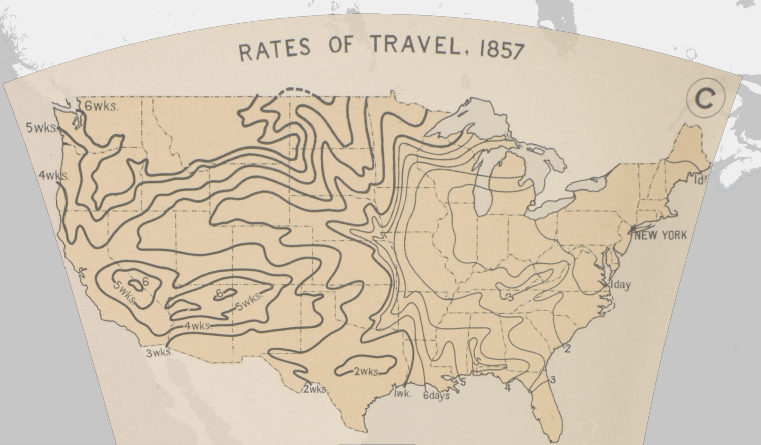
Ok, so the next link actually has “Travel Time” option right on its homepage. The Atlas of the Historical Geology of the United States has stitched together U.S. maps so you can watch the spread of canals or a network of railroads knitting together or, one of my favorites, isolines tracing out travel times to different parts of the U.S. from NYC.
— 7 —
And finally, if you want to warp our understanding of reality (or be on your guard against people who do), you want to read Scott’s summary of Dark Side Statistics.
[T]here are lots of tricks unscrupulous or desperate scientists can use to artificially nudge results to the 5% significance level. The clarity of the presentation is unique. [This paper] start[s] by discussing four particular tricks:
- Measure multiple dependent variables, then report the ones that are significant. For example, if you’re measuring whether treatment for a certain psychiatric disorder improves life outcomes, you can collect five different measures of life outcomes – let’s say educational attainment, income, self-reported happiness, whether or not ever arrested, whether or not in romantic relationship – and have a 25%-ish probability one of them will come out at significance by chance. Then you can publish a paper called “Psychiatric Treatment Found To Increase Educational Attainment” without ever mentioning the four negative tests.
It does not get less depressing from there, especially since later in the post, you’ll hit the following sentence:
The image demonstrates that by using all four tricks, you can squeeze random data into a result significant at the p < 0.05 level about 61% of the time.
So, um, have an ok weekend?
For more Quick Takes, visit Conversion Diary!
Previous Post
January 9, 2014
Don't Rely on the State to Legitimize your Faith
Next Post

January 11, 2014 Sherlock Ciphers to Tackle
Browse Our Archives
Select a Category 7 Quick Takes Apologetics Atheism Book Conversion Debate Tactics Debates Epistemology/Philosophy Housekeeping Ideological Turing Test Marriage Morality in Practice Parsing Catholicism Possibly Heretical Radio Reviews/Recommendations Sequence Index Spiritual Practice Uncategorized
Select a Month April 2017 March 2017 January 2017 December 2016 September 2016 August 2016 July 2016 June 2016 May 2016 April 2016 March 2016 February 2016 January 2016 December 2015 November 2015 October 2015 September 2015 August 2015 July 2015 June 2015 May 2015 April 2015 March 2015 February 2015 January 2015 December 2014 November 2014 October 2014 September 2014 August 2014 July 2014 June 2014 May 2014 April 2014 March 2014 February 2014 January 2014 December 2013 November 2013 October 2013 September 2013 August 2013 July 2013 June 2013 May 2013 April 2013 March 2013 February 2013 January 2013 December 2012 November 2012 October 2012 September 2012 August 2012 July 2012 June 2012 May 2012 April 2012 March 2012 February 2012 January 2012 December 2011 November 2011 October 2011 September 2011 August 2011 July 2011 June 2011 May 2011 April 2011 March 2011 February 2011 January 2011 December 2010 November 2010 October 2010 September 2010 August 2010 July 2010 June 2010
Follow Us!
TAKE THE
Religious Wisdom Quiz
Which Christian group is known for practicing strict nonviolence?
Select your answer to see how you score.
Presbyterians Methodists Lutherans Mennonites
Related posts from Unequally Yoked

7QT: Fake Bears, Faker Weapons, and Austen

7QT: Moms, Pacifist Pilots, and other superheroes

7QT: Remixes, Underwear, & Fake Fingers

7QT: The Peculiar Virtues of Daredevil, Pool Table...
TRENDING AT PATHEOS Catholic

Rejecting Doom: Christian Hope And Human Action
Christianity is a religion of hope. We are to have hope and...

It’s What Comes From Within Which Matters
One of the most difficult things for us to understand is why...

Why I Choose the Eucharist Over the Sermon
Choose the Eucharist, Not the Sermon What are we supposed to get...

5 Design Elements Found in Spiritually Rooted Homes
Putting Spirituality Into Home Decor Our homes are more than our living...

Credo: A Story of God Told with the...
About 10 years ago, I began to imagine a personal "Credo" that...

The Anatomy of Divine Revelation in Catholic Thought
The claim that God has made Himself known to human beings is...
view all Catholic blogs
Ad-Free & Subscriber Log-In Subscription Support
- About Us
- 2026 Calendar
- Videos
- Podcasts
- Library of World Religions
- Faith In Media Tracker
- Advertise With Us
- Write for Us
- Privacy Policy
- Terms of Service
- Do Not Sell My Data
- Contact Us
- Radiant Digital
- Manage Newsletter Subscriptions
- Unsubscribe From Notifications
- Sitemap
Copyright 2008-2026, Patheos. All rights reserved.
Subscription Support Ad-Free & Subscriber Log-In
Follow Patheos