
BuddhistCatholicContemplativeEvangelicalGeneral ChristianHinduJewishLatter-day SaintMuslimNew VisionsProgressive Christian
Beliefs
- Buddhist
- Catholic
- Contemplative
- Evangelical
- General Christian
- Hindu
- Jewish
- Latter-day Saint
- More Voices
- Muslim
- New Visions
- Pagan
- Progressive Christian
Topics
- Religion News
- Food and Religion
- Sports and Religion
- Religious Art
- Religious Music and Entertainment
- Religious Events
- History and Religion
- Style and Religion
- Politics and Religion
- Women in Religion
- Recreation Outdoors and Religion
- Business Finance and Religion
- Careers Workplace and Religion
- Education and Religion
- Family Parenting and Religion
- Health Fitness and Religion
- Home and Religion
- Relationships and Religion
- Technology and Religion
- Travel and Religion
Columnists
- Buddhist Columnists
- Business Finance and Religion Columnists
- Careers Workplace and Religion Columnists
- Catholic Columnists
- Contemplative Columnists
- Education and Religion Columnists
- Evangelists Columnists
- Family Parenting and Religion Columnists
- General Christian Columnists
- Health Fitness and Religion Columnists
- Hindu Columnists
- History and Religion Columnists
- Home and Religion Columnists
- Jewish Columnists
- More Voices Columnists
- Latter Day Columnists
- Muslim Columnists
- New Visions Columnists
- Nonreligious Columnists
- Pagan Columnists
- Politics and Religion Columnists
- Progressive Columnists
- Recreation Outdoors and Religion Columnists
- Relationships and Religion Columnists
- Religion News Columnists
- Religious Art Columnists
- Religious Events Columnists
- Religious Music and Entertainment Columnists
- Sports and Religion Columnists
- Style and Religion Columnists
- Technology and Religion Columnists
- Travel and Religion Columnists
- Women in Religion Columnists
Resource Library
- 2026 Calendar
- Library of World Religions
- The 100 Most Holy Places on Earth
- Patheos Answers
- Podcasts
- Videos
- Faith Leaders Database
- Anglican Episcopalian
- Bahai
- Baptist
- Buddhism
- Christianity
- Confucianism
- Eastern Orthodoxy
- Hinduism
- Holiness and Pentecostal
- ISKCON
- Islam
- Judaism
- Lutheran
- Methodist
- The Church of Jesus Christ of Latter-day Saints
- New Age
- Paganism
- Presbytarian and Reformed
- Protestantism
- Religion Behind the Scenes
- Roman Catholic
- Scientology
- Shia Islam
- Sikhism
- Sufism
- Sunni Islam
- Taoism
- Zen
- See all religions
Research Tools
 Ad-Free & Subscriber Log-In Subscription Support
Ad-Free & Subscriber Log-In Subscription Support
Follow Patheos 

- Trending:
- Forgiveness
- |
- Marriage
- |
- Consciousness
- |
- Death Penalty
- |
- Election
- |
- Halloween
 Unequally Yoked
- Home
- Catholic
- Seven Books of 2013
Seven Books of 2013
Last updated on: December 6, 2013 at 12:15 pm by Leah Libresco
Seven Books of 2013 2013-12-06T12:15:11-05:00 Leah Libresco
Patheos Explore the world's faith through different perspectives on religion and spirituality! Patheos has the views of the prevalent religions and spiritualities of the world.

As the year winds to a close, and you may be starting to wonder what gifts which books to give friends and family for the holiday, I would, of course, like to remind you of the existence of Arcadia, Gödel Escher Bach, Reflections on the Psalms, and the corpus of Sondheim, for this week’s quick takes, I’m sharing my seven favorite books I read for the first time this year. They are in the order I read them chronologically over the last eleven months.
Also, if you would like to do me a mitzvah, when you click any of the links on this page to do your Amazon holiday shopping (whether you’re buying these books specifically or not), I get a small percentage of Amazon’s price, which I use to buy… more books. So, without further ado:
— 1 —
Stories of Your Life and Others – Ted Chiang
I’d had this science fiction anthology on hold at the library for months in DC, but I didn’t actually get the chance to read it til I was in California and got to borrow it from a friend. I’ve loved Ted Chiang since I read “Hell is the Absence of God” and was blown away by the worldbuilding. I love reading his short stories because they feel like I’m falling into well-realized worlds that I’d like to stay in and keep exploring afterwards. And his tech developments tend to tease out human psychology more than physics.
You can read the title story of the collection here. The protagonist works on understanding an alien language and this story made me delighted in some of the same ways ASL and Hofstadter do.
— 2 —
The Strategy of Conflict – Thomas Schelling
When Jesse Galef arranged his bookshelf by Hogwarts House, enough commenters popped up to tell him that Strategy of Conflict belonged on the Slytherin shelf to guarantee this book on game theory a spot in my queue. The author is the Schelling of Schelling Point – the strategy or outcome that people will converge to in the absence of communication (e.g. If you were told to meet someone in NYC, but not where, where would you turn up?).
It has mathy sections, along with plenty of story-like scenarios, so you can get a lot out of it whether or not you’re reading the formulas and proofs. If I wrote fiction, I think I’d be glad to have read this just for the expansion of ways to cause and resolve conflict. As it is, it felt like reading this book took a lot of strategies and ideas I knew about in isolation and knit them together. (It’s amazing how many tactics I recognized specifically from political wheeling and dealing in my college debate group).
— 3 —
Surely You’re Joking, Mr Feynman! – Richard Feynman
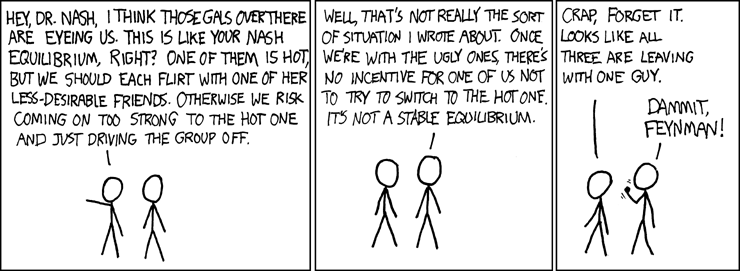
I have no idea how I made it to 24 without reading this. Somehow I managed to read and see QED, the play based on Feynman before actually reading his memoir. It was predictably delightful. The science and math is very clearly explained, and Feynman’s tinkerer’s heart is apparent in every anecdote. He is so full of joy at the prospect of understanding and tinkering with anything, whether it’s high level physics or lockpicking. I kept grabbing people to read parts aloud and then just squeal together appreciatively.
And I feel it’s apropos to remind you of this:
— 4 —
The Death and Life of Great American Cities – Jane Jacobs
Another book that I’d heard praised repeatedly, and somehow never managed to pick up. It’s fascinating to see cities studied as dynamic systems, seeing how small adjustments (more light, fewer storefronts, etc) can trigger major shifts in the character of a neighborhood. This seemed to pair well with Robert Nisbet’s The Quest for Community, since both books look at structural problems preventing people from forming bonds with their neighbors and losing the opportunity to build institutions and traditions.
— 5 —
Catherine of Siena – Sigrid Undset
Technically, I didn’t enjoy Undset’s biography as much as I found it usefully unsettling. It was high time I read something about St. Catherine, given how many Dominican friars I’ve made friends with (and since I felt my St Catherine loyalty was strongly to St Catherine of Alexandria).
Undset’s book is vivid and engaging, enough so that I kept flinching. Everything about Catherine’s life seemed so extreme and grotesque, from her miracles to her visions to her penances. Her experience of Christ is much more mystical and visceral than my somewhat excessively academic and abstract approach, and I kept feeling overwhelmed to the point of being a little repulsed. So, in the end, I was very grateful to Undset for making the saint specific enough to be overpowering.
— 6 —
The Child that Books Built: A Life in Reading – Francis Spufford
I am such a sucker for books-heavy memoirs. In the worlds of Diane Duane, Spufford definitely qualifies as a wizard (“Wizards love words. Most of them read a great deal, and indeed one strong sign of a potential wizard is the inability to get to sleep without reading something first…”). I’ve quoted from his book already in a link round up, and I found his memoir had a pleasing mix of observations that made me feel intense kinship and new reflections for me to mull over.
— 7 —
Shadow and Bone and Siege and Storm – Leigh Bardugo
Warning: don’t read the Amazon description for Siege and Storm or Ruin and Rising since both contain major spoilers for the preceding books.
I read both of these books in Bardugo’s Grisha trilogy in a single day. And, as the word ‘trilogy’ suggests, I’m looking for people to sucker in to wait impatiently until this summer for the debut of Ruin and Rising. I do think the best way to pitch you all is to suggest you read one of Bardugo’s stories set in the same world, “The Witch of Duva.” I still don’t know exactly how to explain it, but there’s something very rich and unsettling about the world she’s made, which is why I didn’t put her books down once I picked them up. So, hopefully a couple of you will be ensorcelled too, and I’ll have people to kvell with.
I’d love to hear your favorite new reads of the year in the comments section!
For more Quick Takes, visit Conversion Diary!
Previous Post

December 4, 2013
Must Pity be Hierarchical?
Next Post

December 7, 2013 The Drunk and the Madmen
Browse Our Archives
Select a Category 7 Quick Takes Apologetics Atheism Book Conversion Debate Tactics Debates Epistemology/Philosophy Housekeeping Ideological Turing Test Marriage Morality in Practice Parsing Catholicism Possibly Heretical Radio Reviews/Recommendations Sequence Index Spiritual Practice Uncategorized
Select a Month April 2017 March 2017 January 2017 December 2016 September 2016 August 2016 July 2016 June 2016 May 2016 April 2016 March 2016 February 2016 January 2016 December 2015 November 2015 October 2015 September 2015 August 2015 July 2015 June 2015 May 2015 April 2015 March 2015 February 2015 January 2015 December 2014 November 2014 October 2014 September 2014 August 2014 July 2014 June 2014 May 2014 April 2014 March 2014 February 2014 January 2014 December 2013 November 2013 October 2013 September 2013 August 2013 July 2013 June 2013 May 2013 April 2013 March 2013 February 2013 January 2013 December 2012 November 2012 October 2012 September 2012 August 2012 July 2012 June 2012 May 2012 April 2012 March 2012 February 2012 January 2012 December 2011 November 2011 October 2011 September 2011 August 2011 July 2011 June 2011 May 2011 April 2011 March 2011 February 2011 January 2011 December 2010 November 2010 October 2010 September 2010 August 2010 July 2010 June 2010
Follow Us!
TAKE THE
Religious Wisdom Quiz
Who said, "Your people will be my people and your God my God"?
Select your answer to see how you score.
Ruth Bathsheba Leah Esther
Related posts from Unequally Yoked

7QT: Fake Bears, Faker Weapons, and Austen

7QT: Moms, Pacifist Pilots, and other superheroes

7QT: Remixes, Underwear, & Fake Fingers

7QT: The Peculiar Virtues of Daredevil, Pool Table...
TRENDING AT PATHEOS Catholic

Creation, Preservation, and Teleology in Catholic Theology
As I write this, it is very early Monday morning. Like millions...

The Parable Of The Sower And The Word...
One of Christ’s most famous parables is that of the sower who...

Rejecting Doom: Christian Hope And Human Action
Christianity is a religion of hope. We are to have hope and...

Why I Choose the Eucharist Over the Sermon
Choose the Eucharist, Not the Sermon What are we supposed to get...

5 Design Elements Found in Spiritually Rooted Homes
Putting Spirituality Into Home Decor Our homes are more than our living...

Credo: A Story of God Told with the...
About 10 years ago, I began to imagine a personal "Credo" that...
view all Catholic blogs
Ad-Free & Subscriber Log-In Subscription Support
- About Us
- 2026 Calendar
- Videos
- Podcasts
- Library of World Religions
- Faith In Media Tracker
- Advertise With Us
- Write for Us
- Privacy Policy
- Terms of Service
- Do Not Sell My Data
- Contact Us
- Radiant Digital
- Manage Newsletter Subscriptions
- Unsubscribe From Notifications
- Sitemap
Copyright 2008-2026, Patheos. All rights reserved.
Subscription Support Ad-Free & Subscriber Log-In
Follow Patheos