
BuddhistCatholicContemplativeEvangelicalGeneral ChristianHinduJewishLatter-day SaintMuslimNew VisionsProgressive Christian
Beliefs
- Buddhist
- Catholic
- Contemplative
- Evangelical
- General Christian
- Hindu
- Jewish
- Latter-day Saint
- More Voices
- Muslim
- New Visions
- Pagan
- Progressive Christian
Topics
- Religion News
- Food and Religion
- Sports and Religion
- Religious Art
- Religious Music and Entertainment
- Religious Events
- History and Religion
- Style and Religion
- Politics and Religion
- Women in Religion
- Recreation Outdoors and Religion
- Business Finance and Religion
- Careers Workplace and Religion
- Education and Religion
- Family Parenting and Religion
- Health Fitness and Religion
- Home and Religion
- Relationships and Religion
- Technology and Religion
- Travel and Religion
Columnists
- Buddhist Columnists
- Business Finance and Religion Columnists
- Careers Workplace and Religion Columnists
- Catholic Columnists
- Contemplative Columnists
- Education and Religion Columnists
- Evangelists Columnists
- Family Parenting and Religion Columnists
- General Christian Columnists
- Health Fitness and Religion Columnists
- Hindu Columnists
- History and Religion Columnists
- Home and Religion Columnists
- Jewish Columnists
- More Voices Columnists
- Latter Day Columnists
- Muslim Columnists
- New Visions Columnists
- Nonreligious Columnists
- Pagan Columnists
- Politics and Religion Columnists
- Progressive Columnists
- Recreation Outdoors and Religion Columnists
- Relationships and Religion Columnists
- Religion News Columnists
- Religious Art Columnists
- Religious Events Columnists
- Religious Music and Entertainment Columnists
- Sports and Religion Columnists
- Style and Religion Columnists
- Technology and Religion Columnists
- Travel and Religion Columnists
- Women in Religion Columnists
Resource Library
- 2026 Calendar
- Library of World Religions
- The 100 Most Holy Places on Earth
- Patheos Answers
- Podcasts
- Videos
- Faith Leaders Database
- Anglican Episcopalian
- Bahai
- Baptist
- Buddhism
- Christianity
- Confucianism
- Eastern Orthodoxy
- Hinduism
- Holiness and Pentecostal
- ISKCON
- Islam
- Judaism
- Lutheran
- Methodist
- The Church of Jesus Christ of Latter-day Saints
- New Age
- Paganism
- Presbytarian and Reformed
- Protestantism
- Religion Behind the Scenes
- Roman Catholic
- Scientology
- Shia Islam
- Sikhism
- Sufism
- Sunni Islam
- Taoism
- Zen
- See all religions
Research Tools
 Ad-Free & Subscriber Log-In Subscription Support
Ad-Free & Subscriber Log-In Subscription Support
Follow Patheos 

- Trending:
- Forgiveness
- |
- Marriage
- |
- Consciousness
- |
- Death Penalty
- |
- Election
- |
- Halloween
 Unequally Yoked
- Home
- Catholic
- Pope Francis and the Mendicant Christ
Pope Francis and the Mendicant Christ
Last updated on: December 17, 2013 at 2:49 pm by Leah Libresco
Pope Francis and the Mendicant Christ 2013-12-17T14:49:24-05:00 Leah Libresco
Patheos Explore the world's faith through different perspectives on religion and spirituality! Patheos has the views of the prevalent religions and spiritualities of the world.
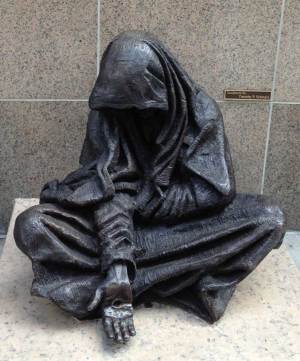
Sculpture by Timothy Schmalz
Pope Francis gave an interview to La Stampa, and, all caveats about translation aside, these two questions and responses caught my eye:
What does Christmas say to people today?
“It speaks of tenderness and hope. When God meets us he tells us two things. The first thing he says is: have hope. God always opens doors, he never closes them. He is the father who opens doors for us. The second thing he says is: don’t be afraid of tenderness. When Christians forget about hope and tenderness they become a cold Church, that loses its sense of direction and is held back by ideologies and worldly attitudes, whereas God’s simplicity tells you: go forward, I am a Father who caresses you. I become fearful when Christians lose hope and the ability to embrace and extend a loving caress to others. Maybe this is why, looking towards the future, I often speak about children and the elderly, about the most defenceless that is. Throughout my life as a priest, going to the parish, I have always sought to transmit this tenderness, particularly to children and the elderly. It does me good and it makes me think of the tenderness God has towards us.”
How is it possible to believe that God, who is considered by religions to be infinite and all-powerful, can make Himself so small?
“The Greek Fathers called it syncatabasis, divine condescension that is: God coming down to be with us. It is one of God’s mysteries. Back in 2000, in Bethlehem, John Paul II said God became a child who was entirely dependent on the care of a father and mother. This is why Christmas gives us so much joy. We don’t feel alone any more; God has come down to be with us. Jesus became one of us and suffered the worst death for us, that of a criminal on the Cross.”
When I was in high school, I was bitterly disappointed by the conclusion of Nancy Kress’s Beggars in Spain trilogy (Beggars in Spain, Beggars and Choosers, Beggars Ride). The trilogy began with genetic engineering, overamped intelligence, and a description of thinking in analogies that filled me with delight. But, by the time the trilogy ends, a bioweapon had been releases that turbocharged the amygdala to make the infected intensely afraid of novelty.
The problem wasn’t solved quickly or cleverly. Instead, some of the uninfected or slightly recovered became beggars, helping to draw people out and teach them courage by offering their need. People who were too frightened to save themselves sometimes overcame their fear when they saw someone who was starving and needed them to bring them food.
I was annoyed by this plot twist. There was nothing exciting or exclusive about the solution. Only scientists could engineer an antidote, but anyone could just publicly starve. I didn’t like the way the protagonists were degrading themselves instead of holding on to their gains while trying to pull others up. And I felt the kind of bait-and-switch indignation that some people experience reading Narnia — I didn’t know much about Christianity, but I knew enough Nietzsche to recognize this as elevating the weak by virtue of their weakness, and thus Christian.
Helping others is a small c-catholic vocation, it’s open to everyone. There is always need that can be served, and Pope Francis has keeps talking about children and the elderly, and personally helping them to remind us that (to crib from Les Mis) “to love another person is to see the face of God.”
Christ came to us as a weak baby, and his helplessness was a gift. God doesn’t require our service or help, but He invites us to offer it, so that we have a way to be connected to Him. God doesn’t need the Mass to be in communion with us, but it is offered to us as a ritual and a discipline so that we have an outward sign of an inward grace — a sacrament.
Responding to the needs of others or being honest about our own need and allowing others to help us is a way of reminding ourselves of the nature of Christ and trying to become like Him. When the abstract or foreign theological terms like syncatabasis feel very far away, we can remember Christ’s nature by helping others and remembering, oh yes, he’s the person who does this, but all the time.
And, for me, asking for help or offering boring aid is a way of crushing pride under my foot while helping others. Which must be why I do it so rarely.
Previous Post
December 15, 2013
Christmas Poems for Gaudete Sunday
Next Post
December 17, 2013 It is not good that man should be alone
Browse Our Archives
Select a Category 7 Quick Takes Apologetics Atheism Book Conversion Debate Tactics Debates Epistemology/Philosophy Housekeeping Ideological Turing Test Marriage Morality in Practice Parsing Catholicism Possibly Heretical Radio Reviews/Recommendations Sequence Index Spiritual Practice Uncategorized
Select a Month April 2017 March 2017 January 2017 December 2016 September 2016 August 2016 July 2016 June 2016 May 2016 April 2016 March 2016 February 2016 January 2016 December 2015 November 2015 October 2015 September 2015 August 2015 July 2015 June 2015 May 2015 April 2015 March 2015 February 2015 January 2015 December 2014 November 2014 October 2014 September 2014 August 2014 July 2014 June 2014 May 2014 April 2014 March 2014 February 2014 January 2014 December 2013 November 2013 October 2013 September 2013 August 2013 July 2013 June 2013 May 2013 April 2013 March 2013 February 2013 January 2013 December 2012 November 2012 October 2012 September 2012 August 2012 July 2012 June 2012 May 2012 April 2012 March 2012 February 2012 January 2012 December 2011 November 2011 October 2011 September 2011 August 2011 July 2011 June 2011 May 2011 April 2011 March 2011 February 2011 January 2011 December 2010 November 2010 October 2010 September 2010 August 2010 July 2010 June 2010
Follow Us!
TAKE THE
Religious Wisdom Quiz
In the New Testament what is the last book?
Select your answer to see how you score.
Revelation Titus Matthew Luke
Related posts from Unequally Yoked

The Tony-Winning Guide To Temptation And Grace

Hedgehogs of Redemption and the Comedy of Grace

Mercy, Justice, and How To Tell The Difference

Pinning down *which* error is made in this...
TRENDING AT PATHEOS Catholic

Rejecting Doom: Christian Hope And Human Action
Christianity is a religion of hope. We are to have hope and...

It’s What Comes From Within Which Matters
One of the most difficult things for us to understand is why...

Why I Choose the Eucharist Over the Sermon
Choose the Eucharist, Not the Sermon What are we supposed to get...

5 Design Elements Found in Spiritually Rooted Homes
Putting Spirituality Into Home Decor Our homes are more than our living...

Credo: A Story of God Told with the...
About 10 years ago, I began to imagine a personal "Credo" that...

The Anatomy of Divine Revelation in Catholic Thought
The claim that God has made Himself known to human beings is...
view all Catholic blogs
Ad-Free & Subscriber Log-In Subscription Support
- About Us
- 2026 Calendar
- Videos
- Podcasts
- Library of World Religions
- Faith In Media Tracker
- Advertise With Us
- Write for Us
- Privacy Policy
- Terms of Service
- Do Not Sell My Data
- Contact Us
- Radiant Digital
- Manage Newsletter Subscriptions
- Unsubscribe From Notifications
- Sitemap
Copyright 2008-2026, Patheos. All rights reserved.
Subscription Support Ad-Free & Subscriber Log-In
Follow Patheos