
BuddhistCatholicContemplativeEvangelicalGeneral ChristianHinduJewishLatter-day SaintMuslimNew VisionsProgressive Christian
Beliefs
- Buddhist
- Catholic
- Contemplative
- Evangelical
- General Christian
- Hindu
- Jewish
- Latter-day Saint
- More Voices
- Muslim
- New Visions
- Pagan
- Progressive Christian
Topics
- Religion News
- Food and Religion
- Sports and Religion
- Religious Art
- Religious Music and Entertainment
- Religious Events
- History and Religion
- Style and Religion
- Politics and Religion
- Women in Religion
- Recreation Outdoors and Religion
- Business Finance and Religion
- Careers Workplace and Religion
- Education and Religion
- Family Parenting and Religion
- Health Fitness and Religion
- Home and Religion
- Relationships and Religion
- Technology and Religion
- Travel and Religion
Columnists
- Buddhist Columnists
- Business Finance and Religion Columnists
- Careers Workplace and Religion Columnists
- Catholic Columnists
- Contemplative Columnists
- Education and Religion Columnists
- Evangelists Columnists
- Family Parenting and Religion Columnists
- General Christian Columnists
- Health Fitness and Religion Columnists
- Hindu Columnists
- History and Religion Columnists
- Home and Religion Columnists
- Jewish Columnists
- More Voices Columnists
- Latter Day Columnists
- Muslim Columnists
- New Visions Columnists
- Nonreligious Columnists
- Pagan Columnists
- Politics and Religion Columnists
- Progressive Columnists
- Recreation Outdoors and Religion Columnists
- Relationships and Religion Columnists
- Religion News Columnists
- Religious Art Columnists
- Religious Events Columnists
- Religious Music and Entertainment Columnists
- Sports and Religion Columnists
- Style and Religion Columnists
- Technology and Religion Columnists
- Travel and Religion Columnists
- Women in Religion Columnists
Resource Library
- 2026 Calendar
- Library of World Religions
- The 100 Most Holy Places on Earth
- Patheos Answers
- Podcasts
- Videos
- Faith Leaders Database
- Anglican Episcopalian
- Bahai
- Baptist
- Buddhism
- Christianity
- Confucianism
- Eastern Orthodoxy
- Hinduism
- Holiness and Pentecostal
- ISKCON
- Islam
- Judaism
- Lutheran
- Methodist
- The Church of Jesus Christ of Latter-day Saints
- New Age
- Paganism
- Presbytarian and Reformed
- Protestantism
- Religion Behind the Scenes
- Roman Catholic
- Scientology
- Shia Islam
- Sikhism
- Sufism
- Sunni Islam
- Taoism
- Zen
- See all religions
Research Tools
 Ad-Free & Subscriber Log-In Subscription Support
Ad-Free & Subscriber Log-In Subscription Support
Follow Patheos 

- Trending:
- Forgiveness
- |
- Marriage
- |
- Consciousness
- |
- Death Penalty
- |
- Election
- |
- Halloween
 Unequally Yoked
- Home
- Catholic
- It’s Hard to Do Vocabulary Drills in Personal Languages
It’s Hard to Do Vocabulary Drills in Personal Languages
Last updated on: November 25, 2013 at 5:01 pm by Leah Libresco
It’s Hard to Do Vocabulary Drills in Personal Languages 2013-11-25T17:01:58-05:00 Leah Libresco
Patheos Explore the world's faith through different perspectives on religion and spirituality! Patheos has the views of the prevalent religions and spiritualities of the world.
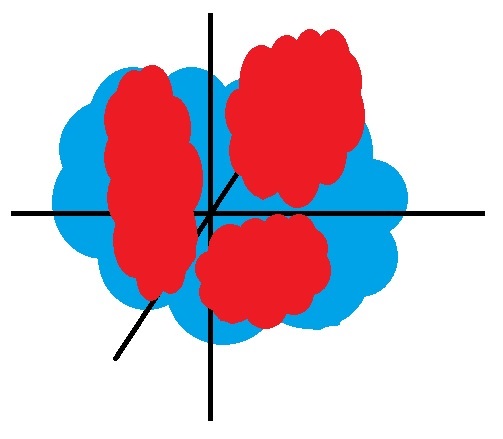
I read Douglas Hofstadter’s Surfaces and Essences: Analogy as the Fuel and Fire of Thinking a few months ago, and, although I wouldn’t recommend it as enthusiastically as Gödel Escher Bach, there was one section I was delighted to read. It felt like Hofstadter had crystallized a very important part of my thinking process and set it down on paper.
We would like to offer a simple visual metaphor for thinking about the words of a language and the concepts they represent. We begin by suggesting that you imagine a two-dimensional space or a three-dimensional one, as you prefer; next, we are going to start filling that space up, in our imagination, with small patches of color, using a different color for each different language we are interested in…
How is a conceptual space filled up with sets of blobs of different colors? For instance, how do the repertoires of concepts possessed by French and English speakers who share essentially the same culture compare?
…Some of the different-colored blobs representing different languages’ coverages of a given extremely frequent concept will tend to have pretty much the same shape, but in the case of other blobs, there will be discrepancies, some minor and some major. We’ve already seen a pretty major one, involving time corresponding to heur, temps, and fois and temps corresponding to both time and weather…
Thus, the center of this conceptual space is inhabited by red and green blobs that often coincide quite well, and, when they don’t coincide, then there are all sorts of overlapping blobs, each with its own curious shape… Let’s take any shell of this conceptual space. Since languages differ enormously, we can easily find a red blog that no single green blog covers precisely. However, a small set of green blobs will collectively do a pretty good job covering all the territory of the red blob (although they will inevitably also cover areas outside the red blob)…
In summary, when language A has a word that strikes its speakers as representing a natural and monolithic concept, and language B has no corresponding word, then language B is poorer and language A is richer, because speakers of language B are forced to cobble different words together in order to cover the zone of conceptual space that language A covers with just one word. Conversely, when language B has a set of words that cut up a zone of conceptual space that is covered by just one word in language A, and when the distinctions offered by language B seem natural to speakers of both languages, then it’s language B that is richer and language A that is poorer.
Just reading this section of Hofstadter’s book was like the experience of finding out that another language has had one blob for my collection of patchworked blobs all this time. For me, this visual metaphor lights up an important region in my conceptual space.
This happens less to me on the level of words, and more often when reading books and suddenly finding a peg for an idea or an emotion that hadn’t felt as unified before my one big blue blog appears as a superset of my little red approximations. So, when I see Sunday in the Park with George, I might realize that “Finishing the Hat” is a metonym for a whole set of experiences where I wind up doing something fairly abstract or creative and end up feeling both energized and lonely à la:
I like that Hofstadter chose the analogy of translation between languages to start talking about analogies generally. Because when I find out that someone doesn’t have the big blue blob of one of my conceptual touchstones in their personal experiential lexicon, I feel as clumsy expressing my ideas as when my ASL teacher asked me to justify my then-atheism using my five-month-old vocabulary.
Thus, I really like arguments framed as book clubs, inviting my friends over for movies, or just sending my gentleman caller a youtube link to a particular musical theatre song when I need to explain the particular way I’m upset. It’s a way of giving someone else a crash course in your internal language and to avoid some of the pitfalls of false cognates. And now, thanks to Hofstadter, I’ve gotten to share another of my core vocabulary ideas with you
P.S. Over at the CFAR blog, I had a post up a few weeks ago on which rationality/cognitive science ideas are easier to express in languages other than English.
Previous Post

November 23, 2013
Football is not healthy for children and other living beings
Next Post

November 26, 2013 Keeping Ideas Close Enough to Play With
Browse Our Archives
Select a Category 7 Quick Takes Apologetics Atheism Book Conversion Debate Tactics Debates Epistemology/Philosophy Housekeeping Ideological Turing Test Marriage Morality in Practice Parsing Catholicism Possibly Heretical Radio Reviews/Recommendations Sequence Index Spiritual Practice Uncategorized
Select a Month April 2017 March 2017 January 2017 December 2016 September 2016 August 2016 July 2016 June 2016 May 2016 April 2016 March 2016 February 2016 January 2016 December 2015 November 2015 October 2015 September 2015 August 2015 July 2015 June 2015 May 2015 April 2015 March 2015 February 2015 January 2015 December 2014 November 2014 October 2014 September 2014 August 2014 July 2014 June 2014 May 2014 April 2014 March 2014 February 2014 January 2014 December 2013 November 2013 October 2013 September 2013 August 2013 July 2013 June 2013 May 2013 April 2013 March 2013 February 2013 January 2013 December 2012 November 2012 October 2012 September 2012 August 2012 July 2012 June 2012 May 2012 April 2012 March 2012 February 2012 January 2012 December 2011 November 2011 October 2011 September 2011 August 2011 July 2011 June 2011 May 2011 April 2011 March 2011 February 2011 January 2011 December 2010 November 2010 October 2010 September 2010 August 2010 July 2010 June 2010
Follow Us!
TAKE THE
Religious Wisdom Quiz
I saw the Promised Land from a mountain but was not allowed to enter it. Who am I?
Select your answer to see how you score.
Joshua Caleb Aaron Moses
Related posts from Unequally Yoked



The Boring, Quiet Rituals That Sustain Us Spiritually

Starving Laypeople of Devotion in Church
TRENDING AT PATHEOS Catholic

Rejecting Doom: Christian Hope And Human Action
Christianity is a religion of hope. We are to have hope and...

It’s What Comes From Within Which Matters
One of the most difficult things for us to understand is why...

Why I Choose the Eucharist Over the Sermon
Choose the Eucharist, Not the Sermon What are we supposed to get...

5 Design Elements Found in Spiritually Rooted Homes
Putting Spirituality Into Home Decor Our homes are more than our living...

Credo: A Story of God Told with the...
About 10 years ago, I began to imagine a personal "Credo" that...

The Anatomy of Divine Revelation in Catholic Thought
The claim that God has made Himself known to human beings is...
view all Catholic blogs
Ad-Free & Subscriber Log-In Subscription Support
- About Us
- 2026 Calendar
- Videos
- Podcasts
- Library of World Religions
- Faith In Media Tracker
- Advertise With Us
- Write for Us
- Privacy Policy
- Terms of Service
- Do Not Sell My Data
- Contact Us
- Radiant Digital
- Manage Newsletter Subscriptions
- Unsubscribe From Notifications
- Sitemap
Copyright 2008-2026, Patheos. All rights reserved.
Subscription Support Ad-Free & Subscriber Log-In
Follow Patheos