
BuddhistCatholicContemplativeEvangelicalGeneral ChristianHinduJewishLatter-day SaintMuslimNew VisionsProgressive Christian
Beliefs
- Buddhist
- Catholic
- Contemplative
- Evangelical
- General Christian
- Hindu
- Jewish
- Latter-day Saint
- More Voices
- Muslim
- New Visions
- Pagan
- Progressive Christian
Topics
- Religion News
- Food and Religion
- Sports and Religion
- Religious Art
- Religious Music and Entertainment
- Religious Events
- History and Religion
- Style and Religion
- Politics and Religion
- Women in Religion
- Recreation Outdoors and Religion
- Business Finance and Religion
- Careers Workplace and Religion
- Education and Religion
- Family Parenting and Religion
- Health Fitness and Religion
- Home and Religion
- Relationships and Religion
- Technology and Religion
- Travel and Religion
Columnists
- Buddhist Columnists
- Business Finance and Religion Columnists
- Careers Workplace and Religion Columnists
- Catholic Columnists
- Contemplative Columnists
- Education and Religion Columnists
- Evangelists Columnists
- Family Parenting and Religion Columnists
- General Christian Columnists
- Health Fitness and Religion Columnists
- Hindu Columnists
- History and Religion Columnists
- Home and Religion Columnists
- Jewish Columnists
- More Voices Columnists
- Latter Day Columnists
- Muslim Columnists
- New Visions Columnists
- Nonreligious Columnists
- Pagan Columnists
- Politics and Religion Columnists
- Progressive Columnists
- Recreation Outdoors and Religion Columnists
- Relationships and Religion Columnists
- Religion News Columnists
- Religious Art Columnists
- Religious Events Columnists
- Religious Music and Entertainment Columnists
- Sports and Religion Columnists
- Style and Religion Columnists
- Technology and Religion Columnists
- Travel and Religion Columnists
- Women in Religion Columnists
Resource Library
- 2026 Calendar
- Library of World Religions
- The 100 Most Holy Places on Earth
- Patheos Answers
- Podcasts
- Videos
- Faith Leaders Database
- Anglican Episcopalian
- Bahai
- Baptist
- Buddhism
- Christianity
- Confucianism
- Eastern Orthodoxy
- Hinduism
- Holiness and Pentecostal
- ISKCON
- Islam
- Judaism
- Lutheran
- Methodist
- The Church of Jesus Christ of Latter-day Saints
- New Age
- Paganism
- Presbytarian and Reformed
- Protestantism
- Religion Behind the Scenes
- Roman Catholic
- Scientology
- Shia Islam
- Sikhism
- Sufism
- Sunni Islam
- Taoism
- Zen
- See all religions
Research Tools
 Ad-Free & Subscriber Log-In Subscription Support
Ad-Free & Subscriber Log-In Subscription Support
Follow Patheos 

- Trending:
- Forgiveness
- |
- Marriage
- |
- Consciousness
- |
- Death Penalty
- |
- Election
- |
- Halloween
 Unequally Yoked
- Home
- Catholic
- Strange Idols and Strange Identities
Strange Idols and Strange Identities
Last updated on: June 2, 2013 at 9:57 pm by Leah Libresco
Strange Idols and Strange Identities 2013-06-02T21:57:54-04:00 Leah Libresco
Patheos Explore the world's faith through different perspectives on religion and spirituality! Patheos has the views of the prevalent religions and spiritualities of the world.
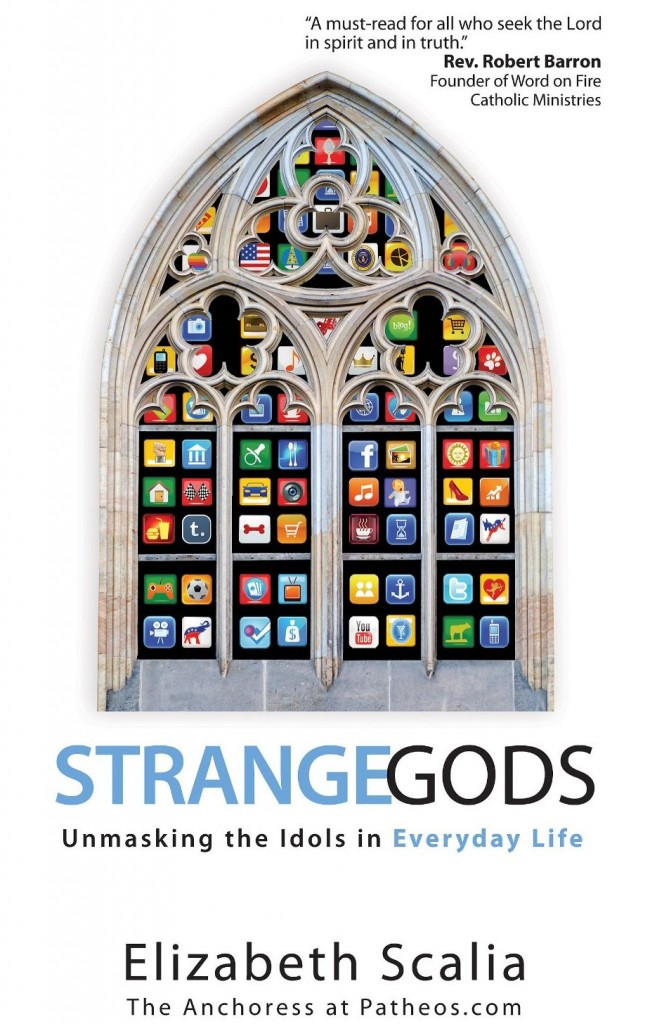
In Strange Gods: Unmasking the Idols in Everyday Life, Elizabeth Scalia has a simple definition of an idol. In the decalogue, we are warned by God to have no other/foreign/strange gods before Him. So, in our modern age, Scalia points out, our idols are less likely to be something like, say a giant golden calf that give burt offerings, and more likely to be letting Reddit usurp our prayer time. An idol doesn’t have to be worshiped to impose itself between us and God.
But what would it be like to face God, with nothing between us and Him? It’s sounds terrifying, akin to the staring at the sun sect that appears in “The Eye of Apollo” from Chesterton’s The Innocence of Father Brown. Or maybe it’s like the experience of Frodo, when he cried out to Sam, “I am naked in the dark, Sam, there is no veil between me and the wheel of fire! I begin to see it even with my waking eyes.”
The technically-good horror of facing God directly is why I’ve always liked this quotation from Diane Duane’s A Wizard Alone:
“Virtue,” he said. “The real thing. It’s not some kind of cuddly teddy bear you can keep on the shelf until you need a hug. It’s dangerous, which is why it makes people so nervous. Virtue has its own agenda, and believe me, it’s not always yours. The word itself means strength, power. And when it gets loose, you’d better watch out.”
“Something bad might happen…”
“Impossible. But possibly something painful”
I’m someone who tends to take about fifteen to twenty minutes to get into a swimming pool — wading in inch by inch, with copious wincing. When I was in kindergarten, and got to play on the monkey bars for the first time, I hung from just the first rung and practiced dangling and swinging back to the platform and getting off. Once I could do that calmly, I dropped from the first bar about a dozen times until I was sure I falling wasn’t too bad. My sense of safety depended on my sense of control. That’s not an option in Catholicism.
I have a wunderkammer of idols, but I notice that a fair amount are an attempt to draw some kind of screen between myself and God or other people (same difference, after all “to love another person is to see the face of God“). It’s easy to interact as a persona, rather than a person. Stephen Colbert-in-character is an extreme example, but it’s always tempting to exaggerate flaws and foibles to the point where they’re comical instead of vulnerabilities.
I’ve been trying to be more careful about running jokes and Homeric epithets since I caught myself using one as a crutch. After seeing The Mikado, I stole one of the phrases (“in my artless Japanese way”) to use as an excuse when I was socially maladroit. Instead of being callous or careless, I was being amusingly strange. But it would be better to be sincere, regretful, and have the ability to grow — to not treat that weakness as an essential distinguishing trait.
In the secular world, you see this point made by many disability activists (a person without the use of her legs, not a paraplegic). In the autistic and Deaf communities, this kind of language becomes controversial precisely because there’s a disagreement about whether their differences are incidental or essential to identity. We can all stand to be a little more thoughtful about the names and identities we hold on to. Paul Graham counsels people to “Keep your identity small” and view as few things as possible as inviolate.
The trouble is, the part I should hold on to “adopted daughter of God” is so much vaguer than the identities I’d like to hand on to: New Yorker (with attendant walking and speaking speed), Sondheim nerd, brusque/efficient, bad at small talk, uninterested in physical activities, kludger/engineer, etc.
But if I only hold on to what I can grasp, I’m choosing to remain small and isolated. To submit to God, I have to be ok with not having mastery.
Previous Post

May 31, 2013
7 Quick Takes (5/31/13)
Next Post
June 4, 2013 Modern Stoicism - The Good, the Bad, and the Ugly
Browse Our Archives
Select a Category 7 Quick Takes Apologetics Atheism Book Conversion Debate Tactics Debates Epistemology/Philosophy Housekeeping Ideological Turing Test Marriage Morality in Practice Parsing Catholicism Possibly Heretical Radio Reviews/Recommendations Sequence Index Spiritual Practice Uncategorized
Select a Month April 2017 March 2017 January 2017 December 2016 September 2016 August 2016 July 2016 June 2016 May 2016 April 2016 March 2016 February 2016 January 2016 December 2015 November 2015 October 2015 September 2015 August 2015 July 2015 June 2015 May 2015 April 2015 March 2015 February 2015 January 2015 December 2014 November 2014 October 2014 September 2014 August 2014 July 2014 June 2014 May 2014 April 2014 March 2014 February 2014 January 2014 December 2013 November 2013 October 2013 September 2013 August 2013 July 2013 June 2013 May 2013 April 2013 March 2013 February 2013 January 2013 December 2012 November 2012 October 2012 September 2012 August 2012 July 2012 June 2012 May 2012 April 2012 March 2012 February 2012 January 2012 December 2011 November 2011 October 2011 September 2011 August 2011 July 2011 June 2011 May 2011 April 2011 March 2011 February 2011 January 2011 December 2010 November 2010 October 2010 September 2010 August 2010 July 2010 June 2010
Follow Us!
TAKE THE
Religious Wisdom Quiz
Who interpreted Nebuchadnezzar's dream of a statue of gold, silver, bronze, iron, and clay?
Select your answer to see how you score.
Daniel Ezekiel Obadiah Hosea
Related posts from Unequally Yoked



The Boring, Quiet Rituals That Sustain Us Spiritually

Starving Laypeople of Devotion in Church
TRENDING AT PATHEOS Catholic

The Parable Of The Sower And The Word...
One of Christ’s most famous parables is that of the sower who...

Rejecting Doom: Christian Hope And Human Action
Christianity is a religion of hope. We are to have hope and...

Why I Choose the Eucharist Over the Sermon
Choose the Eucharist, Not the Sermon What are we supposed to get...

5 Design Elements Found in Spiritually Rooted Homes
Putting Spirituality Into Home Decor Our homes are more than our living...

Credo: A Story of God Told with the...
About 10 years ago, I began to imagine a personal "Credo" that...

The Anatomy of Divine Revelation in Catholic Thought
The claim that God has made Himself known to human beings is...
view all Catholic blogs
Ad-Free & Subscriber Log-In Subscription Support
- About Us
- 2026 Calendar
- Videos
- Podcasts
- Library of World Religions
- Faith In Media Tracker
- Advertise With Us
- Write for Us
- Privacy Policy
- Terms of Service
- Do Not Sell My Data
- Contact Us
- Radiant Digital
- Manage Newsletter Subscriptions
- Unsubscribe From Notifications
- Sitemap
Copyright 2008-2026, Patheos. All rights reserved.
Subscription Support Ad-Free & Subscriber Log-In
Follow Patheos