
BuddhistCatholicContemplativeEvangelicalGeneral ChristianHinduJewishLatter-day SaintMuslimNew VisionsProgressive Christian
Beliefs
- Buddhist
- Catholic
- Contemplative
- Evangelical
- General Christian
- Hindu
- Jewish
- Latter-day Saint
- More Voices
- Muslim
- New Visions
- Pagan
- Progressive Christian
Topics
- Religion News
- Food and Religion
- Sports and Religion
- Religious Art
- Religious Music and Entertainment
- Religious Events
- History and Religion
- Style and Religion
- Politics and Religion
- Women in Religion
- Recreation Outdoors and Religion
- Business Finance and Religion
- Careers Workplace and Religion
- Education and Religion
- Family Parenting and Religion
- Health Fitness and Religion
- Home and Religion
- Relationships and Religion
- Technology and Religion
- Travel and Religion
Columnists
- Buddhist Columnists
- Business Finance and Religion Columnists
- Careers Workplace and Religion Columnists
- Catholic Columnists
- Contemplative Columnists
- Education and Religion Columnists
- Evangelists Columnists
- Family Parenting and Religion Columnists
- General Christian Columnists
- Health Fitness and Religion Columnists
- Hindu Columnists
- History and Religion Columnists
- Home and Religion Columnists
- Jewish Columnists
- More Voices Columnists
- Latter Day Columnists
- Muslim Columnists
- New Visions Columnists
- Nonreligious Columnists
- Pagan Columnists
- Politics and Religion Columnists
- Progressive Columnists
- Recreation Outdoors and Religion Columnists
- Relationships and Religion Columnists
- Religion News Columnists
- Religious Art Columnists
- Religious Events Columnists
- Religious Music and Entertainment Columnists
- Sports and Religion Columnists
- Style and Religion Columnists
- Technology and Religion Columnists
- Travel and Religion Columnists
- Women in Religion Columnists
Resource Library
- 2026 Calendar
- Library of World Religions
- The 100 Most Holy Places on Earth
- Patheos Answers
- Podcasts
- Videos
- Faith Leaders Database
- Anglican Episcopalian
- Bahai
- Baptist
- Buddhism
- Christianity
- Confucianism
- Eastern Orthodoxy
- Hinduism
- Holiness and Pentecostal
- ISKCON
- Islam
- Judaism
- Lutheran
- Methodist
- The Church of Jesus Christ of Latter-day Saints
- New Age
- Paganism
- Presbytarian and Reformed
- Protestantism
- Religion Behind the Scenes
- Roman Catholic
- Scientology
- Shia Islam
- Sikhism
- Sufism
- Sunni Islam
- Taoism
- Zen
- See all religions
Research Tools
 Ad-Free & Subscriber Log-In Subscription Support
Ad-Free & Subscriber Log-In Subscription Support
Follow Patheos 

- Trending:
- Forgiveness
- |
- Marriage
- |
- Consciousness
- |
- Death Penalty
- |
- Election
- |
- Halloween
 Unequally Yoked
- Home
- Catholic
- You Gotta be Kind to be Cruel
You Gotta be Kind to be Cruel
Last updated on: May 29, 2013 at 8:44 am by Leah Libresco
You Gotta be Kind to be Cruel 2013-05-29T08:44:32-04:00 Leah Libresco
Patheos Explore the world's faith through different perspectives on religion and spirituality! Patheos has the views of the prevalent religions and spiritualities of the world.
Libby Ann and Daniel Finke are running another installment of their Forward Thinking series, where they ask bloggers to contribute their thoughts on a topic. This fortnight, it’s cruelty. Daniel kicks us off with this quote from Nietzsche:
Cruelty constituted the great festival pleasure of more primitive men and was indeed an ingredient of almost every one of their pleasures. […] [I]t is not long since princely weddings and public festivals of the more magnificent kind were unthinkable without executions, torturings, or perhaps an auto-da-fé […]To see others suffer does one good, to make others suffer even more: this is a hard saying but an ancient, mighty human, all-too-human principle […] Without cruelty there is no festival,; thus the longest and most ancient part of human history teaches–and in punishment there is so much that is festive.
For me, cruelty seems to entail a strange kind of double think. We’re able to figure out how to be cruel because our victims are similar to us. Cruelty can’t exist without some degree of empathy — the ability to model the way other people think and feel. So, we lean into that feeling of kinship and connection, and then exploit it to hurt the other person in precisely the way we do not want to be hurt. Someone being cruel swings back and forth between connection and detatchment.
Near the end of his post, Daniel wonders what to make of our love of villains like the Joker, Hannibal Lector, or Dexter. Both these men understand humans very well. They can carry out elaborate schemes, because they know exactly how people will respond to their provocations. They look on human thought and feeling and understand it without loving or respecting it. When we watch them, we feel a certain amount of delight at getting to vivisect humanity and safely manipulating it.
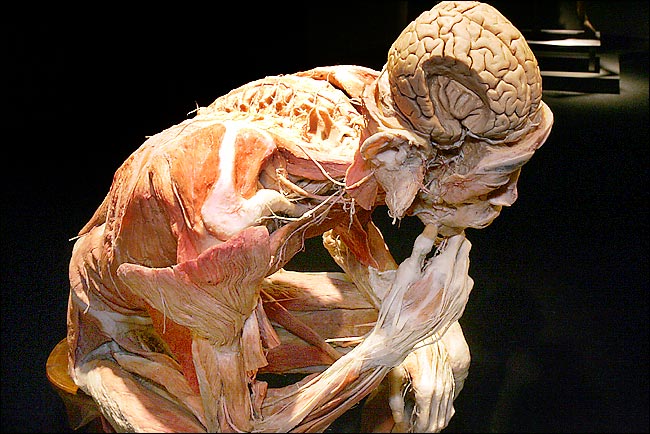
In New York City, I got to attend the Bodies Exhibit, where human bodies are preserved, plasticinated, and displayed after death. I was still pretty gnostic at the time, and found it vaguely embarrassing to be made out of meat. I almost didn’t go, since I assumed it would make me as squeamish as medical shows. But, when I turned up at the museum, I was awestruck.
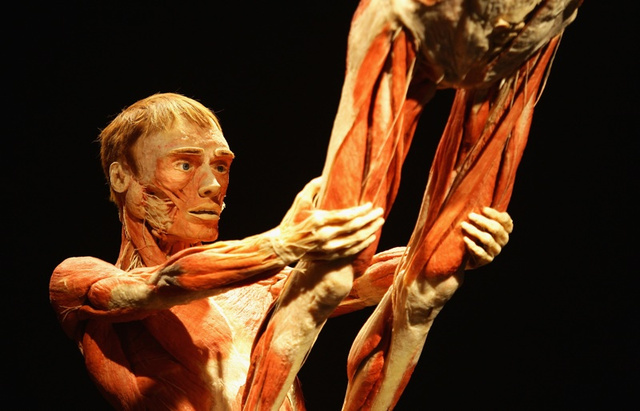
Instead of being disgusted, I was in love. Much like when I took Immunology in college, I could finally see some of the logic of how my body worked, and I was overwhelmed by it’s efficiency and beauty. I tried to remember the flayed muscles and blood vessels so I could almost see them when I looked at myself, and I couldn’t be lulled into complacency by the uniformity of skin. When I saw how the bodies worked, I wanted to hold on to my similarity, so I could carry over that sense of beauty.
But someone indulging in cruelty dissects human feelings without comprehending them as beautiful. Instead of marvelling at our ability to love, and therefore to lose, a person exploring cruelty avoids drawing parallels between zerself and zer victim. Even if you delight in your ability to predict and control someone else, you must label that delight as different than the delight you’re denying to your mark. Or you turn it off all together. You can change (and degrade) yourself, so you can blot out any fellow feeling for the person you’re preying upon.
Earlier this month, in the New Yorker blog, Daniel Mendelson had an interesting observation about the ways we can betray the bodies of others.
The last of the many articles I’ve read about the strange odyssey of Tsarnaev’s body was about the reactions of the residents of the small Virginia town where it was, finally, buried. “What do you do when a monster is buried just down the street?” the subhead asked. The sensationalist diction, the word “monster,” I realized, is the problem—and brings you to the deep meaning of Martha Mullen’s gesture, and of Antigone’s argument, too. There is, in the end, a great ethical wisdom in insisting that the criminal dead, that your bitterest enemy, be buried, too; for in doing so, you are insisting that the criminal, however heinous, is precisely not a “monster.” Whatever else is true of the terrible crime that Tamerlan Tsarnaev is accused of having perpetrated, it was, all too clearly, the product of an entirely human psyche, horribly motivated by beliefs and passions that are very human indeed—deina in the worst possible sense. To call him a monster is to treat this enemy’s mind precisely the way some would treat his unburied body—which is to say, to put it beyond the reach of human consideration (and therefore, paradoxically, to refuse to confront his “monstrosity” at all).
This is the point that obsessed Sophocles’ Antigone: that to not bury her brother, to not treat the war criminal like a human being, would ultimately have been to forfeit her own humanity. This is why it was worth dying for.
Cruelty cannot negate or deny the capacity of others to love and suffer. But, in order to inflict it, we may need to deny ourselves membership in humanity, in order to avoid recognizing the gravity of a wrong. The more we pare down the idea of human dignity, the less we have to rely on in our darker moments, when we half-recognize the ways we wrong others, and need some reassurance that we’re something worth saving.
Previous Post

May 27, 2013
Play in a political Ideological Turing Test
Next Post

May 31, 2013 7 Quick Takes (5/31/13)
Browse Our Archives
Select a Category 7 Quick Takes Apologetics Atheism Book Conversion Debate Tactics Debates Epistemology/Philosophy Housekeeping Ideological Turing Test Marriage Morality in Practice Parsing Catholicism Possibly Heretical Radio Reviews/Recommendations Sequence Index Spiritual Practice Uncategorized
Select a Month April 2017 March 2017 January 2017 December 2016 September 2016 August 2016 July 2016 June 2016 May 2016 April 2016 March 2016 February 2016 January 2016 December 2015 November 2015 October 2015 September 2015 August 2015 July 2015 June 2015 May 2015 April 2015 March 2015 February 2015 January 2015 December 2014 November 2014 October 2014 September 2014 August 2014 July 2014 June 2014 May 2014 April 2014 March 2014 February 2014 January 2014 December 2013 November 2013 October 2013 September 2013 August 2013 July 2013 June 2013 May 2013 April 2013 March 2013 February 2013 January 2013 December 2012 November 2012 October 2012 September 2012 August 2012 July 2012 June 2012 May 2012 April 2012 March 2012 February 2012 January 2012 December 2011 November 2011 October 2011 September 2011 August 2011 July 2011 June 2011 May 2011 April 2011 March 2011 February 2011 January 2011 December 2010 November 2010 October 2010 September 2010 August 2010 July 2010 June 2010
Follow Us!
TAKE THE
Religious Wisdom Quiz
Which Christian observance celebrates the descent of the Holy Spirit on the apostles?
Select your answer to see how you score.
Ash Wednesday Epiphany Ascension Pentecost
Related posts from Unequally Yoked

The Tony-Winning Guide To Temptation And Grace

Hedgehogs of Redemption and the Comedy of Grace

Mercy, Justice, and How To Tell The Difference

Pinning down *which* error is made in this...
TRENDING AT PATHEOS Catholic

Rejecting Doom: Christian Hope And Human Action
Christianity is a religion of hope. We are to have hope and...

It’s What Comes From Within Which Matters
One of the most difficult things for us to understand is why...

Why I Choose the Eucharist Over the Sermon
Choose the Eucharist, Not the Sermon What are we supposed to get...

5 Design Elements Found in Spiritually Rooted Homes
Putting Spirituality Into Home Decor Our homes are more than our living...

Credo: A Story of God Told with the...
About 10 years ago, I began to imagine a personal "Credo" that...

The Anatomy of Divine Revelation in Catholic Thought
The claim that God has made Himself known to human beings is...
view all Catholic blogs
Ad-Free & Subscriber Log-In Subscription Support
- About Us
- 2026 Calendar
- Videos
- Podcasts
- Library of World Religions
- Faith In Media Tracker
- Advertise With Us
- Write for Us
- Privacy Policy
- Terms of Service
- Do Not Sell My Data
- Contact Us
- Radiant Digital
- Manage Newsletter Subscriptions
- Unsubscribe From Notifications
- Sitemap
Copyright 2008-2026, Patheos. All rights reserved.
Subscription Support Ad-Free & Subscriber Log-In
Follow Patheos