
BuddhistCatholicContemplativeEvangelicalGeneral ChristianHinduJewishLatter-day SaintMuslimNew VisionsProgressive Christian
Beliefs
- Buddhist
- Catholic
- Contemplative
- Evangelical
- General Christian
- Hindu
- Jewish
- Latter-day Saint
- More Voices
- Muslim
- New Visions
- Pagan
- Progressive Christian
Topics
- Religion News
- Food and Religion
- Sports and Religion
- Religious Art
- Religious Music and Entertainment
- Religious Events
- History and Religion
- Style and Religion
- Politics and Religion
- Women in Religion
- Recreation Outdoors and Religion
- Business Finance and Religion
- Careers Workplace and Religion
- Education and Religion
- Family Parenting and Religion
- Health Fitness and Religion
- Home and Religion
- Relationships and Religion
- Technology and Religion
- Travel and Religion
Columnists
- Buddhist Columnists
- Business Finance and Religion Columnists
- Careers Workplace and Religion Columnists
- Catholic Columnists
- Contemplative Columnists
- Education and Religion Columnists
- Evangelists Columnists
- Family Parenting and Religion Columnists
- General Christian Columnists
- Health Fitness and Religion Columnists
- Hindu Columnists
- History and Religion Columnists
- Home and Religion Columnists
- Jewish Columnists
- More Voices Columnists
- Latter Day Columnists
- Muslim Columnists
- New Visions Columnists
- Nonreligious Columnists
- Pagan Columnists
- Politics and Religion Columnists
- Progressive Columnists
- Recreation Outdoors and Religion Columnists
- Relationships and Religion Columnists
- Religion News Columnists
- Religious Art Columnists
- Religious Events Columnists
- Religious Music and Entertainment Columnists
- Sports and Religion Columnists
- Style and Religion Columnists
- Technology and Religion Columnists
- Travel and Religion Columnists
- Women in Religion Columnists
Resource Library
- 2026 Calendar
- Library of World Religions
- The 100 Most Holy Places on Earth
- Patheos Answers
- Podcasts
- Videos
- Faith Leaders Database
- Anglican Episcopalian
- Bahai
- Baptist
- Buddhism
- Christianity
- Confucianism
- Eastern Orthodoxy
- Hinduism
- Holiness and Pentecostal
- ISKCON
- Islam
- Judaism
- Lutheran
- Methodist
- The Church of Jesus Christ of Latter-day Saints
- New Age
- Paganism
- Presbytarian and Reformed
- Protestantism
- Religion Behind the Scenes
- Roman Catholic
- Scientology
- Shia Islam
- Sikhism
- Sufism
- Sunni Islam
- Taoism
- Zen
- See all religions
Research Tools
 Ad-Free & Subscriber Log-In Subscription Support
Ad-Free & Subscriber Log-In Subscription Support
Follow Patheos 

- Trending:
- Forgiveness
- |
- Marriage
- |
- Consciousness
- |
- Death Penalty
- |
- Election
- |
- Halloween
 Unequally Yoked
- Home
- Catholic
- 7 Quick Takes (1/11/13)
7 Quick Takes (1/11/13)
Last updated on: January 11, 2013 at 9:20 am by Leah Libresco
7 Quick Takes (1/11/13) 2013-01-11T09:20:13-05:00 Leah Libresco
Patheos Explore the world's faith through different perspectives on religion and spirituality! Patheos has the views of the prevalent religions and spiritualities of the world.

— 1 —
Remember when I told you about that awesome New Yorker article on the professional pickpocket? Well, now they’ve got a video up of how he pulls his heists.
One thing that was particularly fun about watching this is that, although I couldn’t spot how he was doing his steals on the first go-round, I could recognize some of his ways of distracting his mark from aikido class.
— 2 —
The pickpocket revealed his tricks for The New Yorker, and researchers are giving up their secrets on twitter using the hashtag #OverlyHonestMethods. Here are a couple of my favorites:
@AndiFlores_ Our enzyme was proven to be stable for over 3 hours because that’s how long I forgot to put it back in the fridge #overlyhonestmethods
@dr_krystal Data was analysed using Fisher’s Exact t-test because it gave us a statistically significant p-value #overlyhonestmethods
@SciTriGrrl We used predator-stress because someone said “bring in a cat” as a joke, and I thought they were serious #overlyhonestmethods
— 3 —
And while we’re talking about seeing inside to the heart of the matter, check out these latex and paint art pieces by Danny Quirk. He paints anatomy right on the body.

Some of the ones at the link may not be safe for the squeamish.
— 4 —
The art in the last take helps make the unseen visible, but this entertaining feature article from Wired tells the story of when one of their staff writers tried to vanish.
Officially it will be another 24 hours before the manhunt begins. That’s when Wired‘s announcement of my disappearance will be posted online. It coincides with the arrival on newsstands of the September issue of the magazine, which contains a page of mugshot-like photos of me, eyes slightly vacant. The premise is simple: I will try to vanish for a month and start over under a new identity. Wired readers, or whoever else happens upon the chase, will try to find me.
The idea for the contest started with a series of questions, foremost among them: How hard is it to vanish in the digital age? Long fascinated by stories of faked deaths, sudden disappearances, and cat-and-mouse games between investigators and fugitives, I signed on to write a story for Wired about people who’ve tried to end one life and start another…
Wired offered a $5,000 bounty — $3,000 of which would come out of my own pocket — to anyone who could locate me between August 15 and September 15, say the password “fluke,” and take my picture. Nicholas Thompson, my editor, would have complete access to information that a private investigator hired to find me might uncover: my real bank accounts, credit cards, phone records, social networking accounts, and email. I’d give Thompson my friends’ contact information so he could conduct interviews. He would parcel out my personal details online, available to whichever amateur or professional investigators chose to hunt for me. To add a layer of intrigue, Wired hired the puzzle creators at Lone Shark Games to help structure the contest.
— 5 —
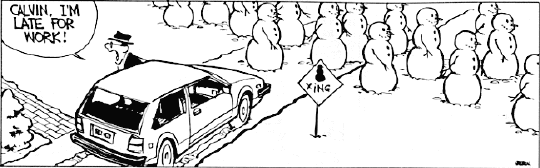
You may not be trying to track down Wired authors, but the Calvin and Hobbes search engine is likely to help you find something pretty awesome.
— 6 —
If you want to find a specific cartoon through the search engine above, but, if you want to find an undervalued basketball player, do you know what you should be looking for? Look, if I like a sports article, it must be pretty darn good.
Here we have a basketball mystery: a player is widely regarded inside the N.B.A. as, at best, a replaceable cog in a machine driven by superstars. And yet every team he has ever played on has acquired some magical ability to win…
Before the game, Battier was given his special package of information. “He’s the only player we give it to,” Morey says. “We can give him this fire hose of data and let him sift. Most players are like golfers. You don’t want them swinging while they’re thinking.” The data essentially broke down the floor into many discrete zones and calculated the odds of Bryant making shots from different places on the court, under different degrees of defensive pressure, in different relationships to other players — how well he scored off screens, off pick-and-rolls, off catch-and-shoots and so on. Battier learns a lot from studying the data on the superstars he is usually assigned to guard. For instance, the numbers show him that Allen Iverson is one of the most efficient scorers in the N.B.A. when he goes to his right; when he goes to his left he kills his team. The Golden State Warriors forward Stephen Jackson is an even stranger case. “Steve Jackson,” Battier says, “is statistically better going to his right, but he loves to go to his left — and goes to his left almost twice as often.” The San Antonio Spurs’ Manu Ginóbili is a statistical freak: he has no imbalance whatsoever in his game — there is no one way to play him that is better than another. He is equally efficient both off the dribble and off the pass, going left and right and from any spot on the floor.
— 7 —
But some mysteries don’t need too much analysis to crack:
In 1934, the second edition of Webster’s New International Dictionary came out. It was a detailed and comprehensive tome that went well beyond giving the definition of a word. It included basic etymology of a word, and some variations in spelling or pronunciation, meant to give readers a complete sense of the word and its history. The entry for “dord” included the fact that it was a noun, and that it was a term from physics and chemistry that meant density. There was no sense of what language or history it came from, or why it was a better term for density than the word “density” was.
It wasn’t long before physicists and chemists started writing in and saying that none of them had ever heard of this property called dord. Who came up with it? Where was it in scientific texts? An investigation that ended in 1939 finally uncovered a sorting error that spawned a word. The original term was “D or d,” and was bound for the stack of words meant to be in the abbreviations section of the dictionary. The capital or lower case d does often stand for density in both physics and chemistry. Somehow, when it found its way into the stack of pages meant to be words, the letters were pushed together and the word “dord” was born.
For more Quick Takes, visit Conversion Diary!
Previous Post

January 10, 2013
Straight from the Humanist's Mouth
Next Post

January 12, 2013 I Want You! (to be a virtuous virus firebreak)
Browse Our Archives
Select a Category 7 Quick Takes Apologetics Atheism Book Conversion Debate Tactics Debates Epistemology/Philosophy Housekeeping Ideological Turing Test Marriage Morality in Practice Parsing Catholicism Possibly Heretical Radio Reviews/Recommendations Sequence Index Spiritual Practice Uncategorized
Select a Month April 2017 March 2017 January 2017 December 2016 September 2016 August 2016 July 2016 June 2016 May 2016 April 2016 March 2016 February 2016 January 2016 December 2015 November 2015 October 2015 September 2015 August 2015 July 2015 June 2015 May 2015 April 2015 March 2015 February 2015 January 2015 December 2014 November 2014 October 2014 September 2014 August 2014 July 2014 June 2014 May 2014 April 2014 March 2014 February 2014 January 2014 December 2013 November 2013 October 2013 September 2013 August 2013 July 2013 June 2013 May 2013 April 2013 March 2013 February 2013 January 2013 December 2012 November 2012 October 2012 September 2012 August 2012 July 2012 June 2012 May 2012 April 2012 March 2012 February 2012 January 2012 December 2011 November 2011 October 2011 September 2011 August 2011 July 2011 June 2011 May 2011 April 2011 March 2011 February 2011 January 2011 December 2010 November 2010 October 2010 September 2010 August 2010 July 2010 June 2010
Follow Us!
TAKE THE
Religious Wisdom Quiz
What does the Bible say is better than gold?
Select your answer to see how you score.
Bread Strength Wisdom Wine
Related posts from Unequally Yoked

7QT: Fake Bears, Faker Weapons, and Austen

7QT: Moms, Pacifist Pilots, and other superheroes

7QT: Remixes, Underwear, & Fake Fingers

7QT: The Peculiar Virtues of Daredevil, Pool Table...
TRENDING AT PATHEOS Catholic

Rejecting Doom: Christian Hope And Human Action
Christianity is a religion of hope. We are to have hope and...

It’s What Comes From Within Which Matters
One of the most difficult things for us to understand is why...

Why I Choose the Eucharist Over the Sermon
Choose the Eucharist, Not the Sermon What are we supposed to get...

5 Design Elements Found in Spiritually Rooted Homes
Putting Spirituality Into Home Decor Our homes are more than our living...

Credo: A Story of God Told with the...
About 10 years ago, I began to imagine a personal "Credo" that...

The Anatomy of Divine Revelation in Catholic Thought
The claim that God has made Himself known to human beings is...
view all Catholic blogs
Ad-Free & Subscriber Log-In Subscription Support
- About Us
- 2026 Calendar
- Videos
- Podcasts
- Library of World Religions
- Faith In Media Tracker
- Advertise With Us
- Write for Us
- Privacy Policy
- Terms of Service
- Do Not Sell My Data
- Contact Us
- Radiant Digital
- Manage Newsletter Subscriptions
- Unsubscribe From Notifications
- Sitemap
Copyright 2008-2026, Patheos. All rights reserved.
Subscription Support Ad-Free & Subscriber Log-In
Follow Patheos