
BuddhistCatholicContemplativeEvangelicalGeneral ChristianHinduJewishLatter-day SaintMuslimNew VisionsProgressive Christian
Beliefs
- Buddhist
- Catholic
- Contemplative
- Evangelical
- General Christian
- Hindu
- Jewish
- Latter-day Saint
- More Voices
- Muslim
- New Visions
- Pagan
- Progressive Christian
Topics
- Religion News
- Food and Religion
- Sports and Religion
- Religious Art
- Religious Music and Entertainment
- Religious Events
- History and Religion
- Style and Religion
- Politics and Religion
- Women in Religion
- Recreation Outdoors and Religion
- Business Finance and Religion
- Careers Workplace and Religion
- Education and Religion
- Family Parenting and Religion
- Health Fitness and Religion
- Home and Religion
- Relationships and Religion
- Technology and Religion
- Travel and Religion
Columnists
- Buddhist Columnists
- Business Finance and Religion Columnists
- Careers Workplace and Religion Columnists
- Catholic Columnists
- Contemplative Columnists
- Education and Religion Columnists
- Evangelists Columnists
- Family Parenting and Religion Columnists
- General Christian Columnists
- Health Fitness and Religion Columnists
- Hindu Columnists
- History and Religion Columnists
- Home and Religion Columnists
- Jewish Columnists
- More Voices Columnists
- Latter Day Columnists
- Muslim Columnists
- New Visions Columnists
- Nonreligious Columnists
- Pagan Columnists
- Politics and Religion Columnists
- Progressive Columnists
- Recreation Outdoors and Religion Columnists
- Relationships and Religion Columnists
- Religion News Columnists
- Religious Art Columnists
- Religious Events Columnists
- Religious Music and Entertainment Columnists
- Sports and Religion Columnists
- Style and Religion Columnists
- Technology and Religion Columnists
- Travel and Religion Columnists
- Women in Religion Columnists
Resource Library
- 2026 Calendar
- Library of World Religions
- The 100 Most Holy Places on Earth
- Patheos Answers
- Podcasts
- Videos
- Faith Leaders Database
- Anglican Episcopalian
- Bahai
- Baptist
- Buddhism
- Christianity
- Confucianism
- Eastern Orthodoxy
- Hinduism
- Holiness and Pentecostal
- ISKCON
- Islam
- Judaism
- Lutheran
- Methodist
- The Church of Jesus Christ of Latter-day Saints
- New Age
- Paganism
- Presbytarian and Reformed
- Protestantism
- Religion Behind the Scenes
- Roman Catholic
- Scientology
- Shia Islam
- Sikhism
- Sufism
- Sunni Islam
- Taoism
- Zen
- See all religions
Research Tools
 Ad-Free & Subscriber Log-In Subscription Support
Ad-Free & Subscriber Log-In Subscription Support
Follow Patheos 

- Trending:
- Forgiveness
- |
- Marriage
- |
- Consciousness
- |
- Death Penalty
- |
- Election
- |
- Halloween
 Unequally Yoked
- Home
- Catholic
- The First Thing We Do, Let’s Kill All the Philosophers
The First Thing We Do, Let’s Kill All the Philosophers
Last updated on: December 5, 2012 at 4:59 pm by Leah Libresco
The First Thing We Do, Let’s Kill All the Philosophers 2012-12-05T16:59:03-05:00 Leah Libresco
Patheos Explore the world's faith through different perspectives on religion and spirituality! Patheos has the views of the prevalent religions and spiritualities of the world.
I know there are some rumblings in yesterday’s thread about sin, judgment, and necessity about my being tardy to reply to comments. When there’s such a fast discussion (over 100 comments in 12 hours, I can’t pop in and out as much as I’d like to.
I did quite appreciate Steve Schuler’s comment that, even though my tardiness was frustrating, “For my purposes the best aspect of Leah’s blog are the comments threads and the overall civil and thoughtful exchanges I am able to read here.” Agreed! I like being able to rely on a lot of you to pull in interesting citations and questions so that I can return to the thread, find a lot of the work done, and latch on to a particular facet to expand.
I found Iota’s post helpful about how theoretical a lot of discussions about soteriology are. If people want to stick other citations in there, I’ll check them out when I look back at this thread over the weekend. And now, on to resurrect another densely populated thread!
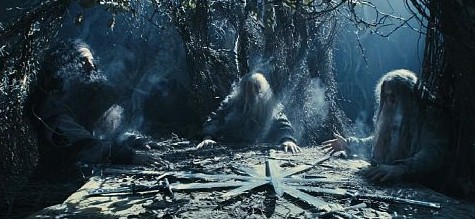
“What sat in those three chairs was three men, though hard to recognize as men till you looked closely. Their hair, which was gray, had grown over their eyes till it almost concealed their faces, and their beards had grown over the table, climbing round and entwining plates and goblets as brambles entwine a fence, until, all mixed in one great mat of hair, they flowed over the edge and down to the floor. And from their heads the hair hung over the backs of their chairs so that they were wholly hidden. In fact the three men were nearly all hair.”
Last week, when I was reading and discussing an excerpt from Chris Hallquist’s in-progress book, Alan drew a distinction between squabbling theologians and atheists in disagreement:
But you have thousands of control guys each claiming exclusive expertise (and that the other experts are in fact wrong). Sure, I may gain something by talking to each of them but I certainly won’t be using them as definitive expertise on the endeavor.
Also, I think the idea of ‘true atheism’ is silly and in no way comparable to true theism. Atheism is simply the disbelief in gods – there is no true or false version of it. There are no variations on the nature of these non-gods or what these non-gods demand of you. You may be trying to say you don’t expect to find the immediately true version of a holistic ethics or metaphysics that excludes gods – but that is a different category and begs the question that such a true version actually exists. Something one need not claim to be an atheist (while nearly all theists that I have ever come across do claim).
Alan is definitely right that there’s no canonical atheism or one atheist intellectual tradition. There’s no reason to expect not!theists to have more in common with each other than not!monarchists. But Alan and other atheists do have a rooting interest in a question that tends to look about as jumbled up as theology: moral philosophy.
Over at LessWrong, Luke Muelhauser recently kicked off a post titled “Philosophy Needs to Trust Your Rationality Even Though It Shouldn’t” by quoting Thomas Kelly:
Philosophy is notable for the extent to which disagreements with respect to even those most basic questions persist among its most able practitioners, despite the fact that the arguments thought relevant to the disputed questions are typically well-known to all parties to the dispute
Luke goes on to say that philosophy doesn’t have some of the advantages of science. The questions that physical science asks are a lot easier to settle definitively, because the physical evidence just ends up being overwhelming. To deny these data, you’d have to jettison too much of your understanding of the world to function in it. But philosophers are working on questions that are hard to test, and they need to be a lot more sensitive to smaller shifts in confidence and/or better at figuring out how to differentiate between hypotheses. He recommends they read more Kahneman (and, really, who shouldn’t?).
But plenty of people have read Kahneman, know about Aumann’s Agreement Theorem, and still disagree about ethics, let alone more-inaccessible metaphysics. So we’ve all got the theologian problem, just in different spheres — some of which feel a lot more germane than theology! We don’t just want to know which person is the level boss on the other side that we have to defeat; we need to know who to follow. When there’s not a clear consensus, we still have to wade into this messy problem, unless we’re willing to deny the cat.
Previous Post

December 4, 2012
Is Judgement Always about Punishment?
Next Post
December 6, 2012 Can you Cyrano de Bergerac your moral philosophy?
Browse Our Archives
Select a Category 7 Quick Takes Apologetics Atheism Book Conversion Debate Tactics Debates Epistemology/Philosophy Housekeeping Ideological Turing Test Marriage Morality in Practice Parsing Catholicism Possibly Heretical Radio Reviews/Recommendations Sequence Index Spiritual Practice Uncategorized
Select a Month April 2017 March 2017 January 2017 December 2016 September 2016 August 2016 July 2016 June 2016 May 2016 April 2016 March 2016 February 2016 January 2016 December 2015 November 2015 October 2015 September 2015 August 2015 July 2015 June 2015 May 2015 April 2015 March 2015 February 2015 January 2015 December 2014 November 2014 October 2014 September 2014 August 2014 July 2014 June 2014 May 2014 April 2014 March 2014 February 2014 January 2014 December 2013 November 2013 October 2013 September 2013 August 2013 July 2013 June 2013 May 2013 April 2013 March 2013 February 2013 January 2013 December 2012 November 2012 October 2012 September 2012 August 2012 July 2012 June 2012 May 2012 April 2012 March 2012 February 2012 January 2012 December 2011 November 2011 October 2011 September 2011 August 2011 July 2011 June 2011 May 2011 April 2011 March 2011 February 2011 January 2011 December 2010 November 2010 October 2010 September 2010 August 2010 July 2010 June 2010
Follow Us!
TAKE THE
Religious Wisdom Quiz
True or False: The Israelites wandered in the wilderness for forty years.
Select your answer to see how you score.
FALSE TRUE
Related posts from Unequally Yoked

Rational Faith: More working hypothesis than logical proof

Life Lessons that Can't be Taught at College's...

Books that Change the Way You Think [Radio...

Your religion... is it bigger than a breadbox?
TRENDING AT PATHEOS Catholic

Rejecting Doom: Christian Hope And Human Action
Christianity is a religion of hope. We are to have hope and...

It’s What Comes From Within Which Matters
One of the most difficult things for us to understand is why...

Why I Choose the Eucharist Over the Sermon
Choose the Eucharist, Not the Sermon What are we supposed to get...

5 Design Elements Found in Spiritually Rooted Homes
Putting Spirituality Into Home Decor Our homes are more than our living...

Credo: A Story of God Told with the...
About 10 years ago, I began to imagine a personal "Credo" that...

The Anatomy of Divine Revelation in Catholic Thought
The claim that God has made Himself known to human beings is...
view all Catholic blogs
Ad-Free & Subscriber Log-In Subscription Support
- About Us
- 2026 Calendar
- Videos
- Podcasts
- Library of World Religions
- Faith In Media Tracker
- Advertise With Us
- Write for Us
- Privacy Policy
- Terms of Service
- Do Not Sell My Data
- Contact Us
- Radiant Digital
- Manage Newsletter Subscriptions
- Unsubscribe From Notifications
- Sitemap
Copyright 2008-2026, Patheos. All rights reserved.
Subscription Support Ad-Free & Subscriber Log-In
Follow Patheos