
BuddhistCatholicContemplativeEvangelicalGeneral ChristianHinduJewishLatter-day SaintMuslimNew VisionsProgressive Christian
Beliefs
- Buddhist
- Catholic
- Contemplative
- Evangelical
- General Christian
- Hindu
- Jewish
- Latter-day Saint
- More Voices
- Muslim
- New Visions
- Pagan
- Progressive Christian
Topics
- Religion News
- Food and Religion
- Sports and Religion
- Religious Art
- Religious Music and Entertainment
- Religious Events
- History and Religion
- Style and Religion
- Politics and Religion
- Women in Religion
- Recreation Outdoors and Religion
- Business Finance and Religion
- Careers Workplace and Religion
- Education and Religion
- Family Parenting and Religion
- Health Fitness and Religion
- Home and Religion
- Relationships and Religion
- Technology and Religion
- Travel and Religion
Columnists
- Buddhist Columnists
- Business Finance and Religion Columnists
- Careers Workplace and Religion Columnists
- Catholic Columnists
- Contemplative Columnists
- Education and Religion Columnists
- Evangelists Columnists
- Family Parenting and Religion Columnists
- General Christian Columnists
- Health Fitness and Religion Columnists
- Hindu Columnists
- History and Religion Columnists
- Home and Religion Columnists
- Jewish Columnists
- More Voices Columnists
- Latter Day Columnists
- Muslim Columnists
- New Visions Columnists
- Nonreligious Columnists
- Pagan Columnists
- Politics and Religion Columnists
- Progressive Columnists
- Recreation Outdoors and Religion Columnists
- Relationships and Religion Columnists
- Religion News Columnists
- Religious Art Columnists
- Religious Events Columnists
- Religious Music and Entertainment Columnists
- Sports and Religion Columnists
- Style and Religion Columnists
- Technology and Religion Columnists
- Travel and Religion Columnists
- Women in Religion Columnists
Resource Library
- 2026 Calendar
- Library of World Religions
- The 100 Most Holy Places on Earth
- Patheos Answers
- Podcasts
- Videos
- Faith Leaders Database
- Anglican Episcopalian
- Bahai
- Baptist
- Buddhism
- Christianity
- Confucianism
- Eastern Orthodoxy
- Hinduism
- Holiness and Pentecostal
- ISKCON
- Islam
- Judaism
- Lutheran
- Methodist
- The Church of Jesus Christ of Latter-day Saints
- New Age
- Paganism
- Presbytarian and Reformed
- Protestantism
- Religion Behind the Scenes
- Roman Catholic
- Scientology
- Shia Islam
- Sikhism
- Sufism
- Sunni Islam
- Taoism
- Zen
- See all religions
Research Tools
 Ad-Free & Subscriber Log-In Subscription Support
Ad-Free & Subscriber Log-In Subscription Support
Follow Patheos 

- Trending:
- Forgiveness
- |
- Marriage
- |
- Consciousness
- |
- Death Penalty
- |
- Election
- |
- Halloween
 Unequally Yoked
- Home
- Catholic
- Mormon Enthusiasm for the Self-Made Man
Mormon Enthusiasm for the Self-Made Man
Last updated on: December 31, 2012 at 8:26 pm by Leah Libresco
Mormon Enthusiasm for the Self-Made Man 2012-12-31T20:26:17-05:00 Leah Libresco
Patheos Explore the world's faith through different perspectives on religion and spirituality! Patheos has the views of the prevalent religions and spiritualities of the world.
I received a free review copy of The God Who Weeps: How Mormonism Makes Sense of Life as part of the Patheos Book Club.
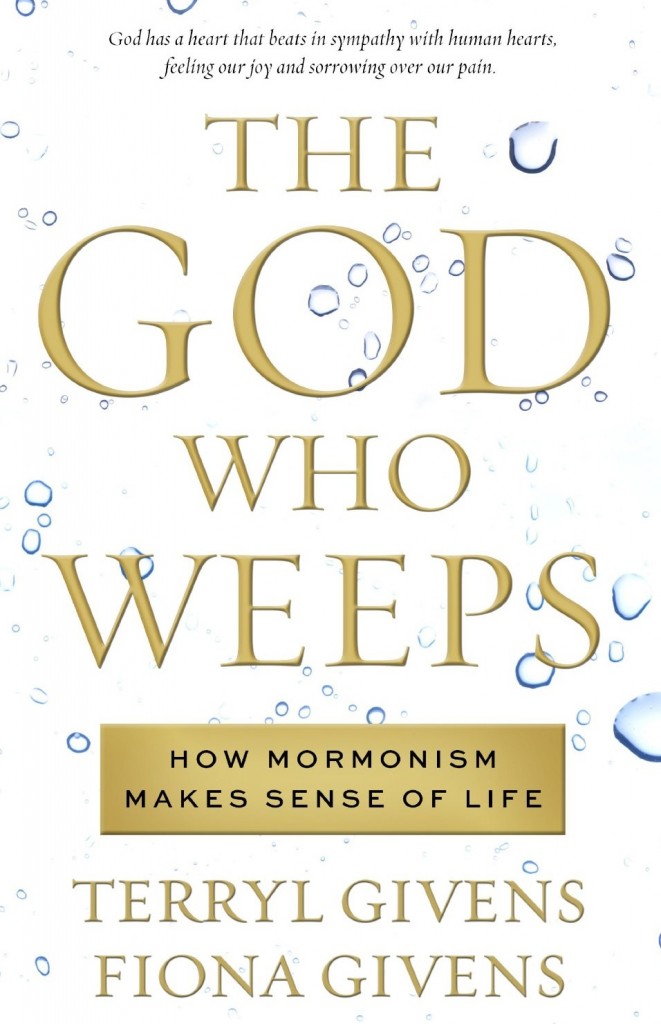
I’m glad to have read The God Who Weeps, since, even in the midst of all the Romney controversy, there’s been very little discussion of Mormon theology. Reporters prefer to cover the Temple rituals because they’re secret, and therefore must be interesting. The Book of Mormon musical prompted some error-checking, but not very many details about what would have been the correct lyrics to “I Believe.” And most people don’t have access to Michael Haycock, who writes an interesting blog on Mormonism (the most recent post has graphs!) and popped by to answer questions about LDS priesthood a while ago.
Givens’ book does more to flesh out Mormon doctrine than anything else I’ve stumbled across, but I wish it spent more time on the how as well as the what of Mormon theology. Some of the arguments remind me of my least favorite apologetic from C.S. Lewis — that the existence of a desire proves that something exists to satisfy that desire.
The authors make a similar pitch for the soul as eternal, with no beginning as well as no end. They argue that all knowledge is memory, so we must have experience prior to our incarnation. They answer Lewis’s question by supposing we have already experienced the thing we desire, prior to birth, and our yearning is the result of our memory of this sated desire. This argument has come up elsewhere in philosophy and cognitive science. It would have been nice to see some of the common objections raised and answered. The God Who Weeps frequently cites literature and poetry, but could have stood to draw a little more on empirical studies.
Frequently, it feels like The God Who Weeps is making an aesthetic argument. The Mormon God is presented as more compassionate, the Mormon salvation story as more optimistic than standard Christian dogma. But what really drew my attention was the book’s focus on human agency. In this story of the Fall, Adam and Eve are not transgressors but partners. The authors frame Eve’s choice not as an act of disobedience but as a dilemma between competing goods. (“Adam and Eve became more, not less, like God insofar as they came to see the same moral distinctions He did”).
But perhaps, in Mormon thinking, the act of disobedience was not such a wound in the word because the relationship between humans and God is a little more tenuous. Part of the aesthetic pitch for a soul that precedes birth is as follows:
In our present, earthly form, we are clearly the product of forces outside our control… and yet, we know we are free. How can this be, unless there is something at the heart of our identity that was not shaped by our environment, not inherited from our parents, and not even created by God?
…Our lives are more like a canvas on which we paint than a script we need to learn–though the illusion of the latter appeals to us by its lower risk. It is easier to learn a part than to create a work of art. The mystery is, how can I be free to shape my own desires, how can I be responsible to the inclination of my heart, for my tendency to love light or darkness, if God created my spirit out of nothing, calling me into existence by His sovereign power, only at the moment of my birth and conception.
The authors celebrate Adam and Eve gaining experiential knowledge of good and evil, because it lessened their dependence on God. The authors seem to be looking toward a fraternal relationship between humans and God (their God chooses to act as a Father, but isn’t intended as Creator). To me, this is a strange freedom to long for. Constraints make identity. I am born dependent, and the love I owe my parents shapes how I can grow. That’s excellent! Undirected and untrammelled growth is the philosophy of cancer.
I don’t want to be free of some constraints (like conscience) any more than I would resent my hearing because it is passive. I don’t choose to hear, I receive impressions of the world around me constantly and without conscious choice. Choosing to learn a script is a meaningful and excellent choice. I’d rather be good than unique (not that it’s necessarily a dichotomy, or that I’m that adept at either).
Later in the book, it’s not clear to me that the Givens have succeeded in enriching human dignity by expanding human independence. As part of their argument for the uncreated soul, the authors come off as nearly as gnostic as I am on a bad day:
If an origin among the stars is difficult to believe, an existence thought to commence with our mortal birth has its own absurdities to contend with. Many beginnings may be inauspicious, but they should at least bear the seeds of future glories… But what are we to say about human beings? That a paltry creature, an anonymous urchin, may grow into a Shakespeare, a Newton, a Mother Teresa is miracle enough. Shall we also claim the destiny of an eternal being for a babe that springs into existence by mere happenstance?
There is an almost intolerable lack of sober reflection, foresight, and design behind most human conception. Life begins by chance,by accident, by violence, or by carelessness. The young, the frivolous, the unworthy, and the thoughtless can engender a child. And yet the product engendered is one we recognize as something majestic, touched with dignity, and endowed with immortality.
Perhaps the dignity of a child is perplexing because sex is not an act of creation in this view. The immortal soul is just slipping into a meatsuit, ready to take on its own independent pursuits. Reading through the whole book, it does seem like the authors think that these uncreated souls, in or out of human flesh, have some sort of telos. What I can’t figure out is where that obligation/binding comes from.
freedom means choosing a master
Previous Post

December 30, 2012
How do you finish being angry?
Next Post

January 1, 2013 Help Me Keep A New Year's Resolution
Browse Our Archives
Select a Category 7 Quick Takes Apologetics Atheism Book Conversion Debate Tactics Debates Epistemology/Philosophy Housekeeping Ideological Turing Test Marriage Morality in Practice Parsing Catholicism Possibly Heretical Radio Reviews/Recommendations Sequence Index Spiritual Practice Uncategorized
Select a Month April 2017 March 2017 January 2017 December 2016 September 2016 August 2016 July 2016 June 2016 May 2016 April 2016 March 2016 February 2016 January 2016 December 2015 November 2015 October 2015 September 2015 August 2015 July 2015 June 2015 May 2015 April 2015 March 2015 February 2015 January 2015 December 2014 November 2014 October 2014 September 2014 August 2014 July 2014 June 2014 May 2014 April 2014 March 2014 February 2014 January 2014 December 2013 November 2013 October 2013 September 2013 August 2013 July 2013 June 2013 May 2013 April 2013 March 2013 February 2013 January 2013 December 2012 November 2012 October 2012 September 2012 August 2012 July 2012 June 2012 May 2012 April 2012 March 2012 February 2012 January 2012 December 2011 November 2011 October 2011 September 2011 August 2011 July 2011 June 2011 May 2011 April 2011 March 2011 February 2011 January 2011 December 2010 November 2010 October 2010 September 2010 August 2010 July 2010 June 2010
Follow Us!
TAKE THE
Religious Wisdom Quiz
Who was the youngest friend who rebuked Job and the other friends?
Select your answer to see how you score.
Zophar Bildad Elihu Eliphaz
Related posts from Unequally Yoked



The Boring, Quiet Rituals That Sustain Us Spiritually

Starving Laypeople of Devotion in Church
TRENDING AT PATHEOS Catholic

Rejecting Doom: Christian Hope And Human Action
Christianity is a religion of hope. We are to have hope and...

It’s What Comes From Within Which Matters
One of the most difficult things for us to understand is why...

Why I Choose the Eucharist Over the Sermon
Choose the Eucharist, Not the Sermon What are we supposed to get...

5 Design Elements Found in Spiritually Rooted Homes
Putting Spirituality Into Home Decor Our homes are more than our living...

Credo: A Story of God Told with the...
About 10 years ago, I began to imagine a personal "Credo" that...

The Anatomy of Divine Revelation in Catholic Thought
The claim that God has made Himself known to human beings is...
view all Catholic blogs
Ad-Free & Subscriber Log-In Subscription Support
- About Us
- 2026 Calendar
- Videos
- Podcasts
- Library of World Religions
- Faith In Media Tracker
- Advertise With Us
- Write for Us
- Privacy Policy
- Terms of Service
- Do Not Sell My Data
- Contact Us
- Radiant Digital
- Manage Newsletter Subscriptions
- Unsubscribe From Notifications
- Sitemap
Copyright 2008-2026, Patheos. All rights reserved.
Subscription Support Ad-Free & Subscriber Log-In
Follow Patheos