
BuddhistCatholicContemplativeEvangelicalGeneral ChristianHinduJewishLatter-day SaintMuslimNew VisionsProgressive Christian
Beliefs
- Buddhist
- Catholic
- Contemplative
- Evangelical
- General Christian
- Hindu
- Jewish
- Latter-day Saint
- More Voices
- Muslim
- New Visions
- Pagan
- Progressive Christian
Topics
- Religion News
- Food and Religion
- Sports and Religion
- Religious Art
- Religious Music and Entertainment
- Religious Events
- History and Religion
- Style and Religion
- Politics and Religion
- Women in Religion
- Recreation Outdoors and Religion
- Business Finance and Religion
- Careers Workplace and Religion
- Education and Religion
- Family Parenting and Religion
- Health Fitness and Religion
- Home and Religion
- Relationships and Religion
- Technology and Religion
- Travel and Religion
Columnists
- Buddhist Columnists
- Business Finance and Religion Columnists
- Careers Workplace and Religion Columnists
- Catholic Columnists
- Contemplative Columnists
- Education and Religion Columnists
- Evangelists Columnists
- Family Parenting and Religion Columnists
- General Christian Columnists
- Health Fitness and Religion Columnists
- Hindu Columnists
- History and Religion Columnists
- Home and Religion Columnists
- Jewish Columnists
- More Voices Columnists
- Latter Day Columnists
- Muslim Columnists
- New Visions Columnists
- Nonreligious Columnists
- Pagan Columnists
- Politics and Religion Columnists
- Progressive Columnists
- Recreation Outdoors and Religion Columnists
- Relationships and Religion Columnists
- Religion News Columnists
- Religious Art Columnists
- Religious Events Columnists
- Religious Music and Entertainment Columnists
- Sports and Religion Columnists
- Style and Religion Columnists
- Technology and Religion Columnists
- Travel and Religion Columnists
- Women in Religion Columnists
Resource Library
- 2026 Calendar
- Library of World Religions
- The 100 Most Holy Places on Earth
- Patheos Answers
- Podcasts
- Videos
- Faith Leaders Database
- Anglican Episcopalian
- Bahai
- Baptist
- Buddhism
- Christianity
- Confucianism
- Eastern Orthodoxy
- Hinduism
- Holiness and Pentecostal
- ISKCON
- Islam
- Judaism
- Lutheran
- Methodist
- The Church of Jesus Christ of Latter-day Saints
- New Age
- Paganism
- Presbytarian and Reformed
- Protestantism
- Religion Behind the Scenes
- Roman Catholic
- Scientology
- Shia Islam
- Sikhism
- Sufism
- Sunni Islam
- Taoism
- Zen
- See all religions
Research Tools
 Ad-Free & Subscriber Log-In Subscription Support
Ad-Free & Subscriber Log-In Subscription Support
Follow Patheos 

- Trending:
- Forgiveness
- |
- Marriage
- |
- Consciousness
- |
- Death Penalty
- |
- Election
- |
- Halloween
 Unequally Yoked
- Home
- Catholic
- Javert and Valjean at Prayer
Javert and Valjean at Prayer
Last updated on: December 28, 2012 at 3:50 pm by Leah Libresco
Javert and Valjean at Prayer 2012-12-28T15:50:04-05:00 Leah Libresco
Patheos Explore the world's faith through different perspectives on religion and spirituality! Patheos has the views of the prevalent religions and spiritualities of the world.

What are puppy dog eyes doing here? Anathema.
The two things I found most frustrating about the Les Mis movie were the camerawork and Russell Crowe’s performance as Javert. And they both came together to annoy me during “Stars.” Crowe is sad-eyed instead of steely from his first appearance and, for this number, director Tom Hooper places him on a ledge. This seems to be done simply so that Hooper can set up some parallelism in his cimematography; the shots of Javert walking right along the edge of the roof in “Stars” are echoed when he paces the bridge in “Soliloquy (Javert’s Suicide).”
But these two scenes don’t correspond in this way. Javert has no suicidal ideation; he is pure certainty. Frankly, even the pacing, on or off a roof, makes no sense. Javert is complete and stable in himself. It’s very fashionable to show villians as sympathetic by revealing their weakness and doubt, but it might be a more accurate (and a better warning!) to show that uncharity can feel like joyful strength. In Hugo’s novel, he describes Javert as follows.
He, Javert personified justice, light, and truth, in their celestial function as destroyers of evil. He was surrounded and supported by infinite depths of authority, reason, precedent, legal conscience, the vengeance of the law, all the stars in the firmament; he protected order, he hurled forth the thunder of the law, he avenged society, he lent aid to the absolute; he stood erect in a halo of glory; there was in his victory a reminder of defiance and of combat; standing haughty resplendent he displayed in full glory the superhuman beastliness of a ferocious archangel; the fearful shadow of the deed which he was accomplishing, making visible in his clenched fist the uncertain flashes of the social sword; happy and indignant, he had set his heel on crime, vice, rebellion, perdition, and hell, he was radiant, exterminating, smiling; there was an incontestable grandeur in this monstrous St. Michael.
Javert is a grotesque echo of something beautiful and truly desirable He lives in the moral uncanny valley. Crowe’s best moment as Javert comes after he is discovered by the revolutionaries, who plan to put him to death. He barks out, “Shoot me now or shoot me later / Every schoolboy to his sport / Death to each and every traitor / I renounce your people’s court!” His defiance is tinged with contempt, but here Crowe musters a joy akin to the Trappist martyrs in Of Gods and Men. He is free because he answers to something higher than other men and is conserving something beside his own life.
The film could have done more to heighten Javert’s jarring not-quite-virtue if “Stars” had been set up to parallel “What Have I Done” instead of the suicide. Valjean sings “What Have I Done” in a moment of profound doubt, as he decides whether he can accept the forgiveness of the bishop he has robbed. Let’s listen to it again:
The staging of this number also frustrated me, since it was really ham-handed. In Hooper’s production, Valjean sings this number while in a side chapel of the bishop’s church. It also involves a lot of pacing with too-literal blocking. During the parts of the song where Valjean wants to yield to grace, he walks toward the chapel; when he doubts, he walks away.
But, since both “What Have I Done” and “Stars” are offered up as prayers, imagine if they were both set in church, so we could contrast the Catholicism of both characters. Here, Valjean is working out his salvation with fear and trembling, just on the cusp of succumbing, while Javert is a rock of stability. Valjean is pursued by furies, while Javert is full of peace and joy.
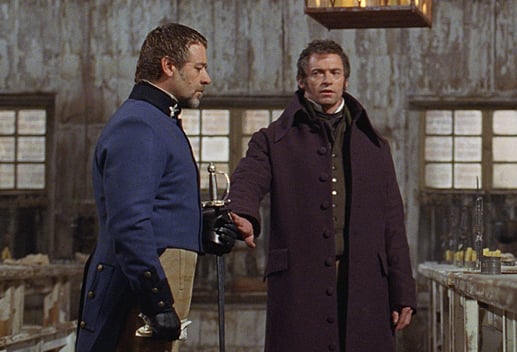
Until we rest in Heaven, something about the Imago Dei will chafe us. That discomfort is data; we can turn in towards the flinches to find what to mend. Javert’s warning is in his peace. He must pray to a very small god, if that god is satisfied with Javert-as-he-is, and only requires him to hold the line. Valjean’s conversion begins with his own weakness; when he wonders how he can know that he has a soul, he has his answer in the lyric “I feel my shame inside me like a knife.”
Valjean’s virtue is in choosing to throw himself into the pain, so he can emerge on the other side of the crucible as a new creation. Valjean’s persistence is the result of the same confidence and joy that Javert has in defying Enjolras and the students. But Valjean has cast himself into battle against a subtler and more powerful enemy; Enjolras threatens to take Javert’s life, but only Valjean himself can threaten his own soul. His worship and his defense is constant transformation and dying to self.
To watch both men at prayer is to see the danger of absolute faith and love given to anything lower than God. Javert’s certainty is the proof of his idolatry, while Valjean suffers because he is growing into something larger than himself.
freedom means choosing a master
Previous Post

December 28, 2012
7 Quick Takes (12/28/12)
Next Post

December 29, 2012 The Inspector Javert Medley [Sequence Index]
Browse Our Archives
Select a Category 7 Quick Takes Apologetics Atheism Book Conversion Debate Tactics Debates Epistemology/Philosophy Housekeeping Ideological Turing Test Marriage Morality in Practice Parsing Catholicism Possibly Heretical Radio Reviews/Recommendations Sequence Index Spiritual Practice Uncategorized
Select a Month April 2017 March 2017 January 2017 December 2016 September 2016 August 2016 July 2016 June 2016 May 2016 April 2016 March 2016 February 2016 January 2016 December 2015 November 2015 October 2015 September 2015 August 2015 July 2015 June 2015 May 2015 April 2015 March 2015 February 2015 January 2015 December 2014 November 2014 October 2014 September 2014 August 2014 July 2014 June 2014 May 2014 April 2014 March 2014 February 2014 January 2014 December 2013 November 2013 October 2013 September 2013 August 2013 July 2013 June 2013 May 2013 April 2013 March 2013 February 2013 January 2013 December 2012 November 2012 October 2012 September 2012 August 2012 July 2012 June 2012 May 2012 April 2012 March 2012 February 2012 January 2012 December 2011 November 2011 October 2011 September 2011 August 2011 July 2011 June 2011 May 2011 April 2011 March 2011 February 2011 January 2011 December 2010 November 2010 October 2010 September 2010 August 2010 July 2010 June 2010
Follow Us!
TAKE THE
Religious Wisdom Quiz
What Christian group is known for using incense during worship?
Select your answer to see how you score.
Baptists Pentecostals Orthodox Christians Jehovah’s Witnesses
Related posts from Unequally Yoked
Running the Stats on Shakespeare!

Dwelling In Wounds To Hide From Grace
How To Offer Community Without Communion

It's Hard To Be A Priest In America,...
TRENDING AT PATHEOS Catholic

Rejecting Doom: Christian Hope And Human Action
Christianity is a religion of hope. We are to have hope and...

It’s What Comes From Within Which Matters
One of the most difficult things for us to understand is why...

Why I Choose the Eucharist Over the Sermon
Choose the Eucharist, Not the Sermon What are we supposed to get...

5 Design Elements Found in Spiritually Rooted Homes
Putting Spirituality Into Home Decor Our homes are more than our living...

Credo: A Story of God Told with the...
About 10 years ago, I began to imagine a personal "Credo" that...

The Anatomy of Divine Revelation in Catholic Thought
The claim that God has made Himself known to human beings is...
view all Catholic blogs
Ad-Free & Subscriber Log-In Subscription Support
- About Us
- 2026 Calendar
- Videos
- Podcasts
- Library of World Religions
- Faith In Media Tracker
- Advertise With Us
- Write for Us
- Privacy Policy
- Terms of Service
- Do Not Sell My Data
- Contact Us
- Radiant Digital
- Manage Newsletter Subscriptions
- Unsubscribe From Notifications
- Sitemap
Copyright 2008-2026, Patheos. All rights reserved.
Subscription Support Ad-Free & Subscriber Log-In
Follow Patheos