
BuddhistCatholicContemplativeEvangelicalGeneral ChristianHinduJewishLatter-day SaintMuslimNew VisionsProgressive Christian
Beliefs
- Buddhist
- Catholic
- Contemplative
- Evangelical
- General Christian
- Hindu
- Jewish
- Latter-day Saint
- More Voices
- Muslim
- New Visions
- Pagan
- Progressive Christian
Topics
- Religion News
- Food and Religion
- Sports and Religion
- Religious Art
- Religious Music and Entertainment
- Religious Events
- History and Religion
- Style and Religion
- Politics and Religion
- Women in Religion
- Recreation Outdoors and Religion
- Business Finance and Religion
- Careers Workplace and Religion
- Education and Religion
- Family Parenting and Religion
- Health Fitness and Religion
- Home and Religion
- Relationships and Religion
- Technology and Religion
- Travel and Religion
Columnists
- Buddhist Columnists
- Business Finance and Religion Columnists
- Careers Workplace and Religion Columnists
- Catholic Columnists
- Contemplative Columnists
- Education and Religion Columnists
- Evangelists Columnists
- Family Parenting and Religion Columnists
- General Christian Columnists
- Health Fitness and Religion Columnists
- Hindu Columnists
- History and Religion Columnists
- Home and Religion Columnists
- Jewish Columnists
- More Voices Columnists
- Latter Day Columnists
- Muslim Columnists
- New Visions Columnists
- Nonreligious Columnists
- Pagan Columnists
- Politics and Religion Columnists
- Progressive Columnists
- Recreation Outdoors and Religion Columnists
- Relationships and Religion Columnists
- Religion News Columnists
- Religious Art Columnists
- Religious Events Columnists
- Religious Music and Entertainment Columnists
- Sports and Religion Columnists
- Style and Religion Columnists
- Technology and Religion Columnists
- Travel and Religion Columnists
- Women in Religion Columnists
Resource Library
- 2026 Calendar
- Library of World Religions
- The 100 Most Holy Places on Earth
- Patheos Answers
- Podcasts
- Videos
- Faith Leaders Database
- Anglican Episcopalian
- Bahai
- Baptist
- Buddhism
- Christianity
- Confucianism
- Eastern Orthodoxy
- Hinduism
- Holiness and Pentecostal
- ISKCON
- Islam
- Judaism
- Lutheran
- Methodist
- The Church of Jesus Christ of Latter-day Saints
- New Age
- Paganism
- Presbytarian and Reformed
- Protestantism
- Religion Behind the Scenes
- Roman Catholic
- Scientology
- Shia Islam
- Sikhism
- Sufism
- Sunni Islam
- Taoism
- Zen
- See all religions
Research Tools
 Ad-Free & Subscriber Log-In Subscription Support
Ad-Free & Subscriber Log-In Subscription Support
Follow Patheos 

- Trending:
- Forgiveness
- |
- Marriage
- |
- Consciousness
- |
- Death Penalty
- |
- Election
- |
- Halloween
 Unequally Yoked
- Home
- Catholic
- “Give Us More To See”
“Give Us More To See”
Last updated on: December 11, 2012 at 6:18 pm by Leah Libresco
“Give Us More To See” 2012-12-11T18:18:22-05:00 Leah Libresco
Patheos Explore the world's faith through different perspectives on religion and spirituality! Patheos has the views of the prevalent religions and spiritualities of the world.
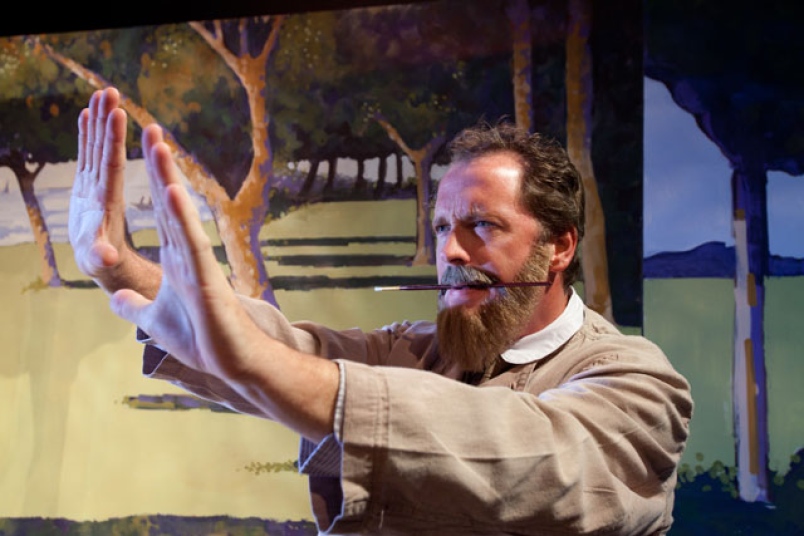
“But how George looks. He could look forever
As if he sees you and he doesn’t all at once.”
Yesterday, I used Georges Seurat (as imagined by Stephen Sondheim in Sunday in the Park with George) to open up a discussion about the difficulty of pursuing intimacy with God (or, often, other people). Play!George might approve of my framing a discussion of truth through artifice, since that’s exactly how he manages to see and comprehend others in the show. In “Finishing the Hat” (below), George explains that he can only understand or interact with people from a distance.
Entering the world of the hat.
Reaching through the world of the hat like a window
Back to this one from that.Studying a face.
Stepping back to look at a face,
leaves a little space in the way like a window.
But to see–
It’s the only way to see.
People are just too much. When he is completely open and present to them, George can’t make any sense out of them. It’s all as much “Chaos” and is as senseless as scanning George’s pointillist painting dot by dot and trying to understand the whole image. But Dot, his lover, either doesn’t realize that this is what intimacy looks like for George, or she doesn’t trust him that his distance allows him perspective, instead of an excuse to blur out what doesn’t appeal. How can she tell?
Maybe George isn’t even engaged enough to merit the accusation that Roger levels at filmmaker Mark in another musical (“You’re always preaching not to be numb, but that’s how you thrive. You pretend to create and observe when you really detach from being alive”). Mark sees the real world, but holds himself back from participation, but Dot justifiably fears that George might not even be withdrawing from her, just his image of her. But I think there’s a hint to the accuracy of George’s vision in the opening of “The Day Off.” George sketches a dog and sings:
If the head was smaller…
If the tail were longer…
If he faced the water…
If the paws were hidden…
If the neck was darker…
If the back was curved…
More like the parasol…
George doesn’t just see, he alters. While I was watching the show, I wasn’t sure if this was a positive sign. If George is just using his art to assert mastery over the world around him as he “brings order to the whole” it looks like a point in favor of Dot’s theory that he doesn’t really know her. But, in order to alter Dot, or the dog, he must be able to see them accurately. Working to bring the elements of his painting into harmony means that George must be intensely aware of every way they jangle against his imagined ideal.
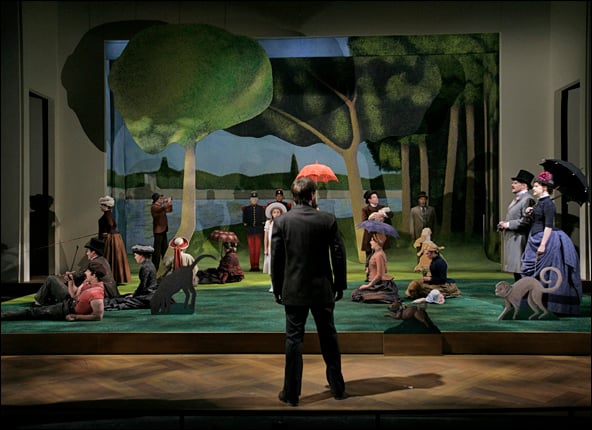
Call it the via negativa, the grotesque, or the virtue of an almost-right solution, but this seems to be exactly what Lewis called for in the Screwtape Letters; an awareness of the inadequacy of the constructed image. By noticing where the representation fails, you gain a better understanding of the thing you still may not be able to picture. Almost-convincing androids show us what we recognize as human; nearly-plausible chatbots teach us what we value most about conversation.
Here’s a practical example. Most days, I pray Morning and Night Office from the Liturgy of the Hours. When I’ve got a bit of extra time, I try to translate the psalms into ASL as I go. I’m pretty terrible at this, since my vocabulary and syntax are patchy, and that ends up being pretty helpful. I might read something like:
My dwelling, like a shepherd’s tent,
is struck down and borne away from me
And see how close I can get with
An actual translator could pull something similarly poetic, but I’m like a Deaf toddler. The inadequacy of my vocabulary is frustrating, and it draws my attention back to the nuances of the prayer I’m making. “Leave” isn’t really like “borne away.” Someone could leave on their own, but if my home is being borne away, I might reasonably wonder who’s doing the bearing and what use they plan to make of it.
Or sometimes, I’ll be surprised by the appropriateness of the sign that reveals something visceral I was missing in the English. I can’t find a decent ASL video of the Agnus Dei, but it’s a lot harder to gloss over the magnitude of “Have mercy on us” when you actually have to inflect the mercy sign as directed to you from God.
We may long for the beatific vision, but we can’t achieve it on our own efforts. The best I can do is to be present enough to be discombobulated by the lacunae in my model. Because if I have a hole, I must have a kind of sense of what it fits (or, at least, what it doesn’t).
Previous Post
December 10, 2012
Finishing the Imago Dei
Next Post

December 12, 2012 Superpowered Feminism
Browse Our Archives
Select a Category 7 Quick Takes Apologetics Atheism Book Conversion Debate Tactics Debates Epistemology/Philosophy Housekeeping Ideological Turing Test Marriage Morality in Practice Parsing Catholicism Possibly Heretical Radio Reviews/Recommendations Sequence Index Spiritual Practice Uncategorized
Select a Month April 2017 March 2017 January 2017 December 2016 September 2016 August 2016 July 2016 June 2016 May 2016 April 2016 March 2016 February 2016 January 2016 December 2015 November 2015 October 2015 September 2015 August 2015 July 2015 June 2015 May 2015 April 2015 March 2015 February 2015 January 2015 December 2014 November 2014 October 2014 September 2014 August 2014 July 2014 June 2014 May 2014 April 2014 March 2014 February 2014 January 2014 December 2013 November 2013 October 2013 September 2013 August 2013 July 2013 June 2013 May 2013 April 2013 March 2013 February 2013 January 2013 December 2012 November 2012 October 2012 September 2012 August 2012 July 2012 June 2012 May 2012 April 2012 March 2012 February 2012 January 2012 December 2011 November 2011 October 2011 September 2011 August 2011 July 2011 June 2011 May 2011 April 2011 March 2011 February 2011 January 2011 December 2010 November 2010 October 2010 September 2010 August 2010 July 2010 June 2010
Follow Us!
TAKE THE
Religious Wisdom Quiz
What did Moses do after breaking the tablets?
Select your answer to see how you score.
Fasted for 30 days Returned to Sinai for new tablets Left the camp Destroyed the calf
Related posts from Unequally Yoked

Starving Laypeople of Devotion in Church

Rational Faith: More working hypothesis than logical proof

Aunt Alberta And Being Right (but the boring...

The Virtues of Sad Songs (a piece for...
TRENDING AT PATHEOS Catholic

Rejecting Doom: Christian Hope And Human Action
Christianity is a religion of hope. We are to have hope and...

It’s What Comes From Within Which Matters
One of the most difficult things for us to understand is why...

Why I Choose the Eucharist Over the Sermon
Choose the Eucharist, Not the Sermon What are we supposed to get...

5 Design Elements Found in Spiritually Rooted Homes
Putting Spirituality Into Home Decor Our homes are more than our living...

Credo: A Story of God Told with the...
About 10 years ago, I began to imagine a personal "Credo" that...

The Anatomy of Divine Revelation in Catholic Thought
The claim that God has made Himself known to human beings is...
view all Catholic blogs
Ad-Free & Subscriber Log-In Subscription Support
- About Us
- 2026 Calendar
- Videos
- Podcasts
- Library of World Religions
- Faith In Media Tracker
- Advertise With Us
- Write for Us
- Privacy Policy
- Terms of Service
- Do Not Sell My Data
- Contact Us
- Radiant Digital
- Manage Newsletter Subscriptions
- Unsubscribe From Notifications
- Sitemap
Copyright 2008-2026, Patheos. All rights reserved.
Subscription Support Ad-Free & Subscriber Log-In
Follow Patheos