
BuddhistCatholicContemplativeEvangelicalGeneral ChristianHinduJewishLatter-day SaintMuslimNew VisionsProgressive Christian
Beliefs
- Buddhist
- Catholic
- Contemplative
- Evangelical
- General Christian
- Hindu
- Jewish
- Latter-day Saint
- More Voices
- Muslim
- New Visions
- Pagan
- Progressive Christian
Topics
- Religion News
- Food and Religion
- Sports and Religion
- Religious Art
- Religious Music and Entertainment
- Religious Events
- History and Religion
- Style and Religion
- Politics and Religion
- Women in Religion
- Recreation Outdoors and Religion
- Business Finance and Religion
- Careers Workplace and Religion
- Education and Religion
- Family Parenting and Religion
- Health Fitness and Religion
- Home and Religion
- Relationships and Religion
- Technology and Religion
- Travel and Religion
Columnists
- Buddhist Columnists
- Business Finance and Religion Columnists
- Careers Workplace and Religion Columnists
- Catholic Columnists
- Contemplative Columnists
- Education and Religion Columnists
- Evangelists Columnists
- Family Parenting and Religion Columnists
- General Christian Columnists
- Health Fitness and Religion Columnists
- Hindu Columnists
- History and Religion Columnists
- Home and Religion Columnists
- Jewish Columnists
- More Voices Columnists
- Latter Day Columnists
- Muslim Columnists
- New Visions Columnists
- Nonreligious Columnists
- Pagan Columnists
- Politics and Religion Columnists
- Progressive Columnists
- Recreation Outdoors and Religion Columnists
- Relationships and Religion Columnists
- Religion News Columnists
- Religious Art Columnists
- Religious Events Columnists
- Religious Music and Entertainment Columnists
- Sports and Religion Columnists
- Style and Religion Columnists
- Technology and Religion Columnists
- Travel and Religion Columnists
- Women in Religion Columnists
Resource Library
- 2026 Calendar
- Library of World Religions
- The 100 Most Holy Places on Earth
- Patheos Answers
- Podcasts
- Videos
- Faith Leaders Database
- Anglican Episcopalian
- Bahai
- Baptist
- Buddhism
- Christianity
- Confucianism
- Eastern Orthodoxy
- Hinduism
- Holiness and Pentecostal
- ISKCON
- Islam
- Judaism
- Lutheran
- Methodist
- The Church of Jesus Christ of Latter-day Saints
- New Age
- Paganism
- Presbytarian and Reformed
- Protestantism
- Religion Behind the Scenes
- Roman Catholic
- Scientology
- Shia Islam
- Sikhism
- Sufism
- Sunni Islam
- Taoism
- Zen
- See all religions
Research Tools
 Ad-Free & Subscriber Log-In Subscription Support
Ad-Free & Subscriber Log-In Subscription Support
Follow Patheos 

- Trending:
- Forgiveness
- |
- Marriage
- |
- Consciousness
- |
- Death Penalty
- |
- Election
- |
- Halloween
 Unequally Yoked
- Home
- Catholic
- Finishing the Imago Dei
Finishing the Imago Dei
Last updated on: December 10, 2012 at 6:04 pm by Leah Libresco
Finishing the Imago Dei 2012-12-10T18:04:59-05:00 Leah Libresco
Patheos Explore the world's faith through different perspectives on religion and spirituality! Patheos has the views of the prevalent religions and spiritualities of the world.
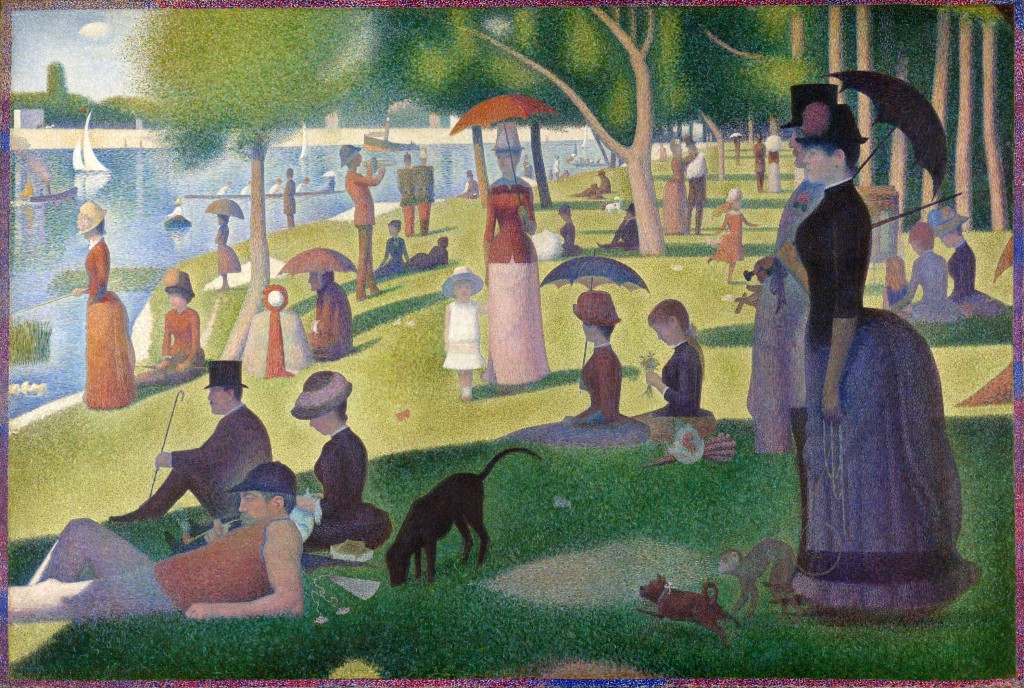
So, apparently if I host an installment of the Stephen Sondheim film festival the night before a silent retreat, I end up spending a lot of time meditating on Seurat instead of Scripture. A few weekends ago, I invited friends over to watch Sunday in the Park with George, Stephen Sondheim’s musical about Georges Seurat’s creation of A Sunday Afternoon on the Island of La Grande Jatte. (It’s on Amazon instant streaming, go enjoy!).
In the first act, Georges struggles to express himself to his lover, to his mother, and to his friend. And his great work can’t quite bridge the gap, since his compatriots conclude that his pointillistic style has “No Life” (“His touch is too deliberate somehow”). When he and his lover, Dot, have their falling out he tries to explain the intimacy he feels they share:
George: I cannot divide my feelings up as neatly as you, and I am not hiding behind my canvas-I am living in it.
Dot: What you care for is yourself.
George: I care for this painting. You will be in this painting.
Dot: I am something you can use.
George: I had thought you understood.
Perhaps it would be easier for Dot to understand if she could see George sketching during the earlier number “The Day Off” (below). As George studies the figures on the island, he’s drawn into their experience. Although he appears absent and distant in dialogue with others, when he draws them he puts on their characters and mimics their cadences in brief musical monologues.
But it’s hard for the audience to decide if looking from behind his sketchpad gives George a genuine intimacy with the people he paints, or if it just simplifies them enough for him to be able to embroider their personalities as suits him. Is he really seeing Dot, his beloved, or just enough of an armature for him to hang his own inventions on?
It’s a question to trouble any lover, including all Christians. When we pray, are we thinking with God or about God? In C.S. Lewis’s Screwtape Letters, a malevolent demon tells his apprentice not to worry when his target turns to prayer, since it’s easy to be misled by the picture we paint:
If you examine the object to which he is attending, you will find that it is a composite object containing many quite ridiculous ingredients. There will be images derived from pictures of the Enemy as He appeared during the discreditable episode known as the Incarnation: there will be vaguer—perhaps quite savage and puerile—images associated with the other two Persons. There will even be some of his own reverence (and of bodily sensations accompanying it) objectified and attributed to the object revered. I have known cases where what the patient called his “God” was actually located—up and to the left at the corner of the bedroom ceiling, or inside his own head, or in a crucifix on the wall. But whatever the nature of the composite object, you must keep him praying to it—to the thing that he has made, not to the Person who has made him. You may even encourage him to attach great importance to the correction and improvement of his composite object, and to keeping it steadily before his imagination during the whole prayer. For if he ever comes to make the distinction, if ever he consciously directs his prayers “Not to what I think thou art but to what thou knowest thyself to be”, our situation is, for the moment, desperate.
As a lover of abstractions, and someone with George-like tendencies to do better with characters I imagine than creatures I encounter, this is a terrifying paragraph to read. I’ll talk a little tomorrow about why neither George nor I should despair (though Dot may well despair of either of us).
Previous Post

December 9, 2012
This Prayer Book is a Stub...
Next Post
December 11, 2012 "Give Us More To See"
Browse Our Archives
Select a Category 7 Quick Takes Apologetics Atheism Book Conversion Debate Tactics Debates Epistemology/Philosophy Housekeeping Ideological Turing Test Marriage Morality in Practice Parsing Catholicism Possibly Heretical Radio Reviews/Recommendations Sequence Index Spiritual Practice Uncategorized
Select a Month April 2017 March 2017 January 2017 December 2016 September 2016 August 2016 July 2016 June 2016 May 2016 April 2016 March 2016 February 2016 January 2016 December 2015 November 2015 October 2015 September 2015 August 2015 July 2015 June 2015 May 2015 April 2015 March 2015 February 2015 January 2015 December 2014 November 2014 October 2014 September 2014 August 2014 July 2014 June 2014 May 2014 April 2014 March 2014 February 2014 January 2014 December 2013 November 2013 October 2013 September 2013 August 2013 July 2013 June 2013 May 2013 April 2013 March 2013 February 2013 January 2013 December 2012 November 2012 October 2012 September 2012 August 2012 July 2012 June 2012 May 2012 April 2012 March 2012 February 2012 January 2012 December 2011 November 2011 October 2011 September 2011 August 2011 July 2011 June 2011 May 2011 April 2011 March 2011 February 2011 January 2011 December 2010 November 2010 October 2010 September 2010 August 2010 July 2010 June 2010
Follow Us!
TAKE THE
Religious Wisdom Quiz
Who cried at the tomb of Lazarus?
Select your answer to see how you score.
Jesus David Peter John
Related posts from Unequally Yoked

Starving Laypeople of Devotion in Church

Aunt Alberta And Being Right (but the boring...

The Virtues of Sad Songs (a piece for...

The (Extra) Mercy of My Conversion
TRENDING AT PATHEOS Catholic

Rejecting Doom: Christian Hope And Human Action
Christianity is a religion of hope. We are to have hope and...

It’s What Comes From Within Which Matters
One of the most difficult things for us to understand is why...

Why I Choose the Eucharist Over the Sermon
Choose the Eucharist, Not the Sermon What are we supposed to get...

5 Design Elements Found in Spiritually Rooted Homes
Putting Spirituality Into Home Decor Our homes are more than our living...

Credo: A Story of God Told with the...
About 10 years ago, I began to imagine a personal "Credo" that...

The Anatomy of Divine Revelation in Catholic Thought
The claim that God has made Himself known to human beings is...
view all Catholic blogs
Ad-Free & Subscriber Log-In Subscription Support
- About Us
- 2026 Calendar
- Videos
- Podcasts
- Library of World Religions
- Faith In Media Tracker
- Advertise With Us
- Write for Us
- Privacy Policy
- Terms of Service
- Do Not Sell My Data
- Contact Us
- Radiant Digital
- Manage Newsletter Subscriptions
- Unsubscribe From Notifications
- Sitemap
Copyright 2008-2026, Patheos. All rights reserved.
Subscription Support Ad-Free & Subscriber Log-In
Follow Patheos