
BuddhistCatholicContemplativeEvangelicalGeneral ChristianHinduJewishLatter-day SaintMuslimNew VisionsProgressive Christian
Beliefs
- Buddhist
- Catholic
- Contemplative
- Evangelical
- General Christian
- Hindu
- Jewish
- Latter-day Saint
- More Voices
- Muslim
- New Visions
- Pagan
- Progressive Christian
Topics
- Religion News
- Food and Religion
- Sports and Religion
- Religious Art
- Religious Music and Entertainment
- Religious Events
- History and Religion
- Style and Religion
- Politics and Religion
- Women in Religion
- Recreation Outdoors and Religion
- Business Finance and Religion
- Careers Workplace and Religion
- Education and Religion
- Family Parenting and Religion
- Health Fitness and Religion
- Home and Religion
- Relationships and Religion
- Technology and Religion
- Travel and Religion
Columnists
- Buddhist Columnists
- Business Finance and Religion Columnists
- Careers Workplace and Religion Columnists
- Catholic Columnists
- Contemplative Columnists
- Education and Religion Columnists
- Evangelists Columnists
- Family Parenting and Religion Columnists
- General Christian Columnists
- Health Fitness and Religion Columnists
- Hindu Columnists
- History and Religion Columnists
- Home and Religion Columnists
- Jewish Columnists
- More Voices Columnists
- Latter Day Columnists
- Muslim Columnists
- New Visions Columnists
- Nonreligious Columnists
- Pagan Columnists
- Politics and Religion Columnists
- Progressive Columnists
- Recreation Outdoors and Religion Columnists
- Relationships and Religion Columnists
- Religion News Columnists
- Religious Art Columnists
- Religious Events Columnists
- Religious Music and Entertainment Columnists
- Sports and Religion Columnists
- Style and Religion Columnists
- Technology and Religion Columnists
- Travel and Religion Columnists
- Women in Religion Columnists
Resource Library
- 2026 Calendar
- Library of World Religions
- The 100 Most Holy Places on Earth
- Patheos Answers
- Podcasts
- Videos
- Faith Leaders Database
- Anglican Episcopalian
- Bahai
- Baptist
- Buddhism
- Christianity
- Confucianism
- Eastern Orthodoxy
- Hinduism
- Holiness and Pentecostal
- ISKCON
- Islam
- Judaism
- Lutheran
- Methodist
- The Church of Jesus Christ of Latter-day Saints
- New Age
- Paganism
- Presbytarian and Reformed
- Protestantism
- Religion Behind the Scenes
- Roman Catholic
- Scientology
- Shia Islam
- Sikhism
- Sufism
- Sunni Islam
- Taoism
- Zen
- See all religions
Research Tools
 Ad-Free & Subscriber Log-In Subscription Support
Ad-Free & Subscriber Log-In Subscription Support
Follow Patheos 

- Trending:
- Forgiveness
- |
- Marriage
- |
- Consciousness
- |
- Death Penalty
- |
- Election
- |
- Halloween
 Unequally Yoked
- Home
- Catholic
- “No one can be what he wants me to be”
“No one can be what he wants me to be”
Last updated on: November 17, 2012 at 7:01 pm by Leah Libresco
“No one can be what he wants me to be” 2012-11-17T19:01:01-05:00 Leah Libresco
Patheos Explore the world's faith through different perspectives on religion and spirituality! Patheos has the views of the prevalent religions and spiritualities of the world.
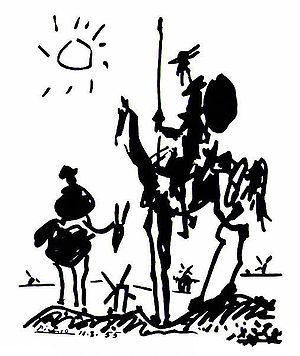
The last two song and sentiment posts have touched on problems of uncertainty. How does Floyd derive comfort from his series of questions about heaven? Why does being unblinded leave Nurse Fay Apple more uncertain that she was in ignorance? The last song I want to discuss is from Man of La Mancha. In “What Does He Want of Me” Aldonza’s song follows the same structure as Floyd’s–a litany of questions–but instead of finding comfort, she seems to be as discomfited as Nurse Fay Apple. You can listen to the song below (with slightly different lyrics than the revival version I’m quoting).
http://www.youtube.com/watch?v=spRnVJ8MDoA
As staged in the revival, Aldonza questions Sancho Panza, the squire of the Mad Don Quixote, about his master’s ways. [This is different than in the audio above, where the song is addressed to Quixote. I prefer the revival’s relyricization, because Aldonza cannot appeal to Quixote for explanation, but she might ask Sancho to explain interpret the man he follows]. Quixote is a holy fool, jarringly out of step with the world. In the musical, his inability to find a place in this Spain is not because of some flaw in himself; it is a rebuke to the world that cannot accommodate his abandonment of self.
Why does he do the things he does?
Why does he do these things?
Why does he march
Through that dream that he’s in,
Covered with glory and rusty old tin?
Why does he live in a world that can’t be,
And what does he want of me…
What does he want of me?
It’s not hard to translate Aldonza’s questions to the experience of the followers of Jesus. Think of the man who walks away after Jesus asks him to sell all he has and give it to the poor. Or the disciples who flee after Jesus reveals the hard teaching of the Eucharist. They, too , must have thought:
No one can be what he wants me to be,
Oh, what does he want of me…
What does he want of me?
But why are Quixote’s unspoken demands frightening to Aldonza. If he asked for the plainly impossible (“Aldonza, sprout wings and fly”) or obviously mistook her (confusing her with the very distinct Sancho, not the ideal of Dulcinea), he would be ridiculous, but there would be no threat to Aldonza. Dulcinea is just close enough to possible that a little seed of fear sprouts in Aldonza that she might be called to be what Quixote asks.
Aldonza doesn’t just ask what to do about Quixote, which would leave her in the comfortable, spectator position of his relatives. By asking “What does he want of me?” she acknowledges a relationship between them. And she questions Sancho urgently about what, exactly Quixote wants from her, because sooner or later, she’s going to have to decide whether to deny it to him.
Doesn’t he know
He’ll be laughed at wherever he’ll go?
And why I’m not laughing myself…
I don’t know.Why does he want the things he wants?
Why does he want these things?
Why does he batter at walls that won’t break?
Why does he give when it’s natural to take?
Where does he see all the good he can see,
And what does he want of me?
What does he want of me?
Aldonza is stuck on the horns of Lewis’s Trilemma: Lunatic, Liar, or Lord. If Quixote’s claim can’t be laughed off, then someone must have the authority to ask Aldonza to be more than she is. But since Quixote is just a man, Aldonza can’t answer his demand with Augustine’s prayer, “Give what you command, and command what you will.” Quixote has unblinded her but doesn’t have to power to lead her, so Aldonza despairs in the gulf between ought and is.
But, for a Christian, there’s no begging off being what He wants you to be, since we’re given a more trustworthy guide than Quixote. But the demands he makes have a tendency to sound just as foolish. I’ve said before I tend to like hymns with a martial tone (especially “God Whose Purpose is to Kindle“), but I think the one that’s most likely to make your blood run cold is “The Summons.”
Will you let the blinded see if I but call your name?
Will you set the prisoners free and never be the same?
Will you kiss the leper clean and do such as this unseen,
and admit to what I mean in you and you in me?
The horror of that let!
Christ calls us Dulcinea already, and rebukes us for clinging to ‘Aldonza’ in our fear. We’ve already been offered the power to be what we ought to be, but, moment by moment, we decline to exercise it or acknowledge it. We couldn’t possibly be so beautiful or so strong. Better to stay small on the sidelines than acknowledge every moment we’ve spent shirking til this point. The first ‘Amen’ is an acknowledgement that we hadn’t said it until now.
But better to bite the bullet and admit that I have greatly sinned, in what I have done and in what I have failed to do, than to deny culpability by denying that I can and should be better.
T-1 day.
Previous Post

November 17, 2012
My Hatred of Football Outweighs My Apathy for Harvard
Next Post
November 18, 2012 To bring him back with a twitch upon the thread
Browse Our Archives
Select a Category 7 Quick Takes Apologetics Atheism Book Conversion Debate Tactics Debates Epistemology/Philosophy Housekeeping Ideological Turing Test Marriage Morality in Practice Parsing Catholicism Possibly Heretical Radio Reviews/Recommendations Sequence Index Spiritual Practice Uncategorized
Select a Month April 2017 March 2017 January 2017 December 2016 September 2016 August 2016 July 2016 June 2016 May 2016 April 2016 March 2016 February 2016 January 2016 December 2015 November 2015 October 2015 September 2015 August 2015 July 2015 June 2015 May 2015 April 2015 March 2015 February 2015 January 2015 December 2014 November 2014 October 2014 September 2014 August 2014 July 2014 June 2014 May 2014 April 2014 March 2014 February 2014 January 2014 December 2013 November 2013 October 2013 September 2013 August 2013 July 2013 June 2013 May 2013 April 2013 March 2013 February 2013 January 2013 December 2012 November 2012 October 2012 September 2012 August 2012 July 2012 June 2012 May 2012 April 2012 March 2012 February 2012 January 2012 December 2011 November 2011 October 2011 September 2011 August 2011 July 2011 June 2011 May 2011 April 2011 March 2011 February 2011 January 2011 December 2010 November 2010 October 2010 September 2010 August 2010 July 2010 June 2010
Follow Us!
TAKE THE
Religious Wisdom Quiz
What king was known for writing many proverbs?
Select your answer to see how you score.
Saul Solomon David Hezekiah
Related posts from Unequally Yoked

I'm speaking about my conversion in Denver!

Rational Faith: More working hypothesis than logical proof
Running the Stats on Shakespeare!

Dwelling In Wounds To Hide From Grace
TRENDING AT PATHEOS Catholic

Rejecting Doom: Christian Hope And Human Action
Christianity is a religion of hope. We are to have hope and...

It’s What Comes From Within Which Matters
One of the most difficult things for us to understand is why...

Why I Choose the Eucharist Over the Sermon
Choose the Eucharist, Not the Sermon What are we supposed to get...

5 Design Elements Found in Spiritually Rooted Homes
Putting Spirituality Into Home Decor Our homes are more than our living...

Credo: A Story of God Told with the...
About 10 years ago, I began to imagine a personal "Credo" that...

The Anatomy of Divine Revelation in Catholic Thought
The claim that God has made Himself known to human beings is...
view all Catholic blogs
Ad-Free & Subscriber Log-In Subscription Support
- About Us
- 2026 Calendar
- Videos
- Podcasts
- Library of World Religions
- Faith In Media Tracker
- Advertise With Us
- Write for Us
- Privacy Policy
- Terms of Service
- Do Not Sell My Data
- Contact Us
- Radiant Digital
- Manage Newsletter Subscriptions
- Unsubscribe From Notifications
- Sitemap
Copyright 2008-2026, Patheos. All rights reserved.
Subscription Support Ad-Free & Subscriber Log-In
Follow Patheos