
BuddhistCatholicContemplativeEvangelicalGeneral ChristianHinduJewishLatter-day SaintMuslimNew VisionsProgressive Christian
Beliefs
- Buddhist
- Catholic
- Contemplative
- Evangelical
- General Christian
- Hindu
- Jewish
- Latter-day Saint
- More Voices
- Muslim
- New Visions
- Pagan
- Progressive Christian
Topics
- Religion News
- Food and Religion
- Sports and Religion
- Religious Art
- Religious Music and Entertainment
- Religious Events
- History and Religion
- Style and Religion
- Politics and Religion
- Women in Religion
- Recreation Outdoors and Religion
- Business Finance and Religion
- Careers Workplace and Religion
- Education and Religion
- Family Parenting and Religion
- Health Fitness and Religion
- Home and Religion
- Relationships and Religion
- Technology and Religion
- Travel and Religion
Columnists
- Buddhist Columnists
- Business Finance and Religion Columnists
- Careers Workplace and Religion Columnists
- Catholic Columnists
- Contemplative Columnists
- Education and Religion Columnists
- Evangelists Columnists
- Family Parenting and Religion Columnists
- General Christian Columnists
- Health Fitness and Religion Columnists
- Hindu Columnists
- History and Religion Columnists
- Home and Religion Columnists
- Jewish Columnists
- More Voices Columnists
- Latter Day Columnists
- Muslim Columnists
- New Visions Columnists
- Nonreligious Columnists
- Pagan Columnists
- Politics and Religion Columnists
- Progressive Columnists
- Recreation Outdoors and Religion Columnists
- Relationships and Religion Columnists
- Religion News Columnists
- Religious Art Columnists
- Religious Events Columnists
- Religious Music and Entertainment Columnists
- Sports and Religion Columnists
- Style and Religion Columnists
- Technology and Religion Columnists
- Travel and Religion Columnists
- Women in Religion Columnists
Resource Library
- 2026 Calendar
- Library of World Religions
- The 100 Most Holy Places on Earth
- Patheos Answers
- Podcasts
- Videos
- Faith Leaders Database
- Anglican Episcopalian
- Bahai
- Baptist
- Buddhism
- Christianity
- Confucianism
- Eastern Orthodoxy
- Hinduism
- Holiness and Pentecostal
- ISKCON
- Islam
- Judaism
- Lutheran
- Methodist
- The Church of Jesus Christ of Latter-day Saints
- New Age
- Paganism
- Presbytarian and Reformed
- Protestantism
- Religion Behind the Scenes
- Roman Catholic
- Scientology
- Shia Islam
- Sikhism
- Sufism
- Sunni Islam
- Taoism
- Zen
- See all religions
Research Tools
 Ad-Free & Subscriber Log-In Subscription Support
Ad-Free & Subscriber Log-In Subscription Support
Follow Patheos 

- Trending:
- Forgiveness
- |
- Marriage
- |
- Consciousness
- |
- Death Penalty
- |
- Election
- |
- Halloween
 Unequally Yoked
- Home
- Catholic
- “Because I am fearfully and wonderfully made”
“Because I am fearfully and wonderfully made”
Last updated on: November 25, 2012 at 4:52 pm by Leah Libresco
“Because I am fearfully and wonderfully made” 2012-11-25T16:52:58-05:00 Leah Libresco
Patheos Explore the world's faith through different perspectives on religion and spirituality! Patheos has the views of the prevalent religions and spiritualities of the world.
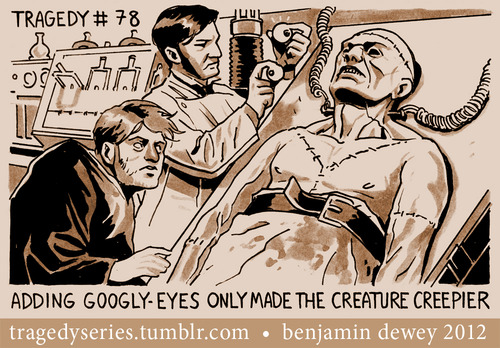
Frankenstein is at least the great-uncle of the zombie story. The alternate title of Shelley’s book is The Modern Prometheus and we can’t quite decide, when it comes to necromancy, whether it’s more frightening to have Prometheus, Frankenstein, Faust and all the rest fail in their quest or succeed. Somewhere along the way, our Frankenstein’s creatures acquired a lot more hardware than the bolts in the neck. Today, Shelley’s story has more in common with HAL and cyborgs than it does with the simple reanimation of the dead.
Today’s zombie aren’t so much about hubris. Sometimes scientists have gone too far and “am playgods!” but, even when this is the case, they’re more likely to have gone wrong by wanting an evil like bioweapons, than lusting after knowledge and mastery in the wrong ways. Sometimes there’s no explanation of the cause at all; life is natural to the human form, so it’s not quite surprising when it recurs, especially if we don’t think the conservation of life requires an external Cause.
So, today’s mad scientists don’t play God by creating life. Life is abundant and dull. The frizzy-haired person in the white coat is creating intellect. We don’t animate flesh, we build AI. And here, part of the mystery is how much we can pare off and still have a human. Airplanes didn’t turn out to need flapping wings to fly; what kind of interface with the world does a rational soul need? What does it need to be human?

In the play, the Creature was intensely embodied. In an interview clip shown before the show, Benedict Cumberbatch explained that he developed the physicality of the Creature by watching footage of stroke victims in physical therapy. In the opening scenes, when he discovered his body and set about learning to use it, I was reminded of an infant, who is enraptured by the simple pleasure of possessing a foot. But instead of growing into partnership with his body, the Creature develops an enmity.
He’d love to slip out of his body and into another for the sake of companionship. The body he possesses isn’t his, it’s his prison. When the blind man cannot see the Creature, he knows him better than any other character. There’s no hint that true companionship would require recognition of the Creature’s body as well as his intellect and feelings.
Cyborgs are more frightening than Frankenstein’s creature, because we’re acutely sensitive to the question of what kind of piece of work is man. When we fear a computer, our terror takes two contradictory forms. We’re afraid of something greater than ourselves that will have no special regard or love for us. What use are we, if they’re something/someone faster and clever than us? But we’re afraid of even building something that matches us. If we can comprehend ourselves, how interesting can we possibly be?
In The Most Human Human, Brian Christian notes that when machines have achieved a task that we thought required a particularly human intellect, we haven’t congratulated the programmer but have just defined the skill as boring in retrospect. But the solar system isn’t diminished when we can put a model of it in our science class. The fun and mystery isn’t drained from a relationship when we know a friend well enough to predict what she’ll like and can get thoughtful presents. If the machine is interesting, how can the schematics be boring?
The appropriate reaction is that of the Creature in the beginning — that of a child. Goodness, a foot! Full of bones and other fleshy things! What happens if I do this*? Oh dear! Wow! Neurons, action potentials, remapping sensations into a phantom foot! Proprioception! Boy howdy!* We might want to tweak or train our bodies, but we won’t end up despising them and we’ll be more curious instead of fearful to see what other shapes intelligence might take.
But, when we look at Frankenstein, we’re afraid of a creature cut off from its Creator, and we scrutinize him carefully, making sure we’re not similarly abandoned. Or we decide that its his relationship with a Creator that was so destabilizing. If he were content in himself, without companionship, without claims or duties, he might have been happy, but he would not have been human.
Previous Post
November 24, 2012
The Man is Father of the Monster
Next Post

November 26, 2012 For C.S. Lewis, Deo Gratias!
Browse Our Archives
Select a Category 7 Quick Takes Apologetics Atheism Book Conversion Debate Tactics Debates Epistemology/Philosophy Housekeeping Ideological Turing Test Marriage Morality in Practice Parsing Catholicism Possibly Heretical Radio Reviews/Recommendations Sequence Index Spiritual Practice Uncategorized
Select a Month April 2017 March 2017 January 2017 December 2016 September 2016 August 2016 July 2016 June 2016 May 2016 April 2016 March 2016 February 2016 January 2016 December 2015 November 2015 October 2015 September 2015 August 2015 July 2015 June 2015 May 2015 April 2015 March 2015 February 2015 January 2015 December 2014 November 2014 October 2014 September 2014 August 2014 July 2014 June 2014 May 2014 April 2014 March 2014 February 2014 January 2014 December 2013 November 2013 October 2013 September 2013 August 2013 July 2013 June 2013 May 2013 April 2013 March 2013 February 2013 January 2013 December 2012 November 2012 October 2012 September 2012 August 2012 July 2012 June 2012 May 2012 April 2012 March 2012 February 2012 January 2012 December 2011 November 2011 October 2011 September 2011 August 2011 July 2011 June 2011 May 2011 April 2011 March 2011 February 2011 January 2011 December 2010 November 2010 October 2010 September 2010 August 2010 July 2010 June 2010
Follow Us!
TAKE THE
Religious Wisdom Quiz
Who was Rahab's great-great-grandson?
Select your answer to see how you score.
Solomon Boaz Jesse King David
Related posts from Unequally Yoked



The Boring, Quiet Rituals That Sustain Us Spiritually

Starving Laypeople of Devotion in Church
TRENDING AT PATHEOS Catholic

Rejecting Doom: Christian Hope And Human Action
Christianity is a religion of hope. We are to have hope and...

It’s What Comes From Within Which Matters
One of the most difficult things for us to understand is why...

Why I Choose the Eucharist Over the Sermon
Choose the Eucharist, Not the Sermon What are we supposed to get...

5 Design Elements Found in Spiritually Rooted Homes
Putting Spirituality Into Home Decor Our homes are more than our living...

Credo: A Story of God Told with the...
About 10 years ago, I began to imagine a personal "Credo" that...

The Anatomy of Divine Revelation in Catholic Thought
The claim that God has made Himself known to human beings is...
view all Catholic blogs
Ad-Free & Subscriber Log-In Subscription Support
- About Us
- 2026 Calendar
- Videos
- Podcasts
- Library of World Religions
- Faith In Media Tracker
- Advertise With Us
- Write for Us
- Privacy Policy
- Terms of Service
- Do Not Sell My Data
- Contact Us
- Radiant Digital
- Manage Newsletter Subscriptions
- Unsubscribe From Notifications
- Sitemap
Copyright 2008-2026, Patheos. All rights reserved.
Subscription Support Ad-Free & Subscriber Log-In
Follow Patheos