
BuddhistCatholicContemplativeEvangelicalGeneral ChristianHinduJewishLatter-day SaintMuslimNew VisionsProgressive Christian
Beliefs
- Buddhist
- Catholic
- Contemplative
- Evangelical
- General Christian
- Hindu
- Jewish
- Latter-day Saint
- More Voices
- Muslim
- New Visions
- Pagan
- Progressive Christian
Topics
- Religion News
- Food and Religion
- Sports and Religion
- Religious Art
- Religious Music and Entertainment
- Religious Events
- History and Religion
- Style and Religion
- Politics and Religion
- Women in Religion
- Recreation Outdoors and Religion
- Business Finance and Religion
- Careers Workplace and Religion
- Education and Religion
- Family Parenting and Religion
- Health Fitness and Religion
- Home and Religion
- Relationships and Religion
- Technology and Religion
- Travel and Religion
Columnists
- Buddhist Columnists
- Business Finance and Religion Columnists
- Careers Workplace and Religion Columnists
- Catholic Columnists
- Contemplative Columnists
- Education and Religion Columnists
- Evangelists Columnists
- Family Parenting and Religion Columnists
- General Christian Columnists
- Health Fitness and Religion Columnists
- Hindu Columnists
- History and Religion Columnists
- Home and Religion Columnists
- Jewish Columnists
- More Voices Columnists
- Latter Day Columnists
- Muslim Columnists
- New Visions Columnists
- Nonreligious Columnists
- Pagan Columnists
- Politics and Religion Columnists
- Progressive Columnists
- Recreation Outdoors and Religion Columnists
- Relationships and Religion Columnists
- Religion News Columnists
- Religious Art Columnists
- Religious Events Columnists
- Religious Music and Entertainment Columnists
- Sports and Religion Columnists
- Style and Religion Columnists
- Technology and Religion Columnists
- Travel and Religion Columnists
- Women in Religion Columnists
Resource Library
- 2026 Calendar
- Library of World Religions
- The 100 Most Holy Places on Earth
- Patheos Answers
- Podcasts
- Videos
- Faith Leaders Database
- Anglican Episcopalian
- Bahai
- Baptist
- Buddhism
- Christianity
- Confucianism
- Eastern Orthodoxy
- Hinduism
- Holiness and Pentecostal
- ISKCON
- Islam
- Judaism
- Lutheran
- Methodist
- The Church of Jesus Christ of Latter-day Saints
- New Age
- Paganism
- Presbytarian and Reformed
- Protestantism
- Religion Behind the Scenes
- Roman Catholic
- Scientology
- Shia Islam
- Sikhism
- Sufism
- Sunni Islam
- Taoism
- Zen
- See all religions
Research Tools
 Ad-Free & Subscriber Log-In Subscription Support
Ad-Free & Subscriber Log-In Subscription Support
Follow Patheos 

- Trending:
- Forgiveness
- |
- Marriage
- |
- Consciousness
- |
- Death Penalty
- |
- Election
- |
- Halloween
 Unequally Yoked
- Home
- Catholic
- “Hey! I didn’t say ‘Science Says'”
“Hey! I didn’t say ‘Science Says'”
Last updated on: September 19, 2012 at 5:39 pm by Leah Libresco
“Hey! I didn’t say ‘Science Says'” 2012-09-19T17:39:54-04:00 Leah Libresco
Patheos Explore the world's faith through different perspectives on religion and spirituality! Patheos has the views of the prevalent religions and spiritualities of the world.
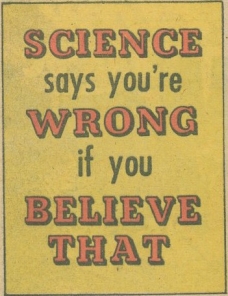
Helen Rittelmeyer is blogging and writing again. She just contributed to the American Spectator’s Youth Symposium, claiming that relativism is no longer conservatism’s greatest enemy. Let me grab a pull quote.
In the last culture war, relativism’s influence was evident in the stock arguments that kept appearing in magazines and op-ed pages: Breaking taboos is valuable for its own sake; people have a right to make their own choices and not be judged for it; what you call a social evil is really just a cultural difference; et cetera.But those articles are no longer seen so often. Now, the most annoyingly ubiquitous genre in journalism is the social-scientific analysis, as if a person can’t speak with authority without citing economics or sociology.This is bad enough in political conversation, but it has begun to affect people’s ethical thinking. Under the new cultural rules, moral condemnation is a legitimate thing to express, but only if you can demonstrate that the sin you want to condemn makes someone twice as likely to take antidepressants or 40 percent less likely to be promoted at work. Malcolm Gladwell and the Freakonomics guys have more moral authority than the archbishop of New York. Great artists are producing movies, TV shows, and songs about tough moral dilemmas, but although liberals buy the tickets and the albums, they don’t take the art they consume very seriously. When moral questions arise, they forget The Wire and The Hold Steady and ask what the studies show.
An excellently ludicrous example of this mindset was offered by an article on weight loss I read earlier this summer. It opened by citing a handful of studies showing obesity to be correlated not just with heart disease but also with slower career advancement and a greater likelihood of developing mental-health problems. Let’s leave aside the fact that the author didn’t feel he could take the undesirability of being fat as a given. The bigger problem is that this sort of argument tries to have it both ways—to have all the benefits of authority without the burden of being answerable to people who disagree. On one hand, the author isn’t saying obesity is bad, science is, which makes it a fact and not an opinion. Your personal experience or common sense might tell you that a few extra pounds aren’t always such a disaster; but that just means you’re in the statistical minority for whom these bad outcomes do not eventuate. In other words: My moral claim is objectively correct, but that doesn’t mean it has to be true in your case. The same evasive maneuver can be seen in the argument that there’s nothing wrong with pornography because its prevalence isn’t correlated with higher crime rates, or that there’s nothing wrong with gay marriage as long as children of same-sex couples aren’t more likely to receive reduced-price lunches at school. The idea that something might be spiritually harmful (or beneficial) in a way that can’t be demonstrated statistically has been written out of the conversation.
Helen brings up the true-in-aggregate characteristic of these studies as a barrier to challenges or questions. I’ve used the line “The plural of anecdote is not data” often enough that I can’t help but feel like she’s talking about me. A lot of the time, it’s a pretty good defense, especially in the public health debates where I tend to use it. When it comes to herd immunity, taking your full course of antibiotic even though you already feel better, or anything else where your actions have a big aggregate impact — almost everyone who thinks they’re an exception to the rule is wrong.

But as long as people don’t understand why they’re being asked to do counter-intuitive things (or, more precisely, why their intuitions are wrong), epidemiologists are going to come off as techno-mystics. When we intone “Lo it is written that the findings were significant at p=.05 in an SRS sample. Let he who denies it be anathema!” it might as well be Latin. (And poorly catechized scientists sometimes treat statistics like magic and introduce a host of errors, but that’s another rant).
For people who aren’t fluent in social science, the growing authority of the studies may not foster relativism, but it does promote an unhealthy agnosticism. It’s natural and delightful to be fascinated by the way things work, and the more distant the data is from every day experience, the more frustrated or fearful you may become in your explorations.
I’m speculating. As a data nerd, I obviously know the other side of the equation a lot better, so let me talk a little about the perils for the savvy. I was a political science major, and when I didn’t quite have time to finish the reading, I knew the quickest way to prepare something to say for class was to just read the methodology of a paper intensively. Spot a flaw or notice a way that the results are hard to generalize (besides the standard WEIRD reason) and you’ve got your comment. This is a useful skill, but it’s a kind of strange habit to cultivate.
The kind of people who get the kind of stat education I have are usually pretty good at analyzing a system and figuring out a way to game it (or at least move through it efficiently). So if I’m not figuring out a plausible reason why a study doesn’t apply to me, I might be figuring out a different way to buy the benefit described. Maybe I can trade keeping a gratitude journal for getting a pet. I still haven’t done the math on how much exercise I can skip in exchange for eating really dark chocolate.
But if I’m talking about virtue, I can’t really do offsets. I can’t be a jerk to my brother and then balance the books by spending some time at a soup kitchen. There’s no way to game goodness the way you can hack happiness.
Previous Post

September 18, 2012
And Now For Something Completely Different
Next Post
September 21, 2012 7 Quick Takes (9/21/12)
Browse Our Archives
Select a Category 7 Quick Takes Apologetics Atheism Book Conversion Debate Tactics Debates Epistemology/Philosophy Housekeeping Ideological Turing Test Marriage Morality in Practice Parsing Catholicism Possibly Heretical Radio Reviews/Recommendations Sequence Index Spiritual Practice Uncategorized
Select a Month April 2017 March 2017 January 2017 December 2016 September 2016 August 2016 July 2016 June 2016 May 2016 April 2016 March 2016 February 2016 January 2016 December 2015 November 2015 October 2015 September 2015 August 2015 July 2015 June 2015 May 2015 April 2015 March 2015 February 2015 January 2015 December 2014 November 2014 October 2014 September 2014 August 2014 July 2014 June 2014 May 2014 April 2014 March 2014 February 2014 January 2014 December 2013 November 2013 October 2013 September 2013 August 2013 July 2013 June 2013 May 2013 April 2013 March 2013 February 2013 January 2013 December 2012 November 2012 October 2012 September 2012 August 2012 July 2012 June 2012 May 2012 April 2012 March 2012 February 2012 January 2012 December 2011 November 2011 October 2011 September 2011 August 2011 July 2011 June 2011 May 2011 April 2011 March 2011 February 2011 January 2011 December 2010 November 2010 October 2010 September 2010 August 2010 July 2010 June 2010
Follow Us!
TAKE THE
Religious Wisdom Quiz
What is the meaning of the word "Golgotha"?
Select your answer to see how you score.
Peaceful Garden City of Bread River of Blood Place of the Skull
Related posts from Unequally Yoked

Rational Faith: More working hypothesis than logical proof

The Tony-Winning Guide To Temptation And Grace

Hedgehogs of Redemption and the Comedy of Grace

Mercy, Justice, and How To Tell The Difference
TRENDING AT PATHEOS Catholic

Rejecting Doom: Christian Hope And Human Action
Christianity is a religion of hope. We are to have hope and...

It’s What Comes From Within Which Matters
One of the most difficult things for us to understand is why...

Why I Choose the Eucharist Over the Sermon
Choose the Eucharist, Not the Sermon What are we supposed to get...

5 Design Elements Found in Spiritually Rooted Homes
Putting Spirituality Into Home Decor Our homes are more than our living...

Credo: A Story of God Told with the...
About 10 years ago, I began to imagine a personal "Credo" that...

The Anatomy of Divine Revelation in Catholic Thought
The claim that God has made Himself known to human beings is...
view all Catholic blogs
Ad-Free & Subscriber Log-In Subscription Support
- About Us
- 2026 Calendar
- Videos
- Podcasts
- Library of World Religions
- Faith In Media Tracker
- Advertise With Us
- Write for Us
- Privacy Policy
- Terms of Service
- Do Not Sell My Data
- Contact Us
- Radiant Digital
- Manage Newsletter Subscriptions
- Unsubscribe From Notifications
- Sitemap
Copyright 2008-2026, Patheos. All rights reserved.
Subscription Support Ad-Free & Subscriber Log-In
Follow Patheos