
BuddhistCatholicContemplativeEvangelicalGeneral ChristianHinduJewishLatter-day SaintMuslimNew VisionsProgressive Christian
Beliefs
- Buddhist
- Catholic
- Contemplative
- Evangelical
- General Christian
- Hindu
- Jewish
- Latter-day Saint
- More Voices
- Muslim
- New Visions
- Pagan
- Progressive Christian
Topics
- Religion News
- Food and Religion
- Sports and Religion
- Religious Art
- Religious Music and Entertainment
- Religious Events
- History and Religion
- Style and Religion
- Politics and Religion
- Women in Religion
- Recreation Outdoors and Religion
- Business Finance and Religion
- Careers Workplace and Religion
- Education and Religion
- Family Parenting and Religion
- Health Fitness and Religion
- Home and Religion
- Relationships and Religion
- Technology and Religion
- Travel and Religion
Columnists
- Buddhist Columnists
- Business Finance and Religion Columnists
- Careers Workplace and Religion Columnists
- Catholic Columnists
- Contemplative Columnists
- Education and Religion Columnists
- Evangelists Columnists
- Family Parenting and Religion Columnists
- General Christian Columnists
- Health Fitness and Religion Columnists
- Hindu Columnists
- History and Religion Columnists
- Home and Religion Columnists
- Jewish Columnists
- More Voices Columnists
- Latter Day Columnists
- Muslim Columnists
- New Visions Columnists
- Nonreligious Columnists
- Pagan Columnists
- Politics and Religion Columnists
- Progressive Columnists
- Recreation Outdoors and Religion Columnists
- Relationships and Religion Columnists
- Religion News Columnists
- Religious Art Columnists
- Religious Events Columnists
- Religious Music and Entertainment Columnists
- Sports and Religion Columnists
- Style and Religion Columnists
- Technology and Religion Columnists
- Travel and Religion Columnists
- Women in Religion Columnists
Resource Library
- 2026 Calendar
- Library of World Religions
- The 100 Most Holy Places on Earth
- Patheos Answers
- Podcasts
- Videos
- Faith Leaders Database
- Anglican Episcopalian
- Bahai
- Baptist
- Buddhism
- Christianity
- Confucianism
- Eastern Orthodoxy
- Hinduism
- Holiness and Pentecostal
- ISKCON
- Islam
- Judaism
- Lutheran
- Methodist
- The Church of Jesus Christ of Latter-day Saints
- New Age
- Paganism
- Presbytarian and Reformed
- Protestantism
- Religion Behind the Scenes
- Roman Catholic
- Scientology
- Shia Islam
- Sikhism
- Sufism
- Sunni Islam
- Taoism
- Zen
- See all religions
Research Tools
 Ad-Free & Subscriber Log-In Subscription Support
Ad-Free & Subscriber Log-In Subscription Support
Follow Patheos 

- Trending:
- Forgiveness
- |
- Marriage
- |
- Consciousness
- |
- Death Penalty
- |
- Election
- |
- Halloween
 Unequally Yoked
- Home
- Catholic
- Let Augustine Move Up a Weight Class
Let Augustine Move Up a Weight Class
Last updated on: August 30, 2012 at 9:26 am by Leah Libresco
Let Augustine Move Up a Weight Class 2012-08-30T09:26:35-04:00 Leah Libresco
Patheos Explore the world's faith through different perspectives on religion and spirituality! Patheos has the views of the prevalent religions and spiritualities of the world.
I got to see Restless Heart, the new Augustine biopic last night. It’s not yet in theatres, but community groups can do special showings, and I was lucky enough to snag tickets to the one sponsored by St Anthony of Padua Church here in DC. (You can put in a request to host a showing or see the list of upcoming events here). Here’s the trailer:
The trailer is super dramatic, but large parts of the movie are just people in period clothes standing around talking to each other… which is just the way I like it. Be warned, there’s a really bad CGI shot of birds right at the beginning, which made me nervous about the quality of the film, but that turned out to be an abberation; on the whole, it’s well put together.
What most surprised me about the film was how unsurprising Augustine’s eventual conversion felt. I’m not sure whether or not I was pleased about that choice. When Augustine is ascendant, as court orator, he was hesitant. Perhaps this was meant to be the canny hanging-back of a mouth for hire, but it certainly came across as a yearning, only too aware that he was eating what was not bread, spending his labor on what failed to satisfy. I think this will end up making it more attractive to Catholics, but less useful as outreach.
Throughout the movie, I wanted the struggle over Augustine’s soul to look a little less one-sided. It’s not surprising that Ambrose is Augustine’s strongest opponent, but I would have liked to see the other philosophies Augustine explored given similarly poignant and eloquent defenders. The audience snickered through the scene where Augustine was being pitched on Manichaeism, and no wonder, since it was quickly glossed as “No one is responsible for their actions, since our nature is imprisoned in matter, which is evil, but if we follow Mani, we will become pure light or spirit.” It sounded New Agish, and Augustine looked uncertain when we saw him in their midst.
But Manichaeism is tempting. (Not just to me, I swear!). It has echoes in the modern worship of the intellect and the abstract. Augustine was drawn to Manichaeism because he was seeking truth, and they seemed plausible at the time. I would have liked to see more of his upward striving toward knowledge and disappointment when he realized he was on the wrong path. In the film, he seemed to be primarily choosing between Catholicism and nihilism. The starkness of that choice makes more sense when you can see that Augustine has been stumbling on his pursuit of Truth and might have reason to wonder whether his mistake was in his choice of path or in believing there was a path at all.
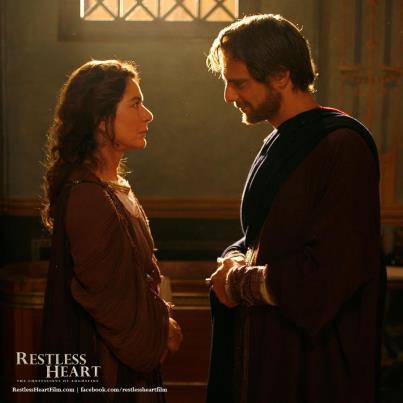
As it is, the nihilism he’s offered is pretty boring nihilism. The Roman court is petty and cruel, and Augustine never seems drawn in. The Empress mother comes off as villainous from her first appearance, so it feels like Augustine sacrifices very little when he throws away his political life in his conversion. I’d prefer the malignancy of his life at court to be less obvious or for the audience to feel more implicated in its ugliness.
His tutor in rhetoric is a more successful devil. The orator asks him if he is strong enough to live without the truth, and he’s not just offering simple hedonism as the prize. Augustine looks the most alive when he is speaking as a lawyer. He wields rhetoric the way an painter uses a brush and tempts us to think the results of both are value neutral. Isn’t technical genius its own licence? You get a real sense of Augustine joy in creation, and that true joy animating unworthy ends is what makes this temptation harder to brush aside and the eventual victory more exhilarating. A philosophy looks strongest when you let it loose on non-strawmen.
P.S. A couple times I wondered about the accuracy or timing of a few incidents (since biopics usually telescope events), but I’m forgoing Wikipedia and rereading the Confessions, instead. This was, as best I can recall, the first Christian work I read post-conversion, and I’m looking forward to returning to it now that some time has passed and I’ve entered the catechumenate.
Previous Post

August 29, 2012
The Virtue of an Almost Right Solution
Next Post
August 30, 2012 Sondheim Symposium [Sequence Index]
Browse Our Archives
Select a Category 7 Quick Takes Apologetics Atheism Book Conversion Debate Tactics Debates Epistemology/Philosophy Housekeeping Ideological Turing Test Marriage Morality in Practice Parsing Catholicism Possibly Heretical Radio Reviews/Recommendations Sequence Index Spiritual Practice Uncategorized
Select a Month April 2017 March 2017 January 2017 December 2016 September 2016 August 2016 July 2016 June 2016 May 2016 April 2016 March 2016 February 2016 January 2016 December 2015 November 2015 October 2015 September 2015 August 2015 July 2015 June 2015 May 2015 April 2015 March 2015 February 2015 January 2015 December 2014 November 2014 October 2014 September 2014 August 2014 July 2014 June 2014 May 2014 April 2014 March 2014 February 2014 January 2014 December 2013 November 2013 October 2013 September 2013 August 2013 July 2013 June 2013 May 2013 April 2013 March 2013 February 2013 January 2013 December 2012 November 2012 October 2012 September 2012 August 2012 July 2012 June 2012 May 2012 April 2012 March 2012 February 2012 January 2012 December 2011 November 2011 October 2011 September 2011 August 2011 July 2011 June 2011 May 2011 April 2011 March 2011 February 2011 January 2011 December 2010 November 2010 October 2010 September 2010 August 2010 July 2010 June 2010
Follow Us!
TAKE THE
Religious Wisdom Quiz
Which prophet predicted that Gentiles would become God's people along with Israel?
Select your answer to see how you score.
Micah Jonah Ezekiel Hosea
Related posts from Unequally Yoked



The Boring, Quiet Rituals That Sustain Us Spiritually

Starving Laypeople of Devotion in Church
TRENDING AT PATHEOS Catholic

Rejecting Doom: Christian Hope And Human Action
Christianity is a religion of hope. We are to have hope and...

It’s What Comes From Within Which Matters
One of the most difficult things for us to understand is why...

Why I Choose the Eucharist Over the Sermon
Choose the Eucharist, Not the Sermon What are we supposed to get...

5 Design Elements Found in Spiritually Rooted Homes
Putting Spirituality Into Home Decor Our homes are more than our living...

Credo: A Story of God Told with the...
About 10 years ago, I began to imagine a personal "Credo" that...

The Anatomy of Divine Revelation in Catholic Thought
The claim that God has made Himself known to human beings is...
view all Catholic blogs
Ad-Free & Subscriber Log-In Subscription Support
- About Us
- 2026 Calendar
- Videos
- Podcasts
- Library of World Religions
- Faith In Media Tracker
- Advertise With Us
- Write for Us
- Privacy Policy
- Terms of Service
- Do Not Sell My Data
- Contact Us
- Radiant Digital
- Manage Newsletter Subscriptions
- Unsubscribe From Notifications
- Sitemap
Copyright 2008-2026, Patheos. All rights reserved.
Subscription Support Ad-Free & Subscriber Log-In
Follow Patheos