
BuddhistCatholicContemplativeEvangelicalGeneral ChristianHinduJewishLatter-day SaintMuslimNew VisionsProgressive Christian
Beliefs
- Buddhist
- Catholic
- Contemplative
- Evangelical
- General Christian
- Hindu
- Jewish
- Latter-day Saint
- More Voices
- Muslim
- New Visions
- Pagan
- Progressive Christian
Topics
- Religion News
- Food and Religion
- Sports and Religion
- Religious Art
- Religious Music and Entertainment
- Religious Events
- History and Religion
- Style and Religion
- Politics and Religion
- Women in Religion
- Recreation Outdoors and Religion
- Business Finance and Religion
- Careers Workplace and Religion
- Education and Religion
- Family Parenting and Religion
- Health Fitness and Religion
- Home and Religion
- Relationships and Religion
- Technology and Religion
- Travel and Religion
Columnists
- Buddhist Columnists
- Business Finance and Religion Columnists
- Careers Workplace and Religion Columnists
- Catholic Columnists
- Contemplative Columnists
- Education and Religion Columnists
- Evangelists Columnists
- Family Parenting and Religion Columnists
- General Christian Columnists
- Health Fitness and Religion Columnists
- Hindu Columnists
- History and Religion Columnists
- Home and Religion Columnists
- Jewish Columnists
- More Voices Columnists
- Latter Day Columnists
- Muslim Columnists
- New Visions Columnists
- Nonreligious Columnists
- Pagan Columnists
- Politics and Religion Columnists
- Progressive Columnists
- Recreation Outdoors and Religion Columnists
- Relationships and Religion Columnists
- Religion News Columnists
- Religious Art Columnists
- Religious Events Columnists
- Religious Music and Entertainment Columnists
- Sports and Religion Columnists
- Style and Religion Columnists
- Technology and Religion Columnists
- Travel and Religion Columnists
- Women in Religion Columnists
Resource Library
- 2026 Calendar
- Library of World Religions
- The 100 Most Holy Places on Earth
- Patheos Answers
- Podcasts
- Videos
- Faith Leaders Database
- Anglican Episcopalian
- Bahai
- Baptist
- Buddhism
- Christianity
- Confucianism
- Eastern Orthodoxy
- Hinduism
- Holiness and Pentecostal
- ISKCON
- Islam
- Judaism
- Lutheran
- Methodist
- The Church of Jesus Christ of Latter-day Saints
- New Age
- Paganism
- Presbytarian and Reformed
- Protestantism
- Religion Behind the Scenes
- Roman Catholic
- Scientology
- Shia Islam
- Sikhism
- Sufism
- Sunni Islam
- Taoism
- Zen
- See all religions
Research Tools
 Ad-Free & Subscriber Log-In Subscription Support
Ad-Free & Subscriber Log-In Subscription Support
Follow Patheos 

- Trending:
- Forgiveness
- |
- Marriage
- |
- Consciousness
- |
- Death Penalty
- |
- Election
- |
- Halloween
 Unequally Yoked
- Home
- Catholic
- “It’s not so hard to be married. I’ve done it three or four times.”
“It’s not so hard to be married. I’ve done it three or four times.”
Last updated on: August 30, 2012 at 2:10 pm by Leah Libresco
“It’s not so hard to be married. I’ve done it three or four times.” 2012-08-30T14:10:37-04:00 Leah Libresco
Patheos Explore the world's faith through different perspectives on religion and spirituality! Patheos has the views of the prevalent religions and spiritualities of the world.
Inspired by the Sondheim Symposium, my college friend Katharine Pitt offered a guest post based on her own experiences acting marriages in Shakespeare (She’s pretty awesome, so I’m sure she won’t mind me inserting a plug for Slings and Arrows in the intro to her post). I think all the rest you need to know is she’s awesome (bears repeating), the photos below were taken by William Sacco (captions courtesy of Katharine), and everything that follows is hers. Take it away, Kate, the prettiest Kate in Christendom, Kate of Kate Hall, my super-dainty Kate!

“Everything’s different…”
I’ve been married three times.
Six times actually, if you count the dead and divorced. Seven, if you believe Helen and Paris made things official.
Yes, that’s right, I did college theater. I’ve never been a married person but I’ve played one onstage. For myself and most of the people I know – unemployed 22-year-olds – that is the extent of our experience with the ties that bind.
I played Lady Macbeth, Gertrude, and Emilia during my last three months of college. Marriages in Shakespeare are fascinating to me because so few of them end well. All three of the women I played in Macbeth, Hamlet, and Othello die violent deaths and in each case their husbands are responsible for their sudden ends: Lady Macbeth kills herself when her husband abandons her, Gertrude is poisoned by her husband, and Emilia is stabbed by her husband.
Some scholars connect these tales of woe to Shakespeare’s personal life and claim that he had an unhappy marriage himself. At eighteen, Shakespeare married Anne Hathaway, a woman eight years his senior who was pregnant with their first child. Despite having two more children, the couple lived apart for most of their married lives and Shakespeare famously left Anne Hathaway his “second best bed” in his will. Ouch.
We will never know the truth about Shakespeare’s marriage, but that hasn’t stopped the historians, gossips and playwrights from speculating about the state of his sheets for the past four hundred years. (“Was he gay? Was he a woman? Did he have a secret love child with the dark lady who was fostered by Essex and Marlowe’s Capulet cousin”?!)
However, there are reasons to believe that the fraught marriage described by scholars is not entirely accurate, including the fact that William and Anne continued to have children after their shotgun wedding and that Shakespeare’s “second-best bed” was probably his own bed.
Although the ultimate success of Shakespeare own marriage may be open to interpretation, the marriages in his plays are universally disastrous, particularly for the women.
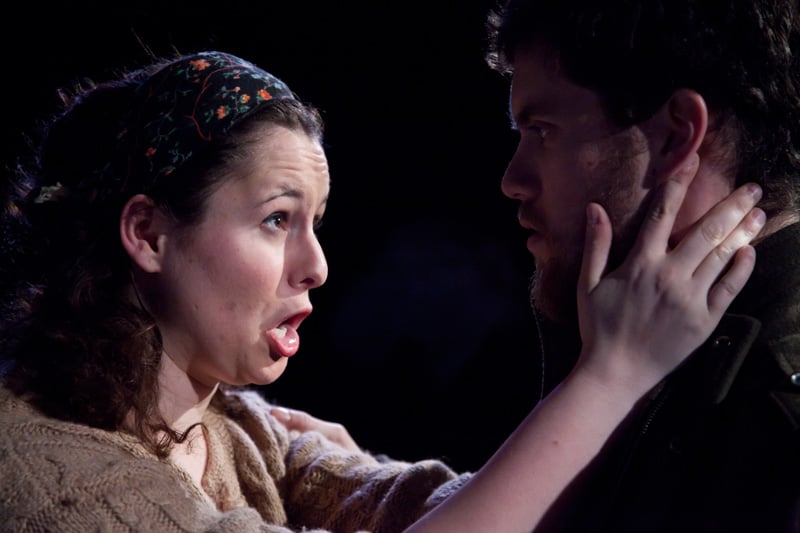
“…nothing’s changed…”
At the beginning of Macbeth, Lady M is a dominating figure, browbeating her husband into killing Duncan, and taunting him when he shows weakness. At the end of the play, she is broken and alone, talking to shadows and lost to the world.
Gertrude dies when her husband, who claims that he murdered his brother at least partly for her sake (the whole “being king” thing also had something to do with it), allows her to drink the poison meant for her son. Love meets Death and Death wins. Emilia dies when her husband stabs her after she reveals his responsibility for Desdemona’s death (another husband-wife murder.)
Both Gertrude and Emilia have about ten minutes of lying-dead-onstage time at the end of Hamlet and Othello, so I had a-lot of time to think about why exactly I was curled up on the floor, breathing shallowly and trying to avoid being stepped on. (Besides actor masochism)
Emilia, Gertrude, and Lady Macbeth die because they love their husbands too much. Emilia loves her husband so much that she tolerates his abuse and covers for his mistakes. When she finally recognizes his murderous intentions, he kills her.
Gertrude loves her husband so much that she chooses his well being over that of her son. When she finally recognizes that Claudius has in turn chosen his throne over her life, she has about ten seconds to deal with that revelation before the poison kills her. Lady Macbeth loves her husband so much that his abandonment after Duncan’s murder leaves her desolate. When she finally recognizes that her husband is lost to her forever, she kills herself.
Despite the differences between Hamlet, Macbeth and Othello, the arc of of love -> recognition -> death remains the same for Gertrude, Lady Macbeth, and Emilia. Despite major differences in family life (Gertrude is a mother, Lady Macbeth was a mother, and Emilia will never be a mother) and status (Gertrude is queen, Lady Macbeth becomes queen, and Emilia will never be queen), all three women share the same fault (love) and the same fate (death).
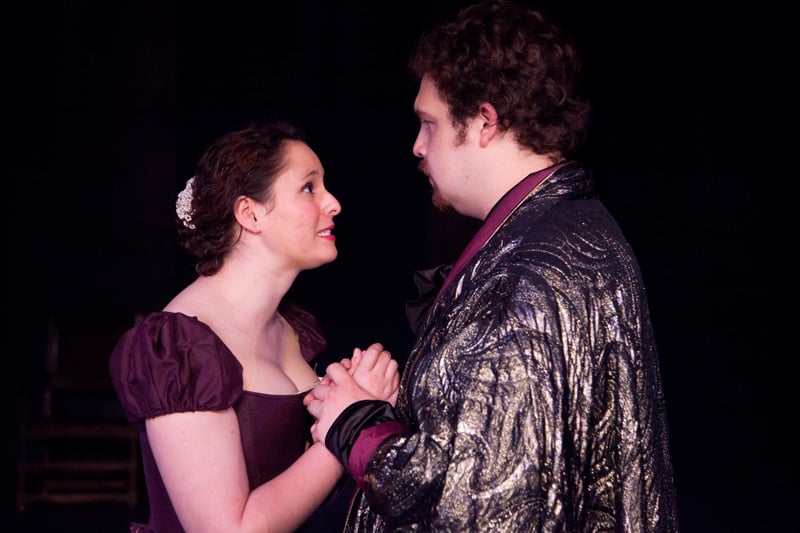
“…only maybe, slightly, re-arranged”
So, what lessons can I take away from the experience of playing these three women? Hopefully not, “Never marry because you will die sad and lonely” because that would just be sad. I think a better answer is rather a) be grateful I don’t live in a Shakespearean tragedy and b) sh*t happens.
In both real life and in the theater, people grow apart. Things go wrong in marriages, and the solution isn’t always as simple as “Well, don’t kill the King of Scotland next time, okay?” My parents were divorcing while I was working on these three roles and as far as I know, neither of them has ever killed anyone. Relationships break in our world and in Shakespeare’s. We are just lucky that more marriages on our side end with splitting assets rather than heads.
Previous Post

August 18, 2012
"Bobby, you've been looking peculiar"
Next Post
August 20, 2012 This Atheist Activism Failure Might Actually be a Win for Skepticism
Browse Our Archives
Select a Category 7 Quick Takes Apologetics Atheism Book Conversion Debate Tactics Debates Epistemology/Philosophy Housekeeping Ideological Turing Test Marriage Morality in Practice Parsing Catholicism Possibly Heretical Radio Reviews/Recommendations Sequence Index Spiritual Practice Uncategorized
Select a Month April 2017 March 2017 January 2017 December 2016 September 2016 August 2016 July 2016 June 2016 May 2016 April 2016 March 2016 February 2016 January 2016 December 2015 November 2015 October 2015 September 2015 August 2015 July 2015 June 2015 May 2015 April 2015 March 2015 February 2015 January 2015 December 2014 November 2014 October 2014 September 2014 August 2014 July 2014 June 2014 May 2014 April 2014 March 2014 February 2014 January 2014 December 2013 November 2013 October 2013 September 2013 August 2013 July 2013 June 2013 May 2013 April 2013 March 2013 February 2013 January 2013 December 2012 November 2012 October 2012 September 2012 August 2012 July 2012 June 2012 May 2012 April 2012 March 2012 February 2012 January 2012 December 2011 November 2011 October 2011 September 2011 August 2011 July 2011 June 2011 May 2011 April 2011 March 2011 February 2011 January 2011 December 2010 November 2010 October 2010 September 2010 August 2010 July 2010 June 2010
Follow Us!
TAKE THE
Religious Wisdom Quiz
What mountain did Jesus ascend from into heaven?
Select your answer to see how you score.
Mount of Olives Mount Sinai Mount Zion Mount Carmel
Related posts from Unequally Yoked
Running the Stats on Shakespeare!
Dwelling In Wounds To Hide From Grace

The Story of Shmuel and Tailoring Support [Guest...

No Villains, Just Inept Lovers in The Last...
TRENDING AT PATHEOS Catholic

Creation, Preservation, and Teleology in Catholic Theology
As I write this, it is very early Monday morning. Like millions...

The Parable Of The Sower And The Word...
One of Christ’s most famous parables is that of the sower who...

Rejecting Doom: Christian Hope And Human Action
Christianity is a religion of hope. We are to have hope and...

Why I Choose the Eucharist Over the Sermon
Choose the Eucharist, Not the Sermon What are we supposed to get...

5 Design Elements Found in Spiritually Rooted Homes
Putting Spirituality Into Home Decor Our homes are more than our living...

Credo: A Story of God Told with the...
About 10 years ago, I began to imagine a personal "Credo" that...
view all Catholic blogs
Ad-Free & Subscriber Log-In Subscription Support
- About Us
- 2026 Calendar
- Videos
- Podcasts
- Library of World Religions
- Faith In Media Tracker
- Advertise With Us
- Write for Us
- Privacy Policy
- Terms of Service
- Do Not Sell My Data
- Contact Us
- Radiant Digital
- Manage Newsletter Subscriptions
- Unsubscribe From Notifications
- Sitemap
Copyright 2008-2026, Patheos. All rights reserved.
Subscription Support Ad-Free & Subscriber Log-In
Follow Patheos