
BuddhistCatholicContemplativeEvangelicalGeneral ChristianHinduJewishLatter-day SaintMuslimNew VisionsProgressive Christian
Beliefs
- Buddhist
- Catholic
- Contemplative
- Evangelical
- General Christian
- Hindu
- Jewish
- Latter-day Saint
- More Voices
- Muslim
- New Visions
- Pagan
- Progressive Christian
Topics
- Religion News
- Food and Religion
- Sports and Religion
- Religious Art
- Religious Music and Entertainment
- Religious Events
- History and Religion
- Style and Religion
- Politics and Religion
- Women in Religion
- Recreation Outdoors and Religion
- Business Finance and Religion
- Careers Workplace and Religion
- Education and Religion
- Family Parenting and Religion
- Health Fitness and Religion
- Home and Religion
- Relationships and Religion
- Technology and Religion
- Travel and Religion
Columnists
- Buddhist Columnists
- Business Finance and Religion Columnists
- Careers Workplace and Religion Columnists
- Catholic Columnists
- Contemplative Columnists
- Education and Religion Columnists
- Evangelists Columnists
- Family Parenting and Religion Columnists
- General Christian Columnists
- Health Fitness and Religion Columnists
- Hindu Columnists
- History and Religion Columnists
- Home and Religion Columnists
- Jewish Columnists
- More Voices Columnists
- Latter Day Columnists
- Muslim Columnists
- New Visions Columnists
- Nonreligious Columnists
- Pagan Columnists
- Politics and Religion Columnists
- Progressive Columnists
- Recreation Outdoors and Religion Columnists
- Relationships and Religion Columnists
- Religion News Columnists
- Religious Art Columnists
- Religious Events Columnists
- Religious Music and Entertainment Columnists
- Sports and Religion Columnists
- Style and Religion Columnists
- Technology and Religion Columnists
- Travel and Religion Columnists
- Women in Religion Columnists
Resource Library
- 2026 Calendar
- Library of World Religions
- The 100 Most Holy Places on Earth
- Patheos Answers
- Podcasts
- Videos
- Faith Leaders Database
- Anglican Episcopalian
- Bahai
- Baptist
- Buddhism
- Christianity
- Confucianism
- Eastern Orthodoxy
- Hinduism
- Holiness and Pentecostal
- ISKCON
- Islam
- Judaism
- Lutheran
- Methodist
- The Church of Jesus Christ of Latter-day Saints
- New Age
- Paganism
- Presbytarian and Reformed
- Protestantism
- Religion Behind the Scenes
- Roman Catholic
- Scientology
- Shia Islam
- Sikhism
- Sufism
- Sunni Islam
- Taoism
- Zen
- See all religions
Research Tools
 Ad-Free & Subscriber Log-In Subscription Support
Ad-Free & Subscriber Log-In Subscription Support
Follow Patheos 

- Trending:
- Forgiveness
- |
- Marriage
- |
- Consciousness
- |
- Death Penalty
- |
- Election
- |
- Halloween
 Unequally Yoked
- Home
- Catholic
- What Can You Do in the War?
What Can You Do in the War?
Last updated on: July 16, 2012 at 8:51 pm by Leah Libresco
What Can You Do in the War? 2012-07-16T20:51:39-04:00 Leah Libresco
Patheos Explore the world's faith through different perspectives on religion and spirituality! Patheos has the views of the prevalent religions and spiritualities of the world.
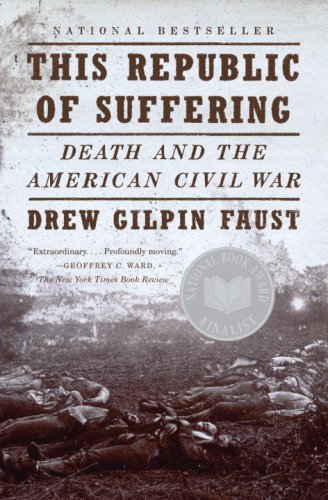
Given the way our discussion of pacifism has meandered over to a debate about martyrdom, what you want to “accomplish” with your death (and whether that’s a coherent question), I’d like to recommend something for your summer reading list: Drew Gilpin Faust’s This Republic of Suffering: Death and the American Civil War. It’s a fabulous book. It doesn’t presuppose that you’re a Civil War buff, so casual readers have no barrier to entry, and it delves into a strange, tightly-circumscribed topic, so even people who already know a lot will probably still find new data and analysis.
I struggled a little with my choice of adjective above, since death isn’t really a strange subject; it’s the one we’re all guaranteed to encounter. But our experience with it is almost always as something unnatural. Gilpin Faust ends up focusing a lot on how nurses and chaplains ended up scripting a good death for their charges. Because soldiers were dying en masse far from home, letters describing their deathbed scenes ended up mapping out what the cultural expectations were for a successful death. Go put a hold on the book at your local library.
One topic from a later chapter is more directly relevant to where we started: the ethics of being a soldier. According the Gilpin Faust’s sources, the Civil War was the first American war to rely heavily on sharpshooters and snipers, and people struggled to fit their actions into the killing-but-not-murder paradigm:
To shoot a man as he defecated, or slept, or sat cooking or eating, or even as he was “sitting under a tree reading Dickens,” could not easily be rationalized as an act of self defense. Soldiers in camp wanted to think of themselves off duty as targets as well as killers, and they found the intentionality and personalism involved in picking out and picking off a single man highly disturbing. Union sharpshooting units customarily wore green uniforms to serve a camoflage and Confederates came to refer to these marksmen as “snakes in the grass.”
The cool calculation, the purposefulness, and the asymmetry of risk involved in sharpshooting rendered it even more threatening to basic principles of humanity than the frenzied excesses of heated battle. When twelve soldiers from a regiment of Union sharpshooters were taken prisoner in Virginia in 1864, a local Petersburg newspaper argued for their execution: “in our estimation they are nothing but murderers creeping up & shooting men in cold blood & should receive the fate of murderers.” After enduring twenty-four days of steady and debilitating sniper fire between Union and Confederate troops near Port Hudson, Louisiana, John De Forest confessed “I could never bring myself to what seemed like taking human life in pure gayety.” Men who had displayed great courage in battle had broken down “under the monotonous worry” generated by sniper fire. De Forest judged it a “sickening, murderous, unnatural, uncivilized way of being.” Men who could kill others in this way were not men as De Forest before the war had understood them to be; they violated his assumptions about both human nature and human civilization; he believed they undermined what defined their human selves.
I didn’t expect the text to be such a perfect echo of the debate over drone warfare today. But what’s really jarring is that it’s not an echo of debates over sniping and general long-range killing. In the hundred fifty years since the Civil War, what struck soldiers as inhuman has become part of our baseline expectations for war. It’s a ratchet effect.
I’m going to be writing more about drone warfare and how much distance it places between us and our actions later this week, but, in the mean time, I’d really like to hear from you guys on what heuristic you would use to decide that a certain way of killing people is unacceptable. I’ll assume we all agree you should minimize the suffering of your victim, but is there anything besides that and efficacy that you need to keep in mind?
Previous Post
July 13, 2012
And what did you win with your death?
Next Post

July 17, 2012 Yes, my comments policy is inspired by MegaUpload
Browse Our Archives
Select a Category 7 Quick Takes Apologetics Atheism Book Conversion Debate Tactics Debates Epistemology/Philosophy Housekeeping Ideological Turing Test Marriage Morality in Practice Parsing Catholicism Possibly Heretical Radio Reviews/Recommendations Sequence Index Spiritual Practice Uncategorized
Select a Month April 2017 March 2017 January 2017 December 2016 September 2016 August 2016 July 2016 June 2016 May 2016 April 2016 March 2016 February 2016 January 2016 December 2015 November 2015 October 2015 September 2015 August 2015 July 2015 June 2015 May 2015 April 2015 March 2015 February 2015 January 2015 December 2014 November 2014 October 2014 September 2014 August 2014 July 2014 June 2014 May 2014 April 2014 March 2014 February 2014 January 2014 December 2013 November 2013 October 2013 September 2013 August 2013 July 2013 June 2013 May 2013 April 2013 March 2013 February 2013 January 2013 December 2012 November 2012 October 2012 September 2012 August 2012 July 2012 June 2012 May 2012 April 2012 March 2012 February 2012 January 2012 December 2011 November 2011 October 2011 September 2011 August 2011 July 2011 June 2011 May 2011 April 2011 March 2011 February 2011 January 2011 December 2010 November 2010 October 2010 September 2010 August 2010 July 2010 June 2010
Follow Us!
TAKE THE
Religious Wisdom Quiz
What does 2 Peter say scoffers will say in the last days?
Select your answer to see how you score.
There is no God Jesus will never return Where is this 'coming' he promised? The world will never end
Related posts from Unequally Yoked



The Boring, Quiet Rituals That Sustain Us Spiritually

Starving Laypeople of Devotion in Church
TRENDING AT PATHEOS Catholic

Rejecting Doom: Christian Hope And Human Action
Christianity is a religion of hope. We are to have hope and...

It’s What Comes From Within Which Matters
One of the most difficult things for us to understand is why...

Why I Choose the Eucharist Over the Sermon
Choose the Eucharist, Not the Sermon What are we supposed to get...

5 Design Elements Found in Spiritually Rooted Homes
Putting Spirituality Into Home Decor Our homes are more than our living...

Credo: A Story of God Told with the...
About 10 years ago, I began to imagine a personal "Credo" that...

The Anatomy of Divine Revelation in Catholic Thought
The claim that God has made Himself known to human beings is...
view all Catholic blogs
Ad-Free & Subscriber Log-In Subscription Support
- About Us
- 2026 Calendar
- Videos
- Podcasts
- Library of World Religions
- Faith In Media Tracker
- Advertise With Us
- Write for Us
- Privacy Policy
- Terms of Service
- Do Not Sell My Data
- Contact Us
- Radiant Digital
- Manage Newsletter Subscriptions
- Unsubscribe From Notifications
- Sitemap
Copyright 2008-2026, Patheos. All rights reserved.
Subscription Support Ad-Free & Subscriber Log-In
Follow Patheos