
BuddhistCatholicContemplativeEvangelicalGeneral ChristianHinduJewishLatter-day SaintMuslimNew VisionsProgressive Christian
Beliefs
- Buddhist
- Catholic
- Contemplative
- Evangelical
- General Christian
- Hindu
- Jewish
- Latter-day Saint
- More Voices
- Muslim
- New Visions
- Pagan
- Progressive Christian
Topics
- Religion News
- Food and Religion
- Sports and Religion
- Religious Art
- Religious Music and Entertainment
- Religious Events
- History and Religion
- Style and Religion
- Politics and Religion
- Women in Religion
- Recreation Outdoors and Religion
- Business Finance and Religion
- Careers Workplace and Religion
- Education and Religion
- Family Parenting and Religion
- Health Fitness and Religion
- Home and Religion
- Relationships and Religion
- Technology and Religion
- Travel and Religion
Columnists
- Buddhist Columnists
- Business Finance and Religion Columnists
- Careers Workplace and Religion Columnists
- Catholic Columnists
- Contemplative Columnists
- Education and Religion Columnists
- Evangelists Columnists
- Family Parenting and Religion Columnists
- General Christian Columnists
- Health Fitness and Religion Columnists
- Hindu Columnists
- History and Religion Columnists
- Home and Religion Columnists
- Jewish Columnists
- More Voices Columnists
- Latter Day Columnists
- Muslim Columnists
- New Visions Columnists
- Nonreligious Columnists
- Pagan Columnists
- Politics and Religion Columnists
- Progressive Columnists
- Recreation Outdoors and Religion Columnists
- Relationships and Religion Columnists
- Religion News Columnists
- Religious Art Columnists
- Religious Events Columnists
- Religious Music and Entertainment Columnists
- Sports and Religion Columnists
- Style and Religion Columnists
- Technology and Religion Columnists
- Travel and Religion Columnists
- Women in Religion Columnists
Resource Library
- 2026 Calendar
- Library of World Religions
- The 100 Most Holy Places on Earth
- Patheos Answers
- Podcasts
- Videos
- Faith Leaders Database
- Anglican Episcopalian
- Bahai
- Baptist
- Buddhism
- Christianity
- Confucianism
- Eastern Orthodoxy
- Hinduism
- Holiness and Pentecostal
- ISKCON
- Islam
- Judaism
- Lutheran
- Methodist
- The Church of Jesus Christ of Latter-day Saints
- New Age
- Paganism
- Presbytarian and Reformed
- Protestantism
- Religion Behind the Scenes
- Roman Catholic
- Scientology
- Shia Islam
- Sikhism
- Sufism
- Sunni Islam
- Taoism
- Zen
- See all religions
Research Tools
 Ad-Free & Subscriber Log-In Subscription Support
Ad-Free & Subscriber Log-In Subscription Support
Follow Patheos 

- Trending:
- Forgiveness
- |
- Marriage
- |
- Consciousness
- |
- Death Penalty
- |
- Election
- |
- Halloween
 Unequally Yoked
- Home
- Catholic
- Play Along with Rationality Camp at Home!
Play Along with Rationality Camp at Home!
Last updated on: July 24, 2012 at 11:20 am by Leah Libresco
Play Along with Rationality Camp at Home! 2012-07-24T11:20:14-04:00 Leah Libresco
Patheos Explore the world's faith through different perspectives on religion and spirituality! Patheos has the views of the prevalent religions and spiritualities of the world.

While you’re all missing me, there are three games you might want to try that I’ve been playing at rationality camp.
The first two games are related. The first one is called the Calibration Game and the second is called the Updating Game. (Note: both those links start downloads of zip files). Both are trivia games, but, although you’re trying to get questions right, the focus is less on how knowledgeable you are and more on how good you are at gauging your own uncertainty.
The Calibration Game asks you question with two possible answers and asks you how sure you are that you’re right. You gain or lose points depending on whether you’re right or wrong, and the change in your points is proportional to how certain you rated yourself. While you’re playing, you can see a graphical representation of your own accuracy about yourself.
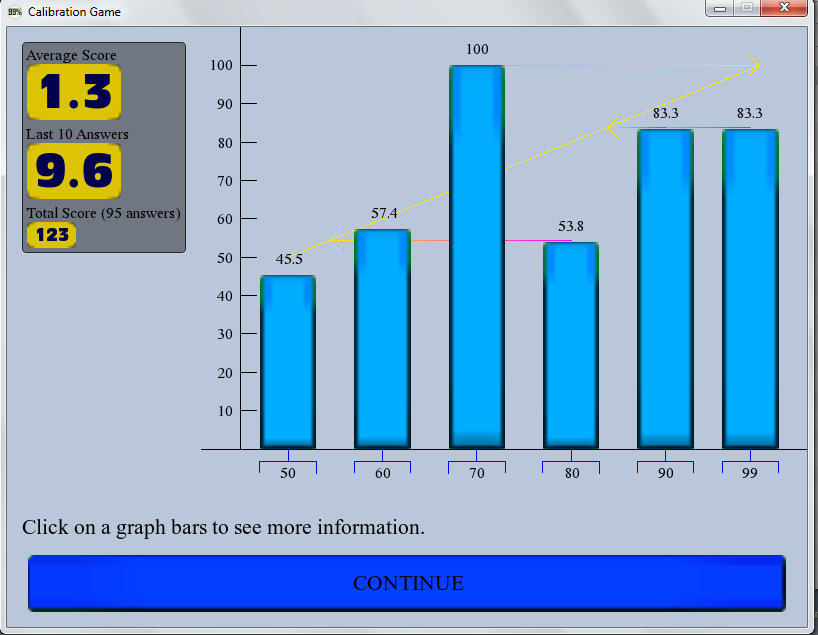
If I were well calibrated, you would expect that when I’m 80% confident, I’d be right about 80% of the time. The bars should all hit a y=x line. That’s obviously still not the case (though, I will say in my own defense, my 70 and 80% bars are especially terrible because I’m very rarely 70-80 percent confident for any of these prompts, so any errors throw me way off).
The Updating Game also tries to make you aware of how badly calibrated you are, but using a different approach. Instead of picking from two answers, you get posed an open-ended question (i.e. What year did The Muppet Show premiere?) and you give an upper and lower bound for a 95% confidence interval. The game keeps track of how often the right answer falls into your specified range (it should be 95% of the time!).
The last game is the one I invented for LessWrong’s Be Specific prompt. I called it the Monday-Tuesday game.
On Monday, your proposition is true. On Tuesday, your proposition is false. Tell me a story about each of the days so I can see how they are different. Don’t just list the differences (because you’re already not doing that well). Start with “I wake up” so you start concrete and move on in that vein, naming the parts of your day that are identical as well as those that are different.
In CFAR’s implementation we paired off, picked two prompts from a hat, and tried to differentiate between two worlds, one in which a proposition was true and one in which it was false. The prompts varied a lot in how specific/quantifiable/etc they were, and my partner and I both pulled this one for our exercise:
On Monday, suffering builds character. On Tuesday, it doesn’t. Describe how Monday and Tuesday are different.
My partner suggested picking out two thousand people and randomizing half of them to torture horribly. Then he planned to give every subject one of the kinds of honesty tests you might find discussed in Bruce Schneier’s book Liars and Outliers. Everyone takes an exam and half of each group gets to grade their own papers. You compare the average score of the self-graders to the average score of the non-self-graders in each group to see how much they lied about their scores. In one world he’d expect that the people who were tortured were more honest than the controls, and in the other, he’s expect they did not differ significantly or that the torture victims were less honest.
I said that I’d expect that, in the world where suffering built character, that the people I most admired and wanted to model myself after would have suffered more relative to the general population. I thought about saying that, in the pro-suffering world, that people would use a lot of positive language to talk about suffering (more specifically that it would sound similar to the way non-athletes talk about exercise), but I wasn’t confident enough that this wouldn’t happen in the Tuesday world, too (because people have Panglossian tendencies) to use it as a criterion.
We ended up with pretty different approaches, since my partner was trying to construct the best experiment he could, practicality and ethics be damned, while I was trying to think, in the course of a normal day, what could I notice that would vary across worlds. I think both approaches can be helpful, especially since we don’t usually carry out experiments for all our beliefs, even if they’d help us be more accurate.
Do folks want to play along with that prompt in the comments? I guess you can also propose other True-on-Monday/False-on-Tuesday ideas and suggest ways that the two worlds differ. The funniest example from class was for “The Sun goes around the Earth on Tuesday” and the student said that, if all laws of physics weren’t believed to be different, he’d expect he’d find out that scientists were all in a conspiracy that he could infiltrate to perpetuate a big lie about how physics works.
Previous Post

July 23, 2012
Head to Head with Hemant Mehta
Next Post
July 25, 2012 Markets in Everything!
Browse Our Archives
Select a Category 7 Quick Takes Apologetics Atheism Book Conversion Debate Tactics Debates Epistemology/Philosophy Housekeeping Ideological Turing Test Marriage Morality in Practice Parsing Catholicism Possibly Heretical Radio Reviews/Recommendations Sequence Index Spiritual Practice Uncategorized
Select a Month April 2017 March 2017 January 2017 December 2016 September 2016 August 2016 July 2016 June 2016 May 2016 April 2016 March 2016 February 2016 January 2016 December 2015 November 2015 October 2015 September 2015 August 2015 July 2015 June 2015 May 2015 April 2015 March 2015 February 2015 January 2015 December 2014 November 2014 October 2014 September 2014 August 2014 July 2014 June 2014 May 2014 April 2014 March 2014 February 2014 January 2014 December 2013 November 2013 October 2013 September 2013 August 2013 July 2013 June 2013 May 2013 April 2013 March 2013 February 2013 January 2013 December 2012 November 2012 October 2012 September 2012 August 2012 July 2012 June 2012 May 2012 April 2012 March 2012 February 2012 January 2012 December 2011 November 2011 October 2011 September 2011 August 2011 July 2011 June 2011 May 2011 April 2011 March 2011 February 2011 January 2011 December 2010 November 2010 October 2010 September 2010 August 2010 July 2010 June 2010
Follow Us!
TAKE THE
Religious Wisdom Quiz
Who interpreted Nebuchadnezzar's dream of a statue of gold, silver, bronze, iron, and clay?
Select your answer to see how you score.
Daniel Ezekiel Obadiah Hosea
Related posts from Unequally Yoked

Rational Faith: More working hypothesis than logical proof

Life Lessons that Can't be Taught at College's...

Books that Change the Way You Think [Radio...

Your religion... is it bigger than a breadbox?
TRENDING AT PATHEOS Catholic

The Parable Of The Sower And The Word...
One of Christ’s most famous parables is that of the sower who...

Rejecting Doom: Christian Hope And Human Action
Christianity is a religion of hope. We are to have hope and...

Why I Choose the Eucharist Over the Sermon
Choose the Eucharist, Not the Sermon What are we supposed to get...

5 Design Elements Found in Spiritually Rooted Homes
Putting Spirituality Into Home Decor Our homes are more than our living...

Credo: A Story of God Told with the...
About 10 years ago, I began to imagine a personal "Credo" that...

The Anatomy of Divine Revelation in Catholic Thought
The claim that God has made Himself known to human beings is...
view all Catholic blogs
Ad-Free & Subscriber Log-In Subscription Support
- About Us
- 2026 Calendar
- Videos
- Podcasts
- Library of World Religions
- Faith In Media Tracker
- Advertise With Us
- Write for Us
- Privacy Policy
- Terms of Service
- Do Not Sell My Data
- Contact Us
- Radiant Digital
- Manage Newsletter Subscriptions
- Unsubscribe From Notifications
- Sitemap
Copyright 2008-2026, Patheos. All rights reserved.
Subscription Support Ad-Free & Subscriber Log-In
Follow Patheos