
BuddhistCatholicContemplativeEvangelicalGeneral ChristianHinduJewishLatter-day SaintMuslimNew VisionsProgressive Christian
Beliefs
- Buddhist
- Catholic
- Contemplative
- Evangelical
- General Christian
- Hindu
- Jewish
- Latter-day Saint
- More Voices
- Muslim
- New Visions
- Pagan
- Progressive Christian
Topics
- Religion News
- Food and Religion
- Sports and Religion
- Religious Art
- Religious Music and Entertainment
- Religious Events
- History and Religion
- Style and Religion
- Politics and Religion
- Women in Religion
- Recreation Outdoors and Religion
- Business Finance and Religion
- Careers Workplace and Religion
- Education and Religion
- Family Parenting and Religion
- Health Fitness and Religion
- Home and Religion
- Relationships and Religion
- Technology and Religion
- Travel and Religion
Columnists
- Buddhist Columnists
- Business Finance and Religion Columnists
- Careers Workplace and Religion Columnists
- Catholic Columnists
- Contemplative Columnists
- Education and Religion Columnists
- Evangelists Columnists
- Family Parenting and Religion Columnists
- General Christian Columnists
- Health Fitness and Religion Columnists
- Hindu Columnists
- History and Religion Columnists
- Home and Religion Columnists
- Jewish Columnists
- More Voices Columnists
- Latter Day Columnists
- Muslim Columnists
- New Visions Columnists
- Nonreligious Columnists
- Pagan Columnists
- Politics and Religion Columnists
- Progressive Columnists
- Recreation Outdoors and Religion Columnists
- Relationships and Religion Columnists
- Religion News Columnists
- Religious Art Columnists
- Religious Events Columnists
- Religious Music and Entertainment Columnists
- Sports and Religion Columnists
- Style and Religion Columnists
- Technology and Religion Columnists
- Travel and Religion Columnists
- Women in Religion Columnists
Resource Library
- 2026 Calendar
- Library of World Religions
- The 100 Most Holy Places on Earth
- Patheos Answers
- Podcasts
- Videos
- Faith Leaders Database
- Anglican Episcopalian
- Bahai
- Baptist
- Buddhism
- Christianity
- Confucianism
- Eastern Orthodoxy
- Hinduism
- Holiness and Pentecostal
- ISKCON
- Islam
- Judaism
- Lutheran
- Methodist
- The Church of Jesus Christ of Latter-day Saints
- New Age
- Paganism
- Presbytarian and Reformed
- Protestantism
- Religion Behind the Scenes
- Roman Catholic
- Scientology
- Shia Islam
- Sikhism
- Sufism
- Sunni Islam
- Taoism
- Zen
- See all religions
Research Tools
 Ad-Free & Subscriber Log-In Subscription Support
Ad-Free & Subscriber Log-In Subscription Support
Follow Patheos 

- Trending:
- Forgiveness
- |
- Marriage
- |
- Consciousness
- |
- Death Penalty
- |
- Election
- |
- Halloween
 Unequally Yoked
- Home
- Catholic
- Morality in Multiple Dimensions
Morality in Multiple Dimensions
Last updated on: December 30, 2012 at 1:27 am by Leah Libresco
Morality in Multiple Dimensions 2012-12-30T01:27:28-05:00 Leah Libresco
Patheos Explore the world's faith through different perspectives on religion and spirituality! Patheos has the views of the prevalent religions and spiritualities of the world.

In college, I got into a lot of debates about moral relativism, cultural imperialism, and epistemological modesty. When we were picking fights, it was useful to be able to get a quick sense of your sparring partner’s positions, and my friends and I had an easy way to do triage:
During the British occupation of India, were the British imperialists right to condemn sati (the practise of burning widows alive on their husbands pyres)? Were they right to want to eliminate it? Were the women wrong if they assented to their own deaths?
No fair sidestepping to fight about how the British went about uprooting the tradition. That’s an admittedly tough problem, but it comes after you evaluate the status quo and decide you have a duty to stand athwart it yelling “Stop!” You may be powerless to act effectively, but once you’ve decided that a cultural practise has to be destroyed, you’ll always be searching for a way to help.
Some of my relativist friends or non-relativists who were more suspicious of neo-colonialists were wary. How would these well-meaning Britishers recognize the limits of their understanding of a culture they didn’t share? How did I propose to keep every moral dispute from turning into a war of annihilation? A Lewis quote from Mere Christianity gave me some good tools to work on this problem:
A girl in the Pacific islands wearing hardly any clothes and a Victorian lady completely covered in clothes might both be equally “modest,” proper, or decent, according to the standards of their own societies…When people break the rule of propriety current in their own time and place, if they do so in order to excite lust in themselves or others, then they are offending against chastity. But if they break it through ignorance or carelessness they are guilty only of bad manners. When, as often happens, they break it defiantly in order to shock or embarrass others, they are not necessarily being unchaste, but they are being uncharitable: for it is uncharitable to take pleasure in making other people uncomfortable.
Here, modesty seems to be a universal value along the lines of “Don’t use your sexuality as a weapon against other people” but the culture you live in has different expectations of what counts as inappropriately aggressive sexuality. This seems like the right balance of universal morality and culture/time variant instantiations of these principles.
Zoomed way out, you’re back to the golden rule of loving your neighbor as yourself, but since that tends to be too abstracted to trip our conscience, we talk about specific aspects of this disposition: modesty, charity, etc. And, since I’m usually thinking topologically, these might analogous to projections of a four-dimensional object into a three-dimensional space. (Ignore that last if it wasn’t helpful).
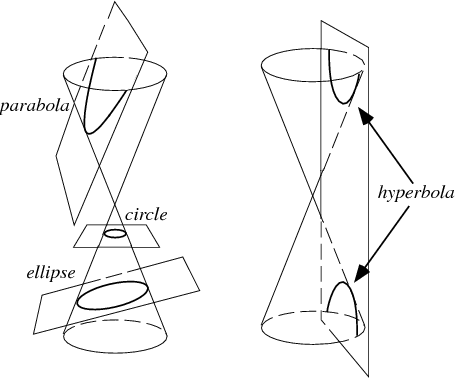
Remember conic sections from middle school? They’re projections of a three dimensional object onto the 2D plane
These aspects of do-as-you-ought-to-be-done-by are still universal, but they’re a little more concrete because they’re limited in scope. It’s easier to recognize that I’m deficient in one of these particular virtues and try and improve than it is to cultivate Virtue-writ-large. By the time I get to quotidian moral decisions, I’m looking to see which virtues I’m conforming to in carrying out a particular act.
To answer that question, I need to combine understanding and love of the virtues with my knowledge of the facts on the ground; it’s Aristotelian practical wisdom. If I’m extremely ignorant of the cultural situation I find myself in, I’ll be slower to act, but the example of sati and others will remind me that sometimes outsiders are right. That’s why I use do-as-you-ought-to-be-done-by, not do-as-you-would-be-done-by. Sometimes we love our neighbor incorrectly because we love ourselves wrongly first.
Oh, and one other big class of error to watch out for: every named virtue is a facet of big-V Virtue, so if we’re elevating one way of showing respect to others as the highest good, that should be a red flag that we’re erring.
Previous Post

April 12, 2012
We Go Together / Like Essence and Telos / Doo-bop a doo-bee doo
Next Post
April 13, 2012 7 Quick Takes (4/13/12)
Browse Our Archives
Select a Category 7 Quick Takes Apologetics Atheism Book Conversion Debate Tactics Debates Epistemology/Philosophy Housekeeping Ideological Turing Test Marriage Morality in Practice Parsing Catholicism Possibly Heretical Radio Reviews/Recommendations Sequence Index Spiritual Practice Uncategorized
Select a Month April 2017 March 2017 January 2017 December 2016 September 2016 August 2016 July 2016 June 2016 May 2016 April 2016 March 2016 February 2016 January 2016 December 2015 November 2015 October 2015 September 2015 August 2015 July 2015 June 2015 May 2015 April 2015 March 2015 February 2015 January 2015 December 2014 November 2014 October 2014 September 2014 August 2014 July 2014 June 2014 May 2014 April 2014 March 2014 February 2014 January 2014 December 2013 November 2013 October 2013 September 2013 August 2013 July 2013 June 2013 May 2013 April 2013 March 2013 February 2013 January 2013 December 2012 November 2012 October 2012 September 2012 August 2012 July 2012 June 2012 May 2012 April 2012 March 2012 February 2012 January 2012 December 2011 November 2011 October 2011 September 2011 August 2011 July 2011 June 2011 May 2011 April 2011 March 2011 February 2011 January 2011 December 2010 November 2010 October 2010 September 2010 August 2010 July 2010 June 2010
Follow Us!
TAKE THE
Religious Wisdom Quiz
How many books are in the entire Bible?
Select your answer to see how you score.
39 80 66 73
Related posts from Unequally Yoked

Rational Faith: More working hypothesis than logical proof

The Tony-Winning Guide To Temptation And Grace

Hedgehogs of Redemption and the Comedy of Grace

Mercy, Justice, and How To Tell The Difference
TRENDING AT PATHEOS Catholic

The Parable Of The Sower And The Word...
One of Christ’s most famous parables is that of the sower who...

Rejecting Doom: Christian Hope And Human Action
Christianity is a religion of hope. We are to have hope and...

Why I Choose the Eucharist Over the Sermon
Choose the Eucharist, Not the Sermon What are we supposed to get...

5 Design Elements Found in Spiritually Rooted Homes
Putting Spirituality Into Home Decor Our homes are more than our living...

Credo: A Story of God Told with the...
About 10 years ago, I began to imagine a personal "Credo" that...

The Anatomy of Divine Revelation in Catholic Thought
The claim that God has made Himself known to human beings is...
view all Catholic blogs
Ad-Free & Subscriber Log-In Subscription Support
- About Us
- 2026 Calendar
- Videos
- Podcasts
- Library of World Religions
- Faith In Media Tracker
- Advertise With Us
- Write for Us
- Privacy Policy
- Terms of Service
- Do Not Sell My Data
- Contact Us
- Radiant Digital
- Manage Newsletter Subscriptions
- Unsubscribe From Notifications
- Sitemap
Copyright 2008-2026, Patheos. All rights reserved.
Subscription Support Ad-Free & Subscriber Log-In
Follow Patheos