
BuddhistCatholicContemplativeEvangelicalGeneral ChristianHinduJewishLatter-day SaintMuslimNew VisionsProgressive Christian
Beliefs
- Buddhist
- Catholic
- Contemplative
- Evangelical
- General Christian
- Hindu
- Jewish
- Latter-day Saint
- More Voices
- Muslim
- New Visions
- Pagan
- Progressive Christian
Topics
- Religion News
- Food and Religion
- Sports and Religion
- Religious Art
- Religious Music and Entertainment
- Religious Events
- History and Religion
- Style and Religion
- Politics and Religion
- Women in Religion
- Recreation Outdoors and Religion
- Business Finance and Religion
- Careers Workplace and Religion
- Education and Religion
- Family Parenting and Religion
- Health Fitness and Religion
- Home and Religion
- Relationships and Religion
- Technology and Religion
- Travel and Religion
Columnists
- Buddhist Columnists
- Business Finance and Religion Columnists
- Careers Workplace and Religion Columnists
- Catholic Columnists
- Contemplative Columnists
- Education and Religion Columnists
- Evangelists Columnists
- Family Parenting and Religion Columnists
- General Christian Columnists
- Health Fitness and Religion Columnists
- Hindu Columnists
- History and Religion Columnists
- Home and Religion Columnists
- Jewish Columnists
- More Voices Columnists
- Latter Day Columnists
- Muslim Columnists
- New Visions Columnists
- Nonreligious Columnists
- Pagan Columnists
- Politics and Religion Columnists
- Progressive Columnists
- Recreation Outdoors and Religion Columnists
- Relationships and Religion Columnists
- Religion News Columnists
- Religious Art Columnists
- Religious Events Columnists
- Religious Music and Entertainment Columnists
- Sports and Religion Columnists
- Style and Religion Columnists
- Technology and Religion Columnists
- Travel and Religion Columnists
- Women in Religion Columnists
Resource Library
- 2026 Calendar
- Library of World Religions
- The 100 Most Holy Places on Earth
- Patheos Answers
- Podcasts
- Videos
- Faith Leaders Database
- Anglican Episcopalian
- Bahai
- Baptist
- Buddhism
- Christianity
- Confucianism
- Eastern Orthodoxy
- Hinduism
- Holiness and Pentecostal
- ISKCON
- Islam
- Judaism
- Lutheran
- Methodist
- The Church of Jesus Christ of Latter-day Saints
- New Age
- Paganism
- Presbytarian and Reformed
- Protestantism
- Religion Behind the Scenes
- Roman Catholic
- Scientology
- Shia Islam
- Sikhism
- Sufism
- Sunni Islam
- Taoism
- Zen
- See all religions
Research Tools
 Ad-Free & Subscriber Log-In Subscription Support
Ad-Free & Subscriber Log-In Subscription Support
Follow Patheos 

- Trending:
- Forgiveness
- |
- Marriage
- |
- Consciousness
- |
- Death Penalty
- |
- Election
- |
- Halloween
 Unequally Yoked
- Home
- Catholic
- Maundy Thursday Problems Again
Maundy Thursday Problems Again
Last updated on: April 5, 2012 at 3:55 pm by Leah Libresco
Maundy Thursday Problems Again 2012-04-05T15:55:54-04:00 Leah Libresco
Patheos Explore the world's faith through different perspectives on religion and spirituality! Patheos has the views of the prevalent religions and spiritualities of the world.

As I explained last year, Maundy Thursday is the day I feel least comfortable attending Mass:
I don’t like to be beholden to anyone. I don’t like accepting a favor from someone I have no way of repaying or being indebted to someone I don’t know and may not like. I frustrated my boyfriend for more than half a year by never taking food from the post-Mass receptions the campus church hosted. In my mind, the food was for people who had bought in, and it would be inappropriate to benefit from the Church’s largesse when I had no intention of supporting. Not to mention, raised on a diet of mythology and fantasy/scifi novels, I have a slight distrust of accepting food in strange places.
And this year, I might be off the hook, but I think I feel worse. There’s been a discussion going on across the Patheos Catholic portal about whether it’s appropriate to include women in this part of the service. Fr. Longenecker of Standing on My Head is adamant:
We should get this straight. The tradition and the rubrics mandate that men are to have their feet washed. Not little girls, not women, not boys. Men. Why is this? Because the foot washing ceremony is not only an example of Christ being the lowest servant of all, as Tom’s article makes clear, but it is also a consolidation of the apostolic ministry.
And Thomas McDonald of God and the Machine concurs, saying “Sadly, this [men-only footwashing] is rarely the case in modern parishes.” I don’t have the standing to criticize their interpretation of the liturgy, but that “Sadly” stuck out to me. They don’t seem to be talking about balancing two goods (the humility required to serve or accept service, which is presumably salutary to everyone in the Church versus the symbol of the apostolic ministry), but as though there is just one good, and it is under siege by the ignorant.
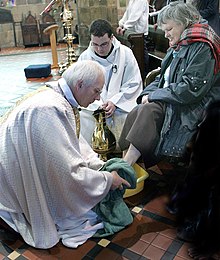
The simple fact is that many institutions and traditions which excluded women from participation and membership have done so for reasons which we now consider dishonorable. Absent any other data, we’d bet that the next exclusion we find is also not well-founded. So it’s unkind for the defenders of men-only footwashing to act as though the cause of the policy is obvious or that we should be in the habit of accepting these kinds of distinction uncritically.
Even after reading several posts on the subject, I don’t really understand why these bloggers have such a high degree of confidence in the purpose of the ritual. When one commenter writes:
Right now I live in a diocese that has an overwhelming majority of liberal Catholics and priests. So I asked the question “Will women be participating, i.e., getting their washed?” The response was an incredulous “Yes, of course. Why not?”. I said that would not be Biblical, since Jesus did this (according to the Gospel of John) for the Apostles, the first priests – at the first Eucharist where no women were present for a reason.
All I can think is that I don’t understand why he thinks it’s permissible for women to participate in the Eucharist either, since that sacrament was created at an event from which they were purposefully excluded. And all the Apostles were (to the best of my knowledge) Jewish, but that quality is treated as more incidental when it comes to modern practice. If you want to overcome my reasonable skepticism, you need to flesh out your arguments more.
Mark Shea had the most approachable posts on this topic. As a layperson, he sought out data and then explained it without using it as a cudgel or berating the people who had questions. Up til his post, it felt like the discussion was falling into the arguments as soldiers error that Yudkowsky describes:
Arguments are soldiers. Once you know which side you’re on, you must support all arguments of that side, and attack all arguments that appear to favor the enemy side; otherwise it’s like stabbing your soldiers in the back. If you abide within that pattern, policy debates will also appear one-sided to you—the costs and drawbacks of your favored policy are enemy soldiers, to be attacked by any means necessary.
Your ‘enemies’ are usually attacking you in good faith, and if you can’t summarize their position as something nicer sounding than a will to destroy, you might convince a straw-man, but you sure as heck won’t move your audience.
One other note: a number of the commenters on Shea’s post seemed to think the all-serving-all model was diminishing the message down to a treacly let’s-be-nice kind of thing. If any of them end up over here, I’d really ask you to read my post from last year’s Maundy Thursday. I didn’t find the practice cloying, I found it terrifying.
Previous Post

April 5, 2012
Q&A with Libby Anne of Love, Joy, Feminism
Next Post
April 6, 2012 7 Quick Takes (4/6/12)
Browse Our Archives
Select a Category 7 Quick Takes Apologetics Atheism Book Conversion Debate Tactics Debates Epistemology/Philosophy Housekeeping Ideological Turing Test Marriage Morality in Practice Parsing Catholicism Possibly Heretical Radio Reviews/Recommendations Sequence Index Spiritual Practice Uncategorized
Select a Month April 2017 March 2017 January 2017 December 2016 September 2016 August 2016 July 2016 June 2016 May 2016 April 2016 March 2016 February 2016 January 2016 December 2015 November 2015 October 2015 September 2015 August 2015 July 2015 June 2015 May 2015 April 2015 March 2015 February 2015 January 2015 December 2014 November 2014 October 2014 September 2014 August 2014 July 2014 June 2014 May 2014 April 2014 March 2014 February 2014 January 2014 December 2013 November 2013 October 2013 September 2013 August 2013 July 2013 June 2013 May 2013 April 2013 March 2013 February 2013 January 2013 December 2012 November 2012 October 2012 September 2012 August 2012 July 2012 June 2012 May 2012 April 2012 March 2012 February 2012 January 2012 December 2011 November 2011 October 2011 September 2011 August 2011 July 2011 June 2011 May 2011 April 2011 March 2011 February 2011 January 2011 December 2010 November 2010 October 2010 September 2010 August 2010 July 2010 June 2010
Follow Us!
TAKE THE
Religious Wisdom Quiz
I am a day when tongues of fire appeared and people spoke in languages they had never learned. Three thousand believed that day. What am I?
Select your answer to see how you score.
The Day of Atonement Passover Pentecost Easter
Related posts from Unequally Yoked
How To Offer Community Without Communion
It's Hard To Be A Priest In America,...

Starting Conversations During Francis's Visit
A Dominican Invitation to Witness [Saints Bookclub]
TRENDING AT PATHEOS Catholic

Rejecting Doom: Christian Hope And Human Action
Christianity is a religion of hope. We are to have hope and...

It’s What Comes From Within Which Matters
One of the most difficult things for us to understand is why...

Why I Choose the Eucharist Over the Sermon
Choose the Eucharist, Not the Sermon What are we supposed to get...

5 Design Elements Found in Spiritually Rooted Homes
Putting Spirituality Into Home Decor Our homes are more than our living...

Credo: A Story of God Told with the...
About 10 years ago, I began to imagine a personal "Credo" that...

The Anatomy of Divine Revelation in Catholic Thought
The claim that God has made Himself known to human beings is...
view all Catholic blogs
Ad-Free & Subscriber Log-In Subscription Support
- About Us
- 2026 Calendar
- Videos
- Podcasts
- Library of World Religions
- Faith In Media Tracker
- Advertise With Us
- Write for Us
- Privacy Policy
- Terms of Service
- Do Not Sell My Data
- Contact Us
- Radiant Digital
- Manage Newsletter Subscriptions
- Unsubscribe From Notifications
- Sitemap
Copyright 2008-2026, Patheos. All rights reserved.
Subscription Support Ad-Free & Subscriber Log-In
Follow Patheos