
BuddhistCatholicContemplativeEvangelicalGeneral ChristianHinduJewishLatter-day SaintMuslimNew VisionsProgressive Christian
Beliefs
- Buddhist
- Catholic
- Contemplative
- Evangelical
- General Christian
- Hindu
- Jewish
- Latter-day Saint
- More Voices
- Muslim
- New Visions
- Pagan
- Progressive Christian
Topics
- Religion News
- Food and Religion
- Sports and Religion
- Religious Art
- Religious Music and Entertainment
- Religious Events
- History and Religion
- Style and Religion
- Politics and Religion
- Women in Religion
- Recreation Outdoors and Religion
- Business Finance and Religion
- Careers Workplace and Religion
- Education and Religion
- Family Parenting and Religion
- Health Fitness and Religion
- Home and Religion
- Relationships and Religion
- Technology and Religion
- Travel and Religion
Columnists
- Buddhist Columnists
- Business Finance and Religion Columnists
- Careers Workplace and Religion Columnists
- Catholic Columnists
- Contemplative Columnists
- Education and Religion Columnists
- Evangelists Columnists
- Family Parenting and Religion Columnists
- General Christian Columnists
- Health Fitness and Religion Columnists
- Hindu Columnists
- History and Religion Columnists
- Home and Religion Columnists
- Jewish Columnists
- More Voices Columnists
- Latter Day Columnists
- Muslim Columnists
- New Visions Columnists
- Nonreligious Columnists
- Pagan Columnists
- Politics and Religion Columnists
- Progressive Columnists
- Recreation Outdoors and Religion Columnists
- Relationships and Religion Columnists
- Religion News Columnists
- Religious Art Columnists
- Religious Events Columnists
- Religious Music and Entertainment Columnists
- Sports and Religion Columnists
- Style and Religion Columnists
- Technology and Religion Columnists
- Travel and Religion Columnists
- Women in Religion Columnists
Resource Library
- 2026 Calendar
- Library of World Religions
- The 100 Most Holy Places on Earth
- Patheos Answers
- Podcasts
- Videos
- Faith Leaders Database
- Anglican Episcopalian
- Bahai
- Baptist
- Buddhism
- Christianity
- Confucianism
- Eastern Orthodoxy
- Hinduism
- Holiness and Pentecostal
- ISKCON
- Islam
- Judaism
- Lutheran
- Methodist
- The Church of Jesus Christ of Latter-day Saints
- New Age
- Paganism
- Presbytarian and Reformed
- Protestantism
- Religion Behind the Scenes
- Roman Catholic
- Scientology
- Shia Islam
- Sikhism
- Sufism
- Sunni Islam
- Taoism
- Zen
- See all religions
Research Tools
 Ad-Free & Subscriber Log-In Subscription Support
Ad-Free & Subscriber Log-In Subscription Support
Follow Patheos 

- Trending:
- Forgiveness
- |
- Marriage
- |
- Consciousness
- |
- Death Penalty
- |
- Election
- |
- Halloween
 Unequally Yoked
- Home
- Catholic
- Is it Maps All the Way Down?
Is it Maps All the Way Down?
Last updated on: December 30, 2012 at 1:25 am by Leah Libresco
Is it Maps All the Way Down? 2012-12-30T01:25:58-05:00 Leah Libresco
Patheos Explore the world's faith through different perspectives on religion and spirituality! Patheos has the views of the prevalent religions and spiritualities of the world.

Yesterday, I went to the Dominican House of Studies for a symposium on Creation and Modern Science, and one of the speakers was Edward Feser, author of The Last Superstition (the book that got me started exploring Aquinas and hanging out with the DC Dominicans). His lecture was on the immaterial nature of thought, and there’s one facet of it I’d like to highlight here.
Feser was talking about the distinction between concepts and phantasms. As briefly as possible (i.e. blame me, not Feser, if I’m oversimplifying):
A phantasm is an instantiation of a concept. It’s a particular triangle, or a specific group of trees. It doesn’t have to be a picture of something that exists — you can have a phantasm of a unicorn.
A concept is clear and distinct. A concept of a triangle isn’t isoceles, equilateral, or scalene because you’re not picturing any specific triangle — you’re just understanding what the nature of a triangle is.
One good example Feser gave: you can have a concept of a chiliagon (a figure with 1000) sides, and that concept will be clearly distinct from a circle, or a figure with 1001 sides. But your phantasm of a chiliagon will ‘look’ the same as a figure with 999 sides or a circle. Your phantasms aren’t granular or clear enough to hit these details, but your concepts encompass all scales.
I’ve been thinking a lot about map-territory problems lately, so I was really interested in this thread of his argument. What I wanted to know was how we could be sure we were differentiating correctly between phantasms and concepts in the first place. If I tell you that I have a clear and distinct idea of a circle: that it’s a set of points at a fixed distance from one point, it certainly doesn’t sound like I’ve got a tangled-up-in-specificity-and-concreteness phantasm.
But several years of chemistry classes have taught me to be suspicious when I think I’ve finally drilled down to Truth. You see, in the first chem class I took, we learned about the orbitals electrons occupied in atoms. We learned about electrons as mini-moons, orbiting the nucleus. When we took AP Chem, our teacher told us, “Look, we lied to you about how orbitals worked, so you could have a reasonable approximation. Now we’re going to teach you the VSEPR model.” I immediately started wondering how many years of chem you had to take before your conceptual models of atoms stabilized, and your professors weren’t constantly telling you that everything you’d learned up to that point had been a noble lie.
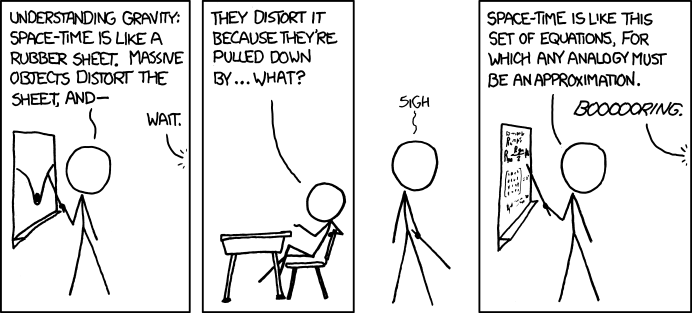
But how good is my supposed concept of a circle in the first place? Just stating that definition is enough to logically entail plenty of properties of circles, however, my clear and distinct idea isn’t good enough to make me instantly remember and understand that the perpendicular bisector of any chord in a circle passes through the center of the circle. It doesn’t feel like I have a firm grasp of what a circle is, just that I have an approximation of it, or a partial listing of its properties, or that I’ve got a clear and distinct idea of one facet of the whole.
I posed this problem to Feser and he told me that my question had already presupposed that I had a sufficiently clear and distinct idea of a circle to know that I was ignorant of some of its properties. To be able to start approximating it in the first place, I needed a concept that I could test phantasms against. This sounded satisfying, but I’d be interested in your takes.
Previous Post

April 13, 2012
7 Quick Takes (4/13/12)
Next Post
April 16, 2012 When Do You Reject Your Intuitions?
Browse Our Archives
Select a Category 7 Quick Takes Apologetics Atheism Book Conversion Debate Tactics Debates Epistemology/Philosophy Housekeeping Ideological Turing Test Marriage Morality in Practice Parsing Catholicism Possibly Heretical Radio Reviews/Recommendations Sequence Index Spiritual Practice Uncategorized
Select a Month April 2017 March 2017 January 2017 December 2016 September 2016 August 2016 July 2016 June 2016 May 2016 April 2016 March 2016 February 2016 January 2016 December 2015 November 2015 October 2015 September 2015 August 2015 July 2015 June 2015 May 2015 April 2015 March 2015 February 2015 January 2015 December 2014 November 2014 October 2014 September 2014 August 2014 July 2014 June 2014 May 2014 April 2014 March 2014 February 2014 January 2014 December 2013 November 2013 October 2013 September 2013 August 2013 July 2013 June 2013 May 2013 April 2013 March 2013 February 2013 January 2013 December 2012 November 2012 October 2012 September 2012 August 2012 July 2012 June 2012 May 2012 April 2012 March 2012 February 2012 January 2012 December 2011 November 2011 October 2011 September 2011 August 2011 July 2011 June 2011 May 2011 April 2011 March 2011 February 2011 January 2011 December 2010 November 2010 October 2010 September 2010 August 2010 July 2010 June 2010
Follow Us!
TAKE THE
Religious Wisdom Quiz
Who said: "Michael the archangel, when contending with the devil he disputed about the body of Moses, dared not bring against him a reviling accusation"?
Select your answer to see how you score.
James Jude Paul Peter
Related posts from Unequally Yoked

Rational Faith: More working hypothesis than logical proof

Life Lessons that Can't be Taught at College's...

Books that Change the Way You Think [Radio...

Your religion... is it bigger than a breadbox?
TRENDING AT PATHEOS Catholic

Rejecting Doom: Christian Hope And Human Action
Christianity is a religion of hope. We are to have hope and...

It’s What Comes From Within Which Matters
One of the most difficult things for us to understand is why...

Why I Choose the Eucharist Over the Sermon
Choose the Eucharist, Not the Sermon What are we supposed to get...

5 Design Elements Found in Spiritually Rooted Homes
Putting Spirituality Into Home Decor Our homes are more than our living...

Credo: A Story of God Told with the...
About 10 years ago, I began to imagine a personal "Credo" that...

The Anatomy of Divine Revelation in Catholic Thought
The claim that God has made Himself known to human beings is...
view all Catholic blogs
Ad-Free & Subscriber Log-In Subscription Support
- About Us
- 2026 Calendar
- Videos
- Podcasts
- Library of World Religions
- Faith In Media Tracker
- Advertise With Us
- Write for Us
- Privacy Policy
- Terms of Service
- Do Not Sell My Data
- Contact Us
- Radiant Digital
- Manage Newsletter Subscriptions
- Unsubscribe From Notifications
- Sitemap
Copyright 2008-2026, Patheos. All rights reserved.
Subscription Support Ad-Free & Subscriber Log-In
Follow Patheos