
BuddhistCatholicContemplativeEvangelicalGeneral ChristianHinduJewishLatter-day SaintMuslimNew VisionsProgressive Christian
Beliefs
- Buddhist
- Catholic
- Contemplative
- Evangelical
- General Christian
- Hindu
- Jewish
- Latter-day Saint
- More Voices
- Muslim
- New Visions
- Pagan
- Progressive Christian
Topics
- Religion News
- Food and Religion
- Sports and Religion
- Religious Art
- Religious Music and Entertainment
- Religious Events
- History and Religion
- Style and Religion
- Politics and Religion
- Women in Religion
- Recreation Outdoors and Religion
- Business Finance and Religion
- Careers Workplace and Religion
- Education and Religion
- Family Parenting and Religion
- Health Fitness and Religion
- Home and Religion
- Relationships and Religion
- Technology and Religion
- Travel and Religion
Columnists
- Buddhist Columnists
- Business Finance and Religion Columnists
- Careers Workplace and Religion Columnists
- Catholic Columnists
- Contemplative Columnists
- Education and Religion Columnists
- Evangelists Columnists
- Family Parenting and Religion Columnists
- General Christian Columnists
- Health Fitness and Religion Columnists
- Hindu Columnists
- History and Religion Columnists
- Home and Religion Columnists
- Jewish Columnists
- More Voices Columnists
- Latter Day Columnists
- Muslim Columnists
- New Visions Columnists
- Nonreligious Columnists
- Pagan Columnists
- Politics and Religion Columnists
- Progressive Columnists
- Recreation Outdoors and Religion Columnists
- Relationships and Religion Columnists
- Religion News Columnists
- Religious Art Columnists
- Religious Events Columnists
- Religious Music and Entertainment Columnists
- Sports and Religion Columnists
- Style and Religion Columnists
- Technology and Religion Columnists
- Travel and Religion Columnists
- Women in Religion Columnists
Resource Library
- 2026 Calendar
- Library of World Religions
- The 100 Most Holy Places on Earth
- Patheos Answers
- Podcasts
- Videos
- Faith Leaders Database
- Anglican Episcopalian
- Bahai
- Baptist
- Buddhism
- Christianity
- Confucianism
- Eastern Orthodoxy
- Hinduism
- Holiness and Pentecostal
- ISKCON
- Islam
- Judaism
- Lutheran
- Methodist
- The Church of Jesus Christ of Latter-day Saints
- New Age
- Paganism
- Presbytarian and Reformed
- Protestantism
- Religion Behind the Scenes
- Roman Catholic
- Scientology
- Shia Islam
- Sikhism
- Sufism
- Sunni Islam
- Taoism
- Zen
- See all religions
Research Tools
 Ad-Free & Subscriber Log-In Subscription Support
Ad-Free & Subscriber Log-In Subscription Support
Follow Patheos 

- Trending:
- Forgiveness
- |
- Marriage
- |
- Consciousness
- |
- Death Penalty
- |
- Election
- |
- Halloween
 Unequally Yoked
- Home
- Catholic
- Immoral Moral Law, Unnatural Nature
Immoral Moral Law, Unnatural Nature
Last updated on: January 2, 2013 at 2:37 pm by Leah Libresco
Immoral Moral Law, Unnatural Nature 2013-01-02T14:37:28-05:00 Leah Libresco
Patheos Explore the world's faith through different perspectives on religion and spirituality! Patheos has the views of the prevalent religions and spiritualities of the world.

Excerpted from Dresden Codak’s Dungeons and Discourse. It was the closest I could get to Squeltchtoad’s hypthothetical
Squeltchtoad’s Immoral Moral Law thought experiment was weird and paradoxical enough that I had a lot of trouble getting purchase on the problem. That confusion might be actually be evidence, but I wanted to make sure I wasn’t giving myself an easy out. Since I was having trouble thinking about the problem in situ, I tried to carry it over into another discipline.
For mathematicians or physicists, perhaps Squelchtoad’s hypothetical would be the discovery that the universe was disordered. Perhaps it would be inconsistent or possibly they’d get let off and just find themselves in an inelegant universe — a world where there would never be a Grand Unified Theory that described physics at every scale. Ah, there’s the queasiness I was after.
When OPERA found data that suggested neutrinos could move faster than light, my friends and I didn’t feel exhilarated that our understanding of the physical world was about to shift again. We felt suspicious and a little fearful. Einstein’s relativity has stood up so well to tests and has made such good predictions that, if it was overturned, we had our doubts that the system could be patched. Luckily for us, the observations were invalid.
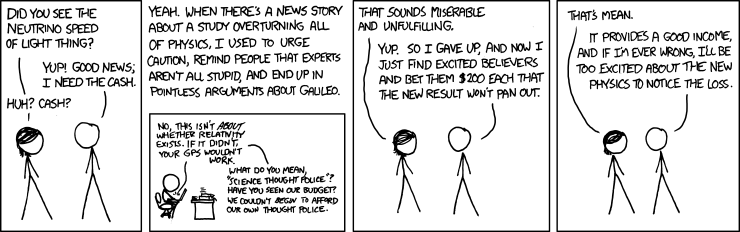
It wasn’t the first time we’ve been in suspense over Einstein’s theories. Yudkowsky wrote up the first major test of Einstein’s predictions as part of a discussion of a different epistemological point.
In 1919, Sir Arthur Eddington led expeditions to Brazil and to the island of Principe, aiming to observe solar eclipses and thereby test an experimental prediction of Einstein’s novel theory of General Relativity. A journalist asked Einstein what he would do if Eddington’s observations failed to match his theory. Einstein famously replied: “Then I would feel sorry for the good Lord. The theory is correct.”
The evidence, like Einstein, turned out to be right. And if the skies had been cloudy and the answer had been delayed, Einstein and most scientists wouldn’t have been agnostic on the question until Eddington came back with the data. The evidence that had led them to expect an orderly, investigatable universe (one where “God did not play dice”) is weak evidence compared to the kinds of proof we expect in number theory, but it’s still evidence. (It’s about the same kind of rigor as anything else that depends on causality actually existing). And it was hard to imagine what kind of result could trump it.
If I were ever confronted by the Immoral Lawgiver in Squeltchtoad’s example, I’d be much more likely to doubt my own senses and reasoning than I would be to doubt that indiscriminate slaughter of other thinking, feeling beings is wrong.
And if I really accept the hypothetical and try to express a preference between a world with no moral order and one where the moral law seems so abhorrent, I’d have to plead the fifth. Squeltchtoad’s hypothetical puts me in the position of a psychopath — so jarringly out of step with the order of the world that my preferences can’t be trusted. And even though every fibre of my body urges rebellion, I’m quite possibly in a “Not even if it’s the right thing to do” situation.
But this world feels as distant and alien as the hypothetical world where there is no regularity in Nature. I don’t see any reason to let this made-up idea creep into my philosophy.
I guess the only thing I could say in answer to Squelchtoad is that at the scale at which I’m living, it’s better for me to follow the Good as far as I understand it than it is for me to seek out an authority whatever horrors may come. My will is better directed in the first case than the second, since I’m practising listening to my moral revulsion instead of disconnecting from my moral-sense perception of the world.

P.S. In the course of writing this post I discovered there was a BBC program titled Einstein and Eddington that featured Gollum as the physicist and Doctor Who as the astrophysicist. Goodness!
Previous Post

April 24, 2012
It's a Bird! It's a Plane! It's an Ethical Vernacular!
Next Post
April 26, 2012 This Doesn't Look Like a Victory to Me
Browse Our Archives
Select a Category 7 Quick Takes Apologetics Atheism Book Conversion Debate Tactics Debates Epistemology/Philosophy Housekeeping Ideological Turing Test Marriage Morality in Practice Parsing Catholicism Possibly Heretical Radio Reviews/Recommendations Sequence Index Spiritual Practice Uncategorized
Select a Month April 2017 March 2017 January 2017 December 2016 September 2016 August 2016 July 2016 June 2016 May 2016 April 2016 March 2016 February 2016 January 2016 December 2015 November 2015 October 2015 September 2015 August 2015 July 2015 June 2015 May 2015 April 2015 March 2015 February 2015 January 2015 December 2014 November 2014 October 2014 September 2014 August 2014 July 2014 June 2014 May 2014 April 2014 March 2014 February 2014 January 2014 December 2013 November 2013 October 2013 September 2013 August 2013 July 2013 June 2013 May 2013 April 2013 March 2013 February 2013 January 2013 December 2012 November 2012 October 2012 September 2012 August 2012 July 2012 June 2012 May 2012 April 2012 March 2012 February 2012 January 2012 December 2011 November 2011 October 2011 September 2011 August 2011 July 2011 June 2011 May 2011 April 2011 March 2011 February 2011 January 2011 December 2010 November 2010 October 2010 September 2010 August 2010 July 2010 June 2010
Follow Us!
TAKE THE
Religious Wisdom Quiz
Who prepared Jesus' body for burial?
Select your answer to see how you score.
Joseph of Arimathea Mary the Mother of Jesus Roman Centurions Peter, James, and John
Related posts from Unequally Yoked

Rational Faith: More working hypothesis than logical proof

The Tony-Winning Guide To Temptation And Grace

Hedgehogs of Redemption and the Comedy of Grace

Mercy, Justice, and How To Tell The Difference
TRENDING AT PATHEOS Catholic

Rejecting Doom: Christian Hope And Human Action
Christianity is a religion of hope. We are to have hope and...

It’s What Comes From Within Which Matters
One of the most difficult things for us to understand is why...

Why I Choose the Eucharist Over the Sermon
Choose the Eucharist, Not the Sermon What are we supposed to get...

5 Design Elements Found in Spiritually Rooted Homes
Putting Spirituality Into Home Decor Our homes are more than our living...

Credo: A Story of God Told with the...
About 10 years ago, I began to imagine a personal "Credo" that...

The Anatomy of Divine Revelation in Catholic Thought
The claim that God has made Himself known to human beings is...
view all Catholic blogs
Ad-Free & Subscriber Log-In Subscription Support
- About Us
- 2026 Calendar
- Videos
- Podcasts
- Library of World Religions
- Faith In Media Tracker
- Advertise With Us
- Write for Us
- Privacy Policy
- Terms of Service
- Do Not Sell My Data
- Contact Us
- Radiant Digital
- Manage Newsletter Subscriptions
- Unsubscribe From Notifications
- Sitemap
Copyright 2008-2026, Patheos. All rights reserved.
Subscription Support Ad-Free & Subscriber Log-In
Follow Patheos