
BuddhistCatholicContemplativeEvangelicalGeneral ChristianHinduJewishLatter-day SaintMuslimNew VisionsProgressive Christian
Beliefs
- Buddhist
- Catholic
- Contemplative
- Evangelical
- General Christian
- Hindu
- Jewish
- Latter-day Saint
- More Voices
- Muslim
- New Visions
- Pagan
- Progressive Christian
Topics
- Religion News
- Food and Religion
- Sports and Religion
- Religious Art
- Religious Music and Entertainment
- Religious Events
- History and Religion
- Style and Religion
- Politics and Religion
- Women in Religion
- Recreation Outdoors and Religion
- Business Finance and Religion
- Careers Workplace and Religion
- Education and Religion
- Family Parenting and Religion
- Health Fitness and Religion
- Home and Religion
- Relationships and Religion
- Technology and Religion
- Travel and Religion
Columnists
- Buddhist Columnists
- Business Finance and Religion Columnists
- Careers Workplace and Religion Columnists
- Catholic Columnists
- Contemplative Columnists
- Education and Religion Columnists
- Evangelists Columnists
- Family Parenting and Religion Columnists
- General Christian Columnists
- Health Fitness and Religion Columnists
- Hindu Columnists
- History and Religion Columnists
- Home and Religion Columnists
- Jewish Columnists
- More Voices Columnists
- Latter Day Columnists
- Muslim Columnists
- New Visions Columnists
- Nonreligious Columnists
- Pagan Columnists
- Politics and Religion Columnists
- Progressive Columnists
- Recreation Outdoors and Religion Columnists
- Relationships and Religion Columnists
- Religion News Columnists
- Religious Art Columnists
- Religious Events Columnists
- Religious Music and Entertainment Columnists
- Sports and Religion Columnists
- Style and Religion Columnists
- Technology and Religion Columnists
- Travel and Religion Columnists
- Women in Religion Columnists
Resource Library
- 2026 Calendar
- Library of World Religions
- The 100 Most Holy Places on Earth
- Patheos Answers
- Podcasts
- Videos
- Faith Leaders Database
- Anglican Episcopalian
- Bahai
- Baptist
- Buddhism
- Christianity
- Confucianism
- Eastern Orthodoxy
- Hinduism
- Holiness and Pentecostal
- ISKCON
- Islam
- Judaism
- Lutheran
- Methodist
- The Church of Jesus Christ of Latter-day Saints
- New Age
- Paganism
- Presbytarian and Reformed
- Protestantism
- Religion Behind the Scenes
- Roman Catholic
- Scientology
- Shia Islam
- Sikhism
- Sufism
- Sunni Islam
- Taoism
- Zen
- See all religions
Research Tools
 Ad-Free & Subscriber Log-In Subscription Support
Ad-Free & Subscriber Log-In Subscription Support
Follow Patheos 

- Trending:
- Forgiveness
- |
- Marriage
- |
- Consciousness
- |
- Death Penalty
- |
- Election
- |
- Halloween
 Unequally Yoked
- Home
- Catholic
- 7 Quick Takes (3/16/12)
7 Quick Takes (3/16/12)
Last updated on: December 10, 2012 at 1:32 pm by Leah Libresco
7 Quick Takes (3/16/12) 2012-12-10T13:32:55-05:00 Leah Libresco
Patheos Explore the world's faith through different perspectives on religion and spirituality! Patheos has the views of the prevalent religions and spiritualities of the world.

— 1 —
This weekend, I’m going up to NYC to see my family, and we’re all seeing the B’way production of Newsies!
I certainly hope you’re all familiar with the best Disney musical, which is based on the Newsboys Strike of 1899, so perhaps you’d all like to pause and sing along with me and a very young Christian Bale:
The NYT did a nice piece about the genesis of the musical and it’s relation to the source material. The best revelation? Most of the characters names in the show (Crutchy Morris, Racetrack Higgins, Spot Conlon) were the real names of the strikers.

So in their honor, it’s an all news-themed Quick Takes.
— 2 —
It’s no match for scrappy youngsters wearing vests, but I really like this video made by The Guardian to highlight the way reporting doesn’t just convey the news, it makes the news.
— 3 —
And now, to highlight some excellent journalism. Foreign Policy recently had a great piece on Patrick Ball — a statistician who analyzes human migrations and testifies in genocide trials.
Since the 1984 publication of Nunca Más, the report of Argentina’s National Commission on the Disappearance of Persons — the first modern truth commission — information about the toll of war and political repression has been routinely collected on a massive scale. Truth commissions from Chile to East Timor have gathered testimonies from tens of thousands of people, a process designed to provide dignity to the victims, identify crimes that require justice or restitution, and write the story of what happened — to try, as much as possible, to give closure to the past. Today, technology has speeded up and broadened the reporting process: Crowdsourced mapping tools collect and plot thousands of text messages from people who have witnessed violence. Ordinary people with cell phones take pictures and videos of atrocities that are uploaded and seen around the world.
But possessing an ocean of testimony is not the same as knowing the truth. No matter how many cases we learn of, they might not be representative of the whole. A truth commission might be scorned by a particular linguistic or ethnic group, which means its members don’t come forward to speak. Fewer media reports of killings might actually mean fewer killings — or it could mean that journalists were intimidated into silence. Human rights groups might record a decline in violence because budget cuts forced them to fire half their outreach team. Rape might never be disclosed. Video collected by cell phones tells us only what was witnessed by people with cell phones.
It’s statistical methods that help you figure out if your data is skewed and how you can compensate for it. Ball’s research has undergirded many human rights stories, and I’m so pleased that FP singled it out for coverage in its own right.
— 4 —
And speaking of statistics, here’s a fun exercise: can you see any problems with the graph below?
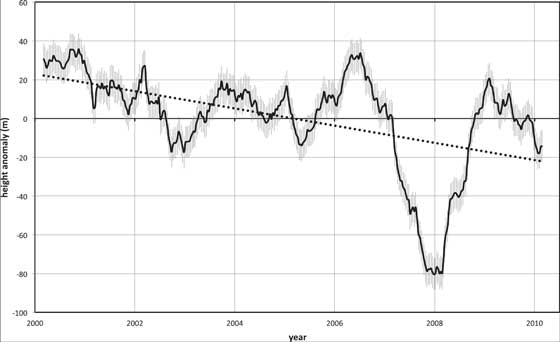
Mike Flynn does a thorough take-down at this blog, but the gist that you should be very suspicious when someone shows you a linear relation that seems to mostly be shaped by a group of anomalous data points (the data circa 2008).
To add to Flynn’s critique: you want to be especially careful with this kind of graph when you’re plotting your data against a time-series. For a lot of other independent variables, you might reasonably expect their relation to the variable you’re studying is continuous — i.e. that small changes in your independent variable (for example: number of students per class) result in small changes in your dependent variable (amount of time that the teacher spends individually with each student).
But when you’re looking at time-series data, the passing of time is really confounded with a lot of other factors (economic conditions, wars, new scientific discoveries, etc) which can change suddenly. So a small change in time can correspond to a big shift in the variables that are actually shaping your outcome, and it may be unreasonable to expect a linear relationship in the first place.
— 5 —
Note: the above was totally still relevant to the stated theme of news because data drives news! And if journalists can’t spot bad statistics, their reporting will be flawed! And unworthy of being featured in these themed Takes!

Luckily, some journalists are also major wonks, and one of my favorites in that genre is Ezra Klein of the Washington Post. He recently wrote a good book review/meditation on the role of money in politics for The New York Review of Books. Here’s a preview:
In other words, lobbyists act like a volunteer, and highly skilled, army for politicians who already agree with them.
This is the most benign, generous explanation of lobbying, but it does not render the practice innocent. In this model, the point of lobbyists is not so much to change votes as to change the legislative agenda. Perhaps you are a legislator interested both in reforming the nation’s drug laws and in cutting taxes on large corporations. If you focus your time on tax cuts for large corporations, you’ll get an enormous amount of money, aid, and attention from lobbyists. If you spend your time on drug policy, you’ll be ignored and your campaign will be underfunded. The disparity is even greater on smaller issues where there may not be another side to engage the debate: if a group of paper companies spends a couple of million dollars hiring lobbyists to persuade politicians of the merits of a change to an obscure provision of the tax code that will net the paper companies a couple of billion dollars, there is likely no one on the other side of that issue amassing materials to explain why this change isn’t a good idea.
— 6 —
And if you’d like to make a satorial statement in support of newspapers, perhaps you’ll like this tutorial for a newsprint manicure:
— 7 —

Finally, just a reminder that you can vote once per day for the About.com Atheism Awards. I’m one of five nominees for Best Atheist Blog. More details here.
For more Quick Takes, visit Conversion Diary!
Previous Post

March 14, 2012
Won't Someone Think of the Children?
Next Post
March 16, 2012 Caution! Philosophy in Progress.
Browse Our Archives
Select a Category 7 Quick Takes Apologetics Atheism Book Conversion Debate Tactics Debates Epistemology/Philosophy Housekeeping Ideological Turing Test Marriage Morality in Practice Parsing Catholicism Possibly Heretical Radio Reviews/Recommendations Sequence Index Spiritual Practice Uncategorized
Select a Month April 2017 March 2017 January 2017 December 2016 September 2016 August 2016 July 2016 June 2016 May 2016 April 2016 March 2016 February 2016 January 2016 December 2015 November 2015 October 2015 September 2015 August 2015 July 2015 June 2015 May 2015 April 2015 March 2015 February 2015 January 2015 December 2014 November 2014 October 2014 September 2014 August 2014 July 2014 June 2014 May 2014 April 2014 March 2014 February 2014 January 2014 December 2013 November 2013 October 2013 September 2013 August 2013 July 2013 June 2013 May 2013 April 2013 March 2013 February 2013 January 2013 December 2012 November 2012 October 2012 September 2012 August 2012 July 2012 June 2012 May 2012 April 2012 March 2012 February 2012 January 2012 December 2011 November 2011 October 2011 September 2011 August 2011 July 2011 June 2011 May 2011 April 2011 March 2011 February 2011 January 2011 December 2010 November 2010 October 2010 September 2010 August 2010 July 2010 June 2010
Follow Us!
TAKE THE
Religious Wisdom Quiz
I wrote of a new covenant where God's law would be written not on stone but where?
Select your answer to see how you score.
In a book On scrolls On their hearts In the temple
Related posts from Unequally Yoked

7QT: Fake Bears, Faker Weapons, and Austen

7QT: Moms, Pacifist Pilots, and other superheroes

7QT: Remixes, Underwear, & Fake Fingers

Running the Stats on Shakespeare!
TRENDING AT PATHEOS Catholic

Rejecting Doom: Christian Hope And Human Action
Christianity is a religion of hope. We are to have hope and...

It’s What Comes From Within Which Matters
One of the most difficult things for us to understand is why...

Why I Choose the Eucharist Over the Sermon
Choose the Eucharist, Not the Sermon What are we supposed to get...

5 Design Elements Found in Spiritually Rooted Homes
Putting Spirituality Into Home Decor Our homes are more than our living...

Credo: A Story of God Told with the...
About 10 years ago, I began to imagine a personal "Credo" that...

The Anatomy of Divine Revelation in Catholic Thought
The claim that God has made Himself known to human beings is...
view all Catholic blogs
Ad-Free & Subscriber Log-In Subscription Support
- About Us
- 2026 Calendar
- Videos
- Podcasts
- Library of World Religions
- Faith In Media Tracker
- Advertise With Us
- Write for Us
- Privacy Policy
- Terms of Service
- Do Not Sell My Data
- Contact Us
- Radiant Digital
- Manage Newsletter Subscriptions
- Unsubscribe From Notifications
- Sitemap
Copyright 2008-2026, Patheos. All rights reserved.
Subscription Support Ad-Free & Subscriber Log-In
Follow Patheos