
BuddhistCatholicContemplativeEvangelicalGeneral ChristianHinduJewishLatter-day SaintMuslimNew VisionsProgressive Christian
Beliefs
- Buddhist
- Catholic
- Contemplative
- Evangelical
- General Christian
- Hindu
- Jewish
- Latter-day Saint
- More Voices
- Muslim
- New Visions
- Pagan
- Progressive Christian
Topics
- Religion News
- Food and Religion
- Sports and Religion
- Religious Art
- Religious Music and Entertainment
- Religious Events
- History and Religion
- Style and Religion
- Politics and Religion
- Women in Religion
- Recreation Outdoors and Religion
- Business Finance and Religion
- Careers Workplace and Religion
- Education and Religion
- Family Parenting and Religion
- Health Fitness and Religion
- Home and Religion
- Relationships and Religion
- Technology and Religion
- Travel and Religion
Columnists
- Buddhist Columnists
- Business Finance and Religion Columnists
- Careers Workplace and Religion Columnists
- Catholic Columnists
- Contemplative Columnists
- Education and Religion Columnists
- Evangelists Columnists
- Family Parenting and Religion Columnists
- General Christian Columnists
- Health Fitness and Religion Columnists
- Hindu Columnists
- History and Religion Columnists
- Home and Religion Columnists
- Jewish Columnists
- More Voices Columnists
- Latter Day Columnists
- Muslim Columnists
- New Visions Columnists
- Nonreligious Columnists
- Pagan Columnists
- Politics and Religion Columnists
- Progressive Columnists
- Recreation Outdoors and Religion Columnists
- Relationships and Religion Columnists
- Religion News Columnists
- Religious Art Columnists
- Religious Events Columnists
- Religious Music and Entertainment Columnists
- Sports and Religion Columnists
- Style and Religion Columnists
- Technology and Religion Columnists
- Travel and Religion Columnists
- Women in Religion Columnists
Resource Library
- 2026 Calendar
- Library of World Religions
- The 100 Most Holy Places on Earth
- Patheos Answers
- Podcasts
- Videos
- Faith Leaders Database
- Anglican Episcopalian
- Bahai
- Baptist
- Buddhism
- Christianity
- Confucianism
- Eastern Orthodoxy
- Hinduism
- Holiness and Pentecostal
- ISKCON
- Islam
- Judaism
- Lutheran
- Methodist
- The Church of Jesus Christ of Latter-day Saints
- New Age
- Paganism
- Presbytarian and Reformed
- Protestantism
- Religion Behind the Scenes
- Roman Catholic
- Scientology
- Shia Islam
- Sikhism
- Sufism
- Sunni Islam
- Taoism
- Zen
- See all religions
Research Tools
 Ad-Free & Subscriber Log-In Subscription Support
Ad-Free & Subscriber Log-In Subscription Support
Follow Patheos 

- Trending:
- Forgiveness
- |
- Marriage
- |
- Consciousness
- |
- Death Penalty
- |
- Election
- |
- Halloween
 Unequally Yoked
- Home
- Catholic
- “So you’re on vacation at a science conference?”
“So you’re on vacation at a science conference?”
Last updated on: December 4, 2012 at 2:46 pm by Leah Libresco
“So you’re on vacation at a science conference?” 2012-12-04T14:46:51-05:00 Leah Libresco
Patheos Explore the world's faith through different perspectives on religion and spirituality! Patheos has the views of the prevalent religions and spiritualities of the world.

Heck yeah I am! Here are some quick highlights from my first day at the AAAS Annual Meeting:

Fifty Years of the Pill: Risk Reduction and Discovery of Benefits Beyond Contraception
How could I skip this session given the topic’s recent prominence? According to the panelists, the non-contraceptive side effects of the pill are varied. It is prescribed to women with certain risk factors for ovarian cancer, because it lowers their chance of incidence. It’s also used as treatment for Polycystic Ovary Syndrome and an assortment of other endocrine disorders or diseases that are exacerbated by certain hormone balances.
The panelists also went over some big studies on the Pill and risk of stroke or other cardiovascular problems. It sounded like hormonal contraception does raise the risk of these events (especially if you smoke) but the magnitude of the change was small enough to be inconsequential. Think getting an x-ray every few years when the dentist checks in on your wisdom teeth.
This should sound familiar if you remember my last post on contraception and statistics. Going from one case for every 100,000 women to two is a 100% increase, but we don’t really care. The risk for some of the ailments the researchers were looking at were so small that they had to do case-control studies just to find enough affected women to give their analyses some oomph.
Case-control studies aren’t as ideal as randomized treatment (which is seldom possible with a well-established medicine) and they’re also seen as a little worse than cohort studies (where you don’t assign people to different treatments, you just see which they choose for themselves and then track them over time). In a case-control study, you recruit people with whatever disease you’re studying and an appropriate number of unaffected people and see what proportion of each group were exposed to whatever treatment you’re looking at (in this case, the Pill). It’s a little less reliable than the other two, but if the disease you’re studying is really really rare, you’re stuck with this methodology. You can’t assume anyone in your randomized treatment groups or cohort will contract the disease otherwise.
Though after all that fun, one of the panelists still talked about the Pill dropping the risk of ovarian cancer for some subset of women by 50% and didn’t talk about the baseline at all. I really need to become a statistics superhero when I grow up.

Global Science and Public Good in the 19th Century: Meteorology, Tidalogy, and Magnetism
This was a cool lecture by Laura Snyder, author of The Philosophical Breakfast Club. She was talking about the first ‘big science’ project — when William Whewell coordinated scientists and governments around the world to get accurate, synced-up measurements of the tides. Prior to this effort, information on the tides was possessed only by harbor masters, who charged ships’ captains for the data. Because the measurements and projections were decentralized, scientists couldn’t make use of it until Whewell’s big trawl.
After his analysis, the British Admirality began publishing tide tables of its own. I asked the presenter if the harbor masters tried to prevent the government from undercutting their niche, but she said not to her knowledge.

Analogy in Applications of Mathematics and Statistics to Other Disciplines
The next time anyone says you can’t trust the theory of evolution because it can’t be tested experimentally, point them toward Richard Lenski’s 20+ year experiment with E. coli. He’s been tracking mutations and adaptation in bacteria for well over 20,000 generations. And he can freeze colonies every few thousand iterations so he can go back and reexamine the lineage or just take them out of storage and see if they progress the same way as their children. Definitely one of the best science talks I’ve ever seen.
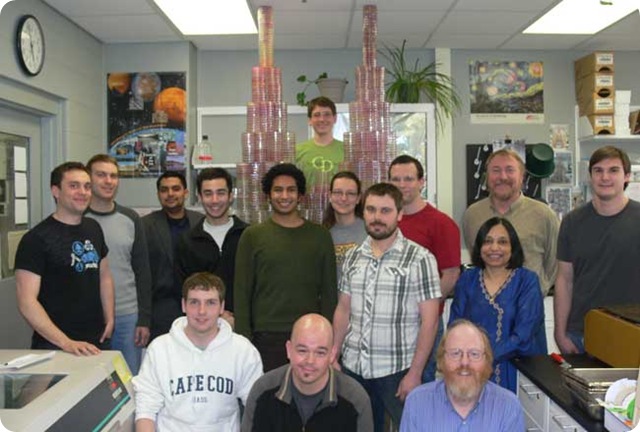
Lenski’s lab with a small fraction of the petri dishes they must run through in a year
Also, there were two papers on data visualization at this panel! One of which was heavily focused on topology. My cup runneth over.
Previous Post

February 16, 2012
7 Quick Takes (2/17/12)
Next Post
February 19, 2012 The Geek Goes On
Browse Our Archives
Select a Category 7 Quick Takes Apologetics Atheism Book Conversion Debate Tactics Debates Epistemology/Philosophy Housekeeping Ideological Turing Test Marriage Morality in Practice Parsing Catholicism Possibly Heretical Radio Reviews/Recommendations Sequence Index Spiritual Practice Uncategorized
Select a Month April 2017 March 2017 January 2017 December 2016 September 2016 August 2016 July 2016 June 2016 May 2016 April 2016 March 2016 February 2016 January 2016 December 2015 November 2015 October 2015 September 2015 August 2015 July 2015 June 2015 May 2015 April 2015 March 2015 February 2015 January 2015 December 2014 November 2014 October 2014 September 2014 August 2014 July 2014 June 2014 May 2014 April 2014 March 2014 February 2014 January 2014 December 2013 November 2013 October 2013 September 2013 August 2013 July 2013 June 2013 May 2013 April 2013 March 2013 February 2013 January 2013 December 2012 November 2012 October 2012 September 2012 August 2012 July 2012 June 2012 May 2012 April 2012 March 2012 February 2012 January 2012 December 2011 November 2011 October 2011 September 2011 August 2011 July 2011 June 2011 May 2011 April 2011 March 2011 February 2011 January 2011 December 2010 November 2010 October 2010 September 2010 August 2010 July 2010 June 2010
Follow Us!
TAKE THE
Religious Wisdom Quiz
What does "Jabez" mean in Hebrew?
Select your answer to see how you score.
Sorrow Strength Victory The Lord Saves
Related posts from Unequally Yoked
Harrison Bergeron-ing a Too-Exceptional Sprinter
Debunking the NYT's Numbers on Contraception

"Just Treating Symptoms" can be a great approach

The Stories We Tell About Illness
TRENDING AT PATHEOS Catholic

Rejecting Doom: Christian Hope And Human Action
Christianity is a religion of hope. We are to have hope and...

It’s What Comes From Within Which Matters
One of the most difficult things for us to understand is why...

Why I Choose the Eucharist Over the Sermon
Choose the Eucharist, Not the Sermon What are we supposed to get...

5 Design Elements Found in Spiritually Rooted Homes
Putting Spirituality Into Home Decor Our homes are more than our living...

Credo: A Story of God Told with the...
About 10 years ago, I began to imagine a personal "Credo" that...

The Anatomy of Divine Revelation in Catholic Thought
The claim that God has made Himself known to human beings is...
view all Catholic blogs
Ad-Free & Subscriber Log-In Subscription Support
- About Us
- 2026 Calendar
- Videos
- Podcasts
- Library of World Religions
- Faith In Media Tracker
- Advertise With Us
- Write for Us
- Privacy Policy
- Terms of Service
- Do Not Sell My Data
- Contact Us
- Radiant Digital
- Manage Newsletter Subscriptions
- Unsubscribe From Notifications
- Sitemap
Copyright 2008-2026, Patheos. All rights reserved.
Subscription Support Ad-Free & Subscriber Log-In
Follow Patheos