
BuddhistCatholicContemplativeEvangelicalGeneral ChristianHinduJewishLatter-day SaintMuslimNew VisionsProgressive Christian
Beliefs
- Buddhist
- Catholic
- Contemplative
- Evangelical
- General Christian
- Hindu
- Jewish
- Latter-day Saint
- More Voices
- Muslim
- New Visions
- Pagan
- Progressive Christian
Topics
- Religion News
- Food and Religion
- Sports and Religion
- Religious Art
- Religious Music and Entertainment
- Religious Events
- History and Religion
- Style and Religion
- Politics and Religion
- Women in Religion
- Recreation Outdoors and Religion
- Business Finance and Religion
- Careers Workplace and Religion
- Education and Religion
- Family Parenting and Religion
- Health Fitness and Religion
- Home and Religion
- Relationships and Religion
- Technology and Religion
- Travel and Religion
Columnists
- Buddhist Columnists
- Business Finance and Religion Columnists
- Careers Workplace and Religion Columnists
- Catholic Columnists
- Contemplative Columnists
- Education and Religion Columnists
- Evangelists Columnists
- Family Parenting and Religion Columnists
- General Christian Columnists
- Health Fitness and Religion Columnists
- Hindu Columnists
- History and Religion Columnists
- Home and Religion Columnists
- Jewish Columnists
- More Voices Columnists
- Latter Day Columnists
- Muslim Columnists
- New Visions Columnists
- Nonreligious Columnists
- Pagan Columnists
- Politics and Religion Columnists
- Progressive Columnists
- Recreation Outdoors and Religion Columnists
- Relationships and Religion Columnists
- Religion News Columnists
- Religious Art Columnists
- Religious Events Columnists
- Religious Music and Entertainment Columnists
- Sports and Religion Columnists
- Style and Religion Columnists
- Technology and Religion Columnists
- Travel and Religion Columnists
- Women in Religion Columnists
Resource Library
- 2026 Calendar
- Library of World Religions
- The 100 Most Holy Places on Earth
- Patheos Answers
- Podcasts
- Videos
- Faith Leaders Database
- Anglican Episcopalian
- Bahai
- Baptist
- Buddhism
- Christianity
- Confucianism
- Eastern Orthodoxy
- Hinduism
- Holiness and Pentecostal
- ISKCON
- Islam
- Judaism
- Lutheran
- Methodist
- The Church of Jesus Christ of Latter-day Saints
- New Age
- Paganism
- Presbytarian and Reformed
- Protestantism
- Religion Behind the Scenes
- Roman Catholic
- Scientology
- Shia Islam
- Sikhism
- Sufism
- Sunni Islam
- Taoism
- Zen
- See all religions
Research Tools
 Ad-Free & Subscriber Log-In Subscription Support
Ad-Free & Subscriber Log-In Subscription Support
Follow Patheos 

- Trending:
- Forgiveness
- |
- Marriage
- |
- Consciousness
- |
- Death Penalty
- |
- Election
- |
- Halloween
 Unequally Yoked
- Home
- Catholic
- Parsing that “98% of Catholics use contraception” figure
Parsing that “98% of Catholics use contraception” figure
Last updated on: December 4, 2012 at 2:45 pm by Leah Libresco
Parsing that “98% of Catholics use contraception” figure 2012-12-04T14:45:49-05:00 Leah Libresco
Patheos Explore the world's faith through different perspectives on religion and spirituality! Patheos has the views of the prevalent religions and spiritualities of the world.
Thanks to TKB who gave me this pic for my birthday
I’ll be back with a longer post on the actual substance of the contraceptive mandate and my ideas about the reasonable limits to the idea that religious mandates exempt you from the law, but I can’t pass up the chance to geek out about social science statistics and methodology.
You’ve all probably heard the “98% of Catholic women use contraception” statistic cited by now, and people have started to take a closer look at the relevant study. Let me chat you through some of the objections.
Who was polled?
The survey done by Guttmacher didn’t include all women. Only women who met these three criteria were included in the computation
- Between the ages of 15-44
- Not pregnant, post-partum, or trying to get pregnant at the time of the survey
- Sexually active (had sex at some point in the last three months)
This seems like a pretty good sampling frame to me. It looks like the researcher was trying to see what percent of women who were having recreational sex were using contraception.
The most intuitively correct restriction is age. We don’t expect children to be using birth control, so including them in the survey just means you’re goosing the ‘no’ responses. That would be reason enough to exclude them, since you’re not trying to learn things about their demographic, but there’s a more important methodological reason to keep them out of your sample.
If both populations (Catholic and non-Catholic) had the same age distribution, including children would just drive down the percentages for both subsets. But if the two groups were demographically mismatched, whichever group was younger relative to the other subset would look like it had a lower contraceptive rate.
But…
This means the study doesn’t have anything to say about all Catholic women. It simply says that Catholic women who are having non-deliberately-procreative-sex use contraception at about the same rates as any other women in those circumstances.
So, it would be good to report what percentage of Catholic women aged 15-44 fall into that subset and contrast that proportion with other religious groups. And these two numbers should be reported together.

The table above doesn’t do it, since it just reports the percent of women who have ever been sexually active outside of marriage. As far as I can tell, the number I’m looking for wasn’t calculated by the researchers.
What were they asked?
The first problem may just be sloppy reporting (and non-ideal, but passable survey design). The second one is more serious. Take a look at the graph from the study below:
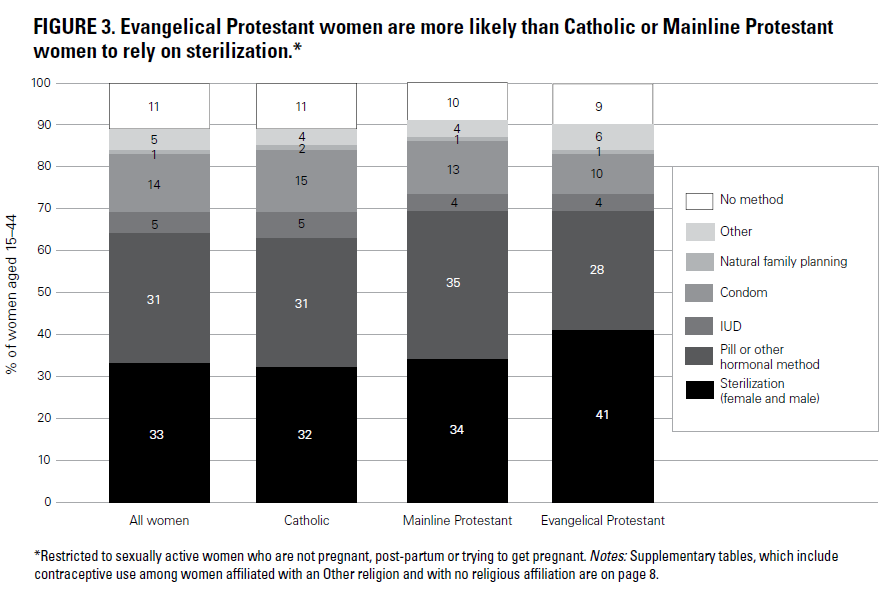
The 98% number is the result of only counting the NFPers as ‘non-contracepting.’ The trouble is that it’s not clear exactly what “other” and “no method” refer to. According to the methodology:
The category of “other” methods mainly consists of withdrawal but also includes less common methods, such as suppositories, sponges and foams.
I think it may vary by religion whether ‘withdrawal’ really counts as contraception. (Someone can fill me in with a comment).
The big problem is that there’s no explanation of what “no method” means in the paper. Get Religion assumed it meant that the women were not using contraception, which certainly seems plausible. However, it may also mean that women answered yes to “Are you currently using some kind of contraception” but refused to specify the type in the followup question. I’ve seen this style of notation for academic studies before. A reporter should have called up and asked for clarification.
So, the percent using contraception is at most 98%, and if you were really being conservative, you should probably cite 83% (condoms, IUDs, the Pill, and sterilization).
So, in a nutshell…
Catholic women who are in a position where they’d be tempted to contracept, use contraception at about the same rate as everyone else in those circumstances, and that rate is somewhere between 83-98%. How many Catholic women are in this situation in the first place? Beats the heck out of me!
Previous Post

February 14, 2012
Whaddya Wanna Get Married For?
Next Post
February 16, 2012 Marriage Q&A
Browse Our Archives
Select a Category 7 Quick Takes Apologetics Atheism Book Conversion Debate Tactics Debates Epistemology/Philosophy Housekeeping Ideological Turing Test Marriage Morality in Practice Parsing Catholicism Possibly Heretical Radio Reviews/Recommendations Sequence Index Spiritual Practice Uncategorized
Select a Month April 2017 March 2017 January 2017 December 2016 September 2016 August 2016 July 2016 June 2016 May 2016 April 2016 March 2016 February 2016 January 2016 December 2015 November 2015 October 2015 September 2015 August 2015 July 2015 June 2015 May 2015 April 2015 March 2015 February 2015 January 2015 December 2014 November 2014 October 2014 September 2014 August 2014 July 2014 June 2014 May 2014 April 2014 March 2014 February 2014 January 2014 December 2013 November 2013 October 2013 September 2013 August 2013 July 2013 June 2013 May 2013 April 2013 March 2013 February 2013 January 2013 December 2012 November 2012 October 2012 September 2012 August 2012 July 2012 June 2012 May 2012 April 2012 March 2012 February 2012 January 2012 December 2011 November 2011 October 2011 September 2011 August 2011 July 2011 June 2011 May 2011 April 2011 March 2011 February 2011 January 2011 December 2010 November 2010 October 2010 September 2010 August 2010 July 2010 June 2010
Follow Us!
TAKE THE
Religious Wisdom Quiz
Who said, "I am the resurrection and the life"?
Select your answer to see how you score.
Jesus Peter Moses Paul
Related posts from Unequally Yoked
Debunking the NYT's Numbers on Contraception

And, now, some #natesilverfacts

And Speaking of Sample Size Problems...
TRENDING AT PATHEOS Catholic

Rejecting Doom: Christian Hope And Human Action
Christianity is a religion of hope. We are to have hope and...

It’s What Comes From Within Which Matters
One of the most difficult things for us to understand is why...

Why I Choose the Eucharist Over the Sermon
Choose the Eucharist, Not the Sermon What are we supposed to get...

5 Design Elements Found in Spiritually Rooted Homes
Putting Spirituality Into Home Decor Our homes are more than our living...

Credo: A Story of God Told with the...
About 10 years ago, I began to imagine a personal "Credo" that...

The Anatomy of Divine Revelation in Catholic Thought
The claim that God has made Himself known to human beings is...
view all Catholic blogs
Ad-Free & Subscriber Log-In Subscription Support
- About Us
- 2026 Calendar
- Videos
- Podcasts
- Library of World Religions
- Faith In Media Tracker
- Advertise With Us
- Write for Us
- Privacy Policy
- Terms of Service
- Do Not Sell My Data
- Contact Us
- Radiant Digital
- Manage Newsletter Subscriptions
- Unsubscribe From Notifications
- Sitemap
Copyright 2008-2026, Patheos. All rights reserved.
Subscription Support Ad-Free & Subscriber Log-In
Follow Patheos