
BuddhistCatholicContemplativeEvangelicalGeneral ChristianHinduJewishLatter-day SaintMuslimNew VisionsProgressive Christian
Beliefs
- Buddhist
- Catholic
- Contemplative
- Evangelical
- General Christian
- Hindu
- Jewish
- Latter-day Saint
- More Voices
- Muslim
- New Visions
- Pagan
- Progressive Christian
Topics
- Religion News
- Food and Religion
- Sports and Religion
- Religious Art
- Religious Music and Entertainment
- Religious Events
- History and Religion
- Style and Religion
- Politics and Religion
- Women in Religion
- Recreation Outdoors and Religion
- Business Finance and Religion
- Careers Workplace and Religion
- Education and Religion
- Family Parenting and Religion
- Health Fitness and Religion
- Home and Religion
- Relationships and Religion
- Technology and Religion
- Travel and Religion
Columnists
- Buddhist Columnists
- Business Finance and Religion Columnists
- Careers Workplace and Religion Columnists
- Catholic Columnists
- Contemplative Columnists
- Education and Religion Columnists
- Evangelists Columnists
- Family Parenting and Religion Columnists
- General Christian Columnists
- Health Fitness and Religion Columnists
- Hindu Columnists
- History and Religion Columnists
- Home and Religion Columnists
- Jewish Columnists
- More Voices Columnists
- Latter Day Columnists
- Muslim Columnists
- New Visions Columnists
- Nonreligious Columnists
- Pagan Columnists
- Politics and Religion Columnists
- Progressive Columnists
- Recreation Outdoors and Religion Columnists
- Relationships and Religion Columnists
- Religion News Columnists
- Religious Art Columnists
- Religious Events Columnists
- Religious Music and Entertainment Columnists
- Sports and Religion Columnists
- Style and Religion Columnists
- Technology and Religion Columnists
- Travel and Religion Columnists
- Women in Religion Columnists
Resource Library
- 2026 Calendar
- Library of World Religions
- The 100 Most Holy Places on Earth
- Patheos Answers
- Podcasts
- Videos
- Faith Leaders Database
- Anglican Episcopalian
- Bahai
- Baptist
- Buddhism
- Christianity
- Confucianism
- Eastern Orthodoxy
- Hinduism
- Holiness and Pentecostal
- ISKCON
- Islam
- Judaism
- Lutheran
- Methodist
- The Church of Jesus Christ of Latter-day Saints
- New Age
- Paganism
- Presbytarian and Reformed
- Protestantism
- Religion Behind the Scenes
- Roman Catholic
- Scientology
- Shia Islam
- Sikhism
- Sufism
- Sunni Islam
- Taoism
- Zen
- See all religions
Research Tools
 Ad-Free & Subscriber Log-In Subscription Support
Ad-Free & Subscriber Log-In Subscription Support
Follow Patheos 

- Trending:
- Forgiveness
- |
- Marriage
- |
- Consciousness
- |
- Death Penalty
- |
- Election
- |
- Halloween
 Unequally Yoked
- Home
- Catholic
- Moral Intuitions Quiz: Lobotomized Meat
Moral Intuitions Quiz: Lobotomized Meat
Last updated on: December 6, 2012 at 3:13 pm by Leah Libresco
Moral Intuitions Quiz: Lobotomized Meat 2012-12-06T15:13:53-05:00 Leah Libresco
Patheos Explore the world's faith through different perspectives on religion and spirituality! Patheos has the views of the prevalent religions and spiritualities of the world.
Remember you can vote once per day for the About.com Atheism Awards. I’m one of five nominees for Best Atheist Blog. More details here.
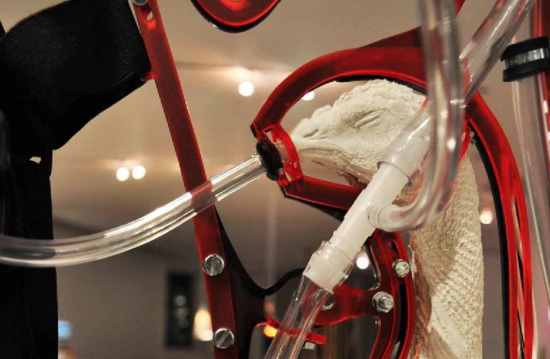
It’s only a conceptual chicken. For now.
Via the Daily Dish, André Ford, a student in the architecture department at the Royal College of Art came up with a kind of grotesque final project for a class focusing on “how a dense and vertical architecture can bring back food production and consumption in the city.” Ford designed an apparatus that would give a whole new definition to the phrase “factory-farmed meat.” He proposed that chickens bound for the pot on industrial farms be lobotomized early in life.
By removing the cerebral cortex of the chicken, its sensory perceptions are removed. It can be produced in a denser condition while remaining alive, and oblivious. The feet will also be removed so the body of the chicken can be packed together in a dense volume.
Food, water and air are delivered via an arterial network and excreta is removed in the same manner. Around 1000 chickens will be packed into each ‘leaf’, which forms part of a moving, productive system.
Most of my friends reacted with disgust when I shared the story, and I’m still trying to decide if that’s the right reaction. Here’s where I stand: if it’s a given that we’re going to raise animals in unpleasant conditions, better to kill them early and just keep their bodies going artificially until we make use of them. Though it seems preferable to not raise animals in conditions where they’d be better off brain-dead in the first place.
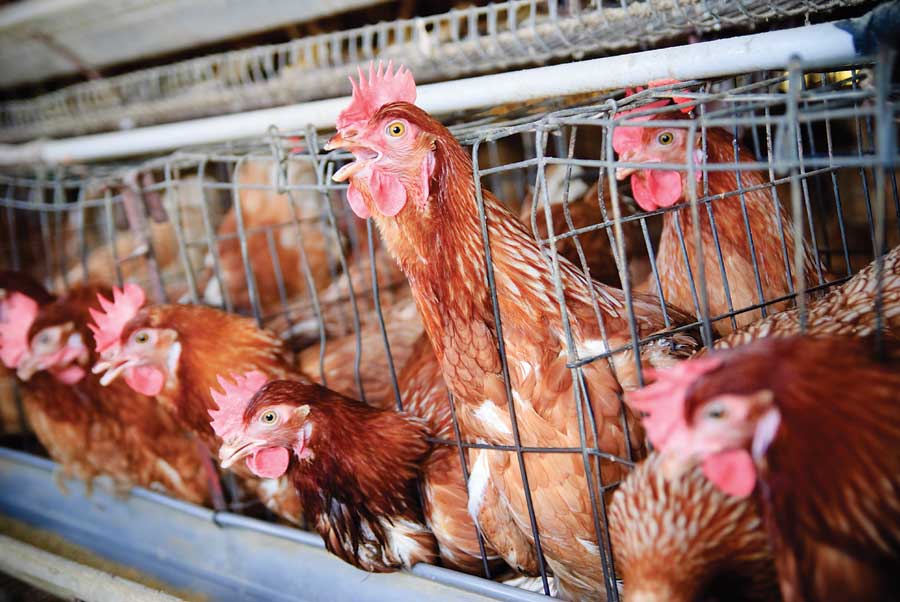
This is how the non-lobotomized chickens live
I don’t think the grotesqueness of Ford’s idea is sufficient to disqualify it. My suspicion is that we’re reluctant to switch to a new, unpleasant system — even if it’s better than the status quo — because to choose to switch would imply a kind of assent. We imagine that not overthrowing the old way is equivalent to remaining neutral, but a choice to maintain the current norms is still a choice. Animals shouldn’t be tormented so that we can imagine our hands are clean.
If you want to reject Ford’s idea, I think you need to believe that it is meaningfully worse than the current system on industrial farms. I can imagine a couple ways of making that argument. The first point for the status quo is that, because we know the animals are capable of pain, we might be spurred to minimize that suffering. Lobotomizing the animal frees us from that cognitive dissonance and probably locks us into the new system indefinitely.
But I’m really skeptical about the strategy of heightening the contradictions by making everything even worse. The brutality of factory farming isn’t exactly a secret, but most people make their peace with their meals. (I’ve been vegetarian since I was five, but this is because I’m a picky eater; I never had to take a moral stand on the issue).
I can also imagine arguing that, especially in my virtue ethics framework, it’s bad to be in the habit of turning off the sensory capacities of other living beings. I certainly think this is an important point, but I’m not sure how much better it is to be in the habit of tormenting those beings in the first place. Changing them from sensing animals to unperceiving ones seems less troubling when I remember our ultimate goal is to change them from live animals into dead ones.
I’d be quite interested in your instincts and explanations in the comment thread. It’d be helpful if you’d give a sentence or two about your general approach to ethics (or metaphysical allegiances) so we know what framework you’re working in. I’m still trying to thrash this one out.
Oh, and bonus question: if you disapprove of Ford’s idea, do you also disapprove of lab-grown meat — no animal involved? I’m trying to pin down whether people are objecting to the ethics of lobotomizing chickens or the aesthetics of mechanized meat production.
Previous Post

February 26, 2012
'Atheist Lent' and False Unity
Next Post
February 28, 2012 The Other Contraception Mandate Fight
Browse Our Archives
Select a Category 7 Quick Takes Apologetics Atheism Book Conversion Debate Tactics Debates Epistemology/Philosophy Housekeeping Ideological Turing Test Marriage Morality in Practice Parsing Catholicism Possibly Heretical Radio Reviews/Recommendations Sequence Index Spiritual Practice Uncategorized
Select a Month April 2017 March 2017 January 2017 December 2016 September 2016 August 2016 July 2016 June 2016 May 2016 April 2016 March 2016 February 2016 January 2016 December 2015 November 2015 October 2015 September 2015 August 2015 July 2015 June 2015 May 2015 April 2015 March 2015 February 2015 January 2015 December 2014 November 2014 October 2014 September 2014 August 2014 July 2014 June 2014 May 2014 April 2014 March 2014 February 2014 January 2014 December 2013 November 2013 October 2013 September 2013 August 2013 July 2013 June 2013 May 2013 April 2013 March 2013 February 2013 January 2013 December 2012 November 2012 October 2012 September 2012 August 2012 July 2012 June 2012 May 2012 April 2012 March 2012 February 2012 January 2012 December 2011 November 2011 October 2011 September 2011 August 2011 July 2011 June 2011 May 2011 April 2011 March 2011 February 2011 January 2011 December 2010 November 2010 October 2010 September 2010 August 2010 July 2010 June 2010
Follow Us!
TAKE THE
Religious Wisdom Quiz
What did Elisha heal by throwing salt into it?
Select your answer to see how you score.
River Jordan A pot of stew A spring of water A fig tree
Related posts from Unequally Yoked

The Tony-Winning Guide To Temptation And Grace

Hedgehogs of Redemption and the Comedy of Grace

Mercy, Justice, and How To Tell The Difference

Pinning down *which* error is made in this...
TRENDING AT PATHEOS Catholic

Rejecting Doom: Christian Hope And Human Action
Christianity is a religion of hope. We are to have hope and...

It’s What Comes From Within Which Matters
One of the most difficult things for us to understand is why...

Why I Choose the Eucharist Over the Sermon
Choose the Eucharist, Not the Sermon What are we supposed to get...

5 Design Elements Found in Spiritually Rooted Homes
Putting Spirituality Into Home Decor Our homes are more than our living...

Credo: A Story of God Told with the...
About 10 years ago, I began to imagine a personal "Credo" that...

The Anatomy of Divine Revelation in Catholic Thought
The claim that God has made Himself known to human beings is...
view all Catholic blogs
Ad-Free & Subscriber Log-In Subscription Support
- About Us
- 2026 Calendar
- Videos
- Podcasts
- Library of World Religions
- Faith In Media Tracker
- Advertise With Us
- Write for Us
- Privacy Policy
- Terms of Service
- Do Not Sell My Data
- Contact Us
- Radiant Digital
- Manage Newsletter Subscriptions
- Unsubscribe From Notifications
- Sitemap
Copyright 2008-2026, Patheos. All rights reserved.
Subscription Support Ad-Free & Subscriber Log-In
Follow Patheos