
BuddhistCatholicContemplativeEvangelicalGeneral ChristianHinduJewishLatter-day SaintMuslimNew VisionsProgressive Christian
Beliefs
- Buddhist
- Catholic
- Contemplative
- Evangelical
- General Christian
- Hindu
- Jewish
- Latter-day Saint
- More Voices
- Muslim
- New Visions
- Pagan
- Progressive Christian
Topics
- Religion News
- Food and Religion
- Sports and Religion
- Religious Art
- Religious Music and Entertainment
- Religious Events
- History and Religion
- Style and Religion
- Politics and Religion
- Women in Religion
- Recreation Outdoors and Religion
- Business Finance and Religion
- Careers Workplace and Religion
- Education and Religion
- Family Parenting and Religion
- Health Fitness and Religion
- Home and Religion
- Relationships and Religion
- Technology and Religion
- Travel and Religion
Columnists
- Buddhist Columnists
- Business Finance and Religion Columnists
- Careers Workplace and Religion Columnists
- Catholic Columnists
- Contemplative Columnists
- Education and Religion Columnists
- Evangelists Columnists
- Family Parenting and Religion Columnists
- General Christian Columnists
- Health Fitness and Religion Columnists
- Hindu Columnists
- History and Religion Columnists
- Home and Religion Columnists
- Jewish Columnists
- More Voices Columnists
- Latter Day Columnists
- Muslim Columnists
- New Visions Columnists
- Nonreligious Columnists
- Pagan Columnists
- Politics and Religion Columnists
- Progressive Columnists
- Recreation Outdoors and Religion Columnists
- Relationships and Religion Columnists
- Religion News Columnists
- Religious Art Columnists
- Religious Events Columnists
- Religious Music and Entertainment Columnists
- Sports and Religion Columnists
- Style and Religion Columnists
- Technology and Religion Columnists
- Travel and Religion Columnists
- Women in Religion Columnists
Resource Library
- 2026 Calendar
- Library of World Religions
- The 100 Most Holy Places on Earth
- Patheos Answers
- Podcasts
- Videos
- Faith Leaders Database
- Anglican Episcopalian
- Bahai
- Baptist
- Buddhism
- Christianity
- Confucianism
- Eastern Orthodoxy
- Hinduism
- Holiness and Pentecostal
- ISKCON
- Islam
- Judaism
- Lutheran
- Methodist
- The Church of Jesus Christ of Latter-day Saints
- New Age
- Paganism
- Presbytarian and Reformed
- Protestantism
- Religion Behind the Scenes
- Roman Catholic
- Scientology
- Shia Islam
- Sikhism
- Sufism
- Sunni Islam
- Taoism
- Zen
- See all religions
Research Tools
 Ad-Free & Subscriber Log-In Subscription Support
Ad-Free & Subscriber Log-In Subscription Support
Follow Patheos 

- Trending:
- Forgiveness
- |
- Marriage
- |
- Consciousness
- |
- Death Penalty
- |
- Election
- |
- Halloween
 Unequally Yoked
- Home
- Catholic
- I’m like Beetlejuice, except you only have to say ‘Statistician’ once!
I’m like Beetlejuice, except you only have to say ‘Statistician’ once!
Last updated on: December 6, 2012 at 3:11 pm by Leah Libresco
I’m like Beetlejuice, except you only have to say ‘Statistician’ once! 2012-12-06T15:11:55-05:00 Leah Libresco
Patheos Explore the world's faith through different perspectives on religion and spirituality! Patheos has the views of the prevalent religions and spiritualities of the world.
Remember you can vote once per day for the About.com Atheism Awards. I’m one of five nominees for Best Atheist Blog. More details here.

The Bright Maidens, a trio of young Catholic women who try to dispel myths and misconceptions about their faith, frequently do themed blog carnivals, and this week their topic is “Instructing the Ignorant.” Elizabeth Hillgrove of Startling the Day covered a lot of topics in her post, but you can’t be surprised to find out it was this one that caught my eye:
I got to explain to her, no, NFP is not like the rhythm method anymore. I explained that the rhythm method was used back in the 1930s and that we know a lot more about how best to avoid or to achieve pregnancy while keeping God in our bedrooms.
I also used the opportunity to explain that most of the methods are at least 97% effective when used properly (which relies on married couples communicating — another benefit), which is far more promising than something like condoms. The error margin of condom use increases exponentially with every use (statisticians, help me learn how best to explain this, please!), while NFP methods remain effective as long as couples chart and communicate.
You call for statisticians and I appear!
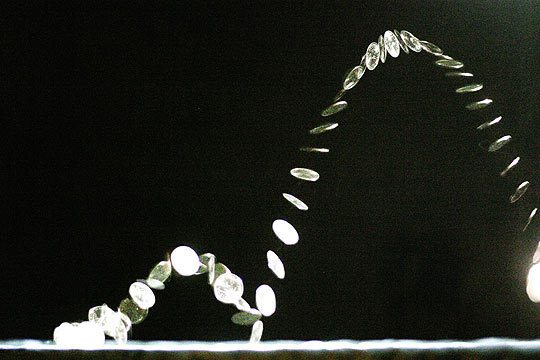
I think I know what Elizabeth is referencing when she talks about the risk of condom failure growing with every use, so here comes the quickie explanation. Imagine you have a weighted coin that is really, really likely to come down heads every time you flip it. Let’s say 97% heads and 3% tails. Obviously, you’ll call heads every time you flip it and make a profit. But if your goal isn’t to be right most of the time, but to never be wrong, you’re going to run into a problem pretty fast.
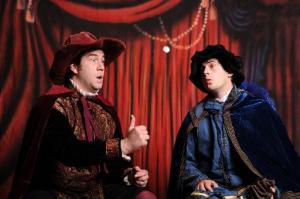
Rosencrantz and Guildenstern, flipping coins
How do you figure out how likely it is you’ll lose a coin flip if you keep calling heads. Well, the chance that you’re never wrong in N flips is .97^N. So, the chance that you miss at least one is 1-.97^N. So if we flip 20 times, the odds I’ll miss at least one call is 46%. Not good if failure is costly.
The coin flip isn’t exactly analogous to the failure rates of condoms. According to the Guttmacher Institute, with perfect use, condoms are 98% effective over a year of use. So the errors don’t mount up anywhere near as fast as they would if they were only 98% effective each time you used them. But the same problem exists — in five years of use at 98% efficacy, 10% of users will get pregnant.
But this problem is decidedly not unique to condom usage. It applies to any method of forestalling pregnancy where the chance of failure each time you use it is independent. ‘Independent’ is a statistics word which means the chance of failure is the same in every trial — it doesn’t matter what the previous results have been. A coin flip is independent, but drawing cards from a deck is not, as long as you’re not replacing the cards you drew. Most contraceptives’ risk of failure is independent or at least has an independent component (putting a condom on correctly, taking the pill at the same time every day), but IUDs and sterilization are more binary — either the procedures were done right or not — the independent component is small. NFP presumably has an independent risk — the risk of making errors in charting.
I think the most likely difference between NFP and methods like the Pill and condoms has nothing to do with those ‘perfect use’ statistics. Those numbers tend to be irrelevant since a lot of people use contraception correctly. The ‘actual use’ success rates for condoms and the pill over a year are 91% and 83% respectively. At those rates, the five year failure rate for condoms shoots to 62%.
Guttmacher doesn’t have statistics on ‘typical use’ for NFP, just the perfect use rate of 98% effective. My hunch is that more people who sign on for NFP hit that mark than people who use condoms. NFP is visibly hard — people who commit to using it take classes. Condoms are perceived as easy to use, and abstinence only education doesn’t clue people in on common errors or even that their use is not necessarily intuitive. So, the people that opt for the ‘hard’ method, aware of how hard it is, are probably more likely to stick to the ‘perfect use’ regimen than people who think they have an easy option.
This difference might very well vanish if NFP became more common, so NFP users were less likely to be people who had made a carefully considered choice. Ideally, everyone trying to delay pregnancy would put as much effort into their regimen as NFPers do. Or they’d opt for a method that requires low user commitment like an IUD or a patch.
Previous Post

February 24, 2012
No 'Healthy Outlet' for Bad Habits
Next Post
February 26, 2012 'Atheist Lent' and False Unity
Browse Our Archives
Select a Category 7 Quick Takes Apologetics Atheism Book Conversion Debate Tactics Debates Epistemology/Philosophy Housekeeping Ideological Turing Test Marriage Morality in Practice Parsing Catholicism Possibly Heretical Radio Reviews/Recommendations Sequence Index Spiritual Practice Uncategorized
Select a Month April 2017 March 2017 January 2017 December 2016 September 2016 August 2016 July 2016 June 2016 May 2016 April 2016 March 2016 February 2016 January 2016 December 2015 November 2015 October 2015 September 2015 August 2015 July 2015 June 2015 May 2015 April 2015 March 2015 February 2015 January 2015 December 2014 November 2014 October 2014 September 2014 August 2014 July 2014 June 2014 May 2014 April 2014 March 2014 February 2014 January 2014 December 2013 November 2013 October 2013 September 2013 August 2013 July 2013 June 2013 May 2013 April 2013 March 2013 February 2013 January 2013 December 2012 November 2012 October 2012 September 2012 August 2012 July 2012 June 2012 May 2012 April 2012 March 2012 February 2012 January 2012 December 2011 November 2011 October 2011 September 2011 August 2011 July 2011 June 2011 May 2011 April 2011 March 2011 February 2011 January 2011 December 2010 November 2010 October 2010 September 2010 August 2010 July 2010 June 2010
Follow Us!
TAKE THE
Religious Wisdom Quiz
What does Paul say happens when we are baptized into Christ Jesus?
Select your answer to see how you score.
We are saved We become children of God We are baptized into his death We receive the Holy Spirit
Related posts from Unequally Yoked

Debunking the NYT's Numbers on Contraception

And, now, some #natesilverfacts


And Speaking of Sample Size Problems...
TRENDING AT PATHEOS Catholic

Rejecting Doom: Christian Hope And Human Action
Christianity is a religion of hope. We are to have hope and...

It’s What Comes From Within Which Matters
One of the most difficult things for us to understand is why...

Why I Choose the Eucharist Over the Sermon
Choose the Eucharist, Not the Sermon What are we supposed to get...

5 Design Elements Found in Spiritually Rooted Homes
Putting Spirituality Into Home Decor Our homes are more than our living...

Credo: A Story of God Told with the...
About 10 years ago, I began to imagine a personal "Credo" that...

The Anatomy of Divine Revelation in Catholic Thought
The claim that God has made Himself known to human beings is...
view all Catholic blogs
Ad-Free & Subscriber Log-In Subscription Support
- About Us
- 2026 Calendar
- Videos
- Podcasts
- Library of World Religions
- Faith In Media Tracker
- Advertise With Us
- Write for Us
- Privacy Policy
- Terms of Service
- Do Not Sell My Data
- Contact Us
- Radiant Digital
- Manage Newsletter Subscriptions
- Unsubscribe From Notifications
- Sitemap
Copyright 2008-2026, Patheos. All rights reserved.
Subscription Support Ad-Free & Subscriber Log-In
Follow Patheos