
BuddhistCatholicContemplativeEvangelicalGeneral ChristianHinduJewishLatter-day SaintMuslimNew VisionsProgressive Christian
Beliefs
- Buddhist
- Catholic
- Contemplative
- Evangelical
- General Christian
- Hindu
- Jewish
- Latter-day Saint
- More Voices
- Muslim
- New Visions
- Pagan
- Progressive Christian
Topics
- Religion News
- Food and Religion
- Sports and Religion
- Religious Art
- Religious Music and Entertainment
- Religious Events
- History and Religion
- Style and Religion
- Politics and Religion
- Women in Religion
- Recreation Outdoors and Religion
- Business Finance and Religion
- Careers Workplace and Religion
- Education and Religion
- Family Parenting and Religion
- Health Fitness and Religion
- Home and Religion
- Relationships and Religion
- Technology and Religion
- Travel and Religion
Columnists
- Buddhist Columnists
- Business Finance and Religion Columnists
- Careers Workplace and Religion Columnists
- Catholic Columnists
- Contemplative Columnists
- Education and Religion Columnists
- Evangelists Columnists
- Family Parenting and Religion Columnists
- General Christian Columnists
- Health Fitness and Religion Columnists
- Hindu Columnists
- History and Religion Columnists
- Home and Religion Columnists
- Jewish Columnists
- More Voices Columnists
- Latter Day Columnists
- Muslim Columnists
- New Visions Columnists
- Nonreligious Columnists
- Pagan Columnists
- Politics and Religion Columnists
- Progressive Columnists
- Recreation Outdoors and Religion Columnists
- Relationships and Religion Columnists
- Religion News Columnists
- Religious Art Columnists
- Religious Events Columnists
- Religious Music and Entertainment Columnists
- Sports and Religion Columnists
- Style and Religion Columnists
- Technology and Religion Columnists
- Travel and Religion Columnists
- Women in Religion Columnists
Resource Library
- 2026 Calendar
- Library of World Religions
- The 100 Most Holy Places on Earth
- Patheos Answers
- Podcasts
- Videos
- Faith Leaders Database
- Anglican Episcopalian
- Bahai
- Baptist
- Buddhism
- Christianity
- Confucianism
- Eastern Orthodoxy
- Hinduism
- Holiness and Pentecostal
- ISKCON
- Islam
- Judaism
- Lutheran
- Methodist
- The Church of Jesus Christ of Latter-day Saints
- New Age
- Paganism
- Presbytarian and Reformed
- Protestantism
- Religion Behind the Scenes
- Roman Catholic
- Scientology
- Shia Islam
- Sikhism
- Sufism
- Sunni Islam
- Taoism
- Zen
- See all religions
Research Tools
 Ad-Free & Subscriber Log-In Subscription Support
Ad-Free & Subscriber Log-In Subscription Support
Follow Patheos 

- Trending:
- Forgiveness
- |
- Marriage
- |
- Consciousness
- |
- Death Penalty
- |
- Election
- |
- Halloween
 Unequally Yoked
- Home
- Catholic
- It’s Hard Out Here for a Platonist
It’s Hard Out Here for a Platonist
Last updated on: December 3, 2012 at 5:00 pm by Leah Libresco
It’s Hard Out Here for a Platonist 2012-12-03T17:00:20-05:00 Leah Libresco
Patheos Explore the world's faith through different perspectives on religion and spirituality! Patheos has the views of the prevalent religions and spiritualities of the world.
Alex Knapp took issue with my quasi-Platonism (and possible math idolatry) over at his tech blog for Forbes. Here’s the crux of his argument:
The bottom line is that human beings have brains capable of counting to high numbers and manipulating them, so we use mathematics as a useful tool to describe the world around us. But numbers and math themselves are no more real than the color blue – ‘blue’ is just what we tag a certain wavelength of light because of the way we perceive that wavelength. An alien intelligence that is blind has no use for the color blue. It might learn about light and the wavelengths of light and translate those concepts completely differently than we do.
In the same way, since the only truly good mathematicians among the animals are ourselves, we assume that if we encounter other systems of intelligence that they’ll have the same concepts of math was we do. But there’s no evidence to base that assumption on. For all we know, there are much easier ways to describe physics than through complicated systems of equations, but our minds may not be capable of symbolically interpreting the world in a way that allows us to use those tools, any more than we’re capable of a tool that requires the use of a prehensile tail.
It’s a good attack on my metaphysics of math, but I think this line of attack takes a lot of other abstract ideas down with it. In fact, it’s so broadly applicable that it raises the possibility that this line of attack is self-refuting, depending on how confident we are that parts of our subjective experience count as ‘real.’
Let’s start by expanding Knapp’s point about ‘blue’ being a human-dependent label for an arbitrary span of light wavelengths. If we’re trying to go to the absolute base level of ‘real’ we can go a lot further. Quantum wave functions are the most fundamental we’ve gotten, and you can make the argument that they’re what’s what’s really real and that humans are just an artifact of scale, of putting arbitrary labels on phenomena too big for us to understand.
That’s the endpoint of this argument, but you’re probably more familiar with it’s application to moral judgement. Talking about The Good is a labeling error. We may be able to say some things seem more or less good, but it’s all continuous and who’s to say we’re looking at the whole thing with the right metric, anyway? Maybe being SuperHappy is the most babyeating thing you can be. [See “Three Worlds Collide” a short story by Yudkowsky if that last sentence didn’t make sense].
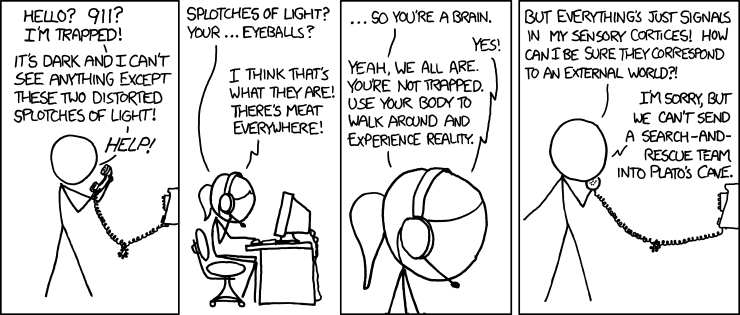
Knapp’s argument isn’t excluding math from the category of Forms, it’s denying the existence of any Forms at all. I think that’s too much epistemological modesty. At the very least, the evidence for math is compatible with my explanation as well as Knapp’s. He thinks the correspondence between abstract math and physical phenomena shows that we generalized from our experience. I think it means we get a sense of something we can’t perceive directly by seeing it imbued in the physical world. We see it by its shadow.
You can accuse me of multiplying entities past what is required for an explanation, and you may be right. But if you think that there’s some kind of external metric for judging our actions, that we have imperfect, indirect access to, and isn’t something that necessarily corresponds to dominant game theory/evolutionary strategies, you’re going to have to come up with a criteria that specifically disqualifies math from fitting into the Form-like category you’ve reserved for morality. If you’re comfortable jettisoning all of these transcendentals, that’s going to be a much longer and harder fight.
Previous Post

January 23, 2012
Futzing Around with Final Causes
Next Post
January 27, 2012 7 Quick Takes (1/27/12)
Browse Our Archives
Select a Category 7 Quick Takes Apologetics Atheism Book Conversion Debate Tactics Debates Epistemology/Philosophy Housekeeping Ideological Turing Test Marriage Morality in Practice Parsing Catholicism Possibly Heretical Radio Reviews/Recommendations Sequence Index Spiritual Practice Uncategorized
Select a Month April 2017 March 2017 January 2017 December 2016 September 2016 August 2016 July 2016 June 2016 May 2016 April 2016 March 2016 February 2016 January 2016 December 2015 November 2015 October 2015 September 2015 August 2015 July 2015 June 2015 May 2015 April 2015 March 2015 February 2015 January 2015 December 2014 November 2014 October 2014 September 2014 August 2014 July 2014 June 2014 May 2014 April 2014 March 2014 February 2014 January 2014 December 2013 November 2013 October 2013 September 2013 August 2013 July 2013 June 2013 May 2013 April 2013 March 2013 February 2013 January 2013 December 2012 November 2012 October 2012 September 2012 August 2012 July 2012 June 2012 May 2012 April 2012 March 2012 February 2012 January 2012 December 2011 November 2011 October 2011 September 2011 August 2011 July 2011 June 2011 May 2011 April 2011 March 2011 February 2011 January 2011 December 2010 November 2010 October 2010 September 2010 August 2010 July 2010 June 2010
Follow Us!
TAKE THE
Religious Wisdom Quiz
Who said, "It is finished"?
Select your answer to see how you score.
John Peter Jesus Paul
Related posts from Unequally Yoked

Rational Faith: More working hypothesis than logical proof

Life Lessons that Can't be Taught at College's...

Books that Change the Way You Think [Radio...

Your religion... is it bigger than a breadbox?
TRENDING AT PATHEOS Catholic

Rejecting Doom: Christian Hope And Human Action
Christianity is a religion of hope. We are to have hope and...

It’s What Comes From Within Which Matters
One of the most difficult things for us to understand is why...

Why I Choose the Eucharist Over the Sermon
Choose the Eucharist, Not the Sermon What are we supposed to get...

5 Design Elements Found in Spiritually Rooted Homes
Putting Spirituality Into Home Decor Our homes are more than our living...

Credo: A Story of God Told with the...
About 10 years ago, I began to imagine a personal "Credo" that...

The Anatomy of Divine Revelation in Catholic Thought
The claim that God has made Himself known to human beings is...
view all Catholic blogs
Ad-Free & Subscriber Log-In Subscription Support
- About Us
- 2026 Calendar
- Videos
- Podcasts
- Library of World Religions
- Faith In Media Tracker
- Advertise With Us
- Write for Us
- Privacy Policy
- Terms of Service
- Do Not Sell My Data
- Contact Us
- Radiant Digital
- Manage Newsletter Subscriptions
- Unsubscribe From Notifications
- Sitemap
Copyright 2008-2026, Patheos. All rights reserved.
Subscription Support Ad-Free & Subscriber Log-In
Follow Patheos